Coffee leaf rust
Coffee leaf rust is a disease that attacks the leaves of a coffee tree, not the fruit. A fungus settles on the underside of a leaf, feeds off it, and covers it in orange powder. The leaf falls off early. A tree with no leaves cannot ripen a crop, and after a bad year it may not survive the next one. Growers across Latin America call it la roya; the trade shortens it to CLR.1
The fungus is Hemileia vastatrix, named by the British mycologists Berkeley and Broome in 1869. An English explorer had recorded the disease eight years earlier, in 1861, on wild Coffea plants near Lake Victoria in East Africa.2
It matters here because it is the invisible hand behind a surprising amount of this wiki. Don Pachi Serracín carried Geisha seed to Panama in 1963 because it shrugged off rust, not because of how it tasted. Hacienda La Esmeralda noticed the same thing on its Jaramillo plots in 1997. Bourbon keeps losing ground on farms for the opposite reason: it catches rust easily.
What it looks like on the tree
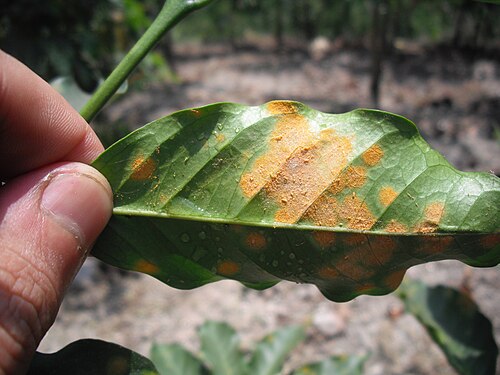
The orange spore masses on a leaf underside — what growers are looking for when they turn a leaf over. Photo by Smartse, CC BY-SA 3.0.

- Pale yellow blotches — plant scientists call them chlorotic spots, meaning the green has drained out — appear first on the upper side of the leaf.
- On the underside, orange to yellow-orange powdery masses erupt. The powder is spores.
- Infected leaves drop early. Fewer leaves means less photosynthesis, which means a smaller crop this year and a weakened tree next year.3
Mechanically, spores land on the underside of a leaf and push a thread of fungus in through the stomata — the pores a leaf breathes through. Inside, the fungus grows haustoria, feeding structures that tap into living plant cells. New spores (urediniospores) form on the surface and blow to the next tree; wind carries them long distances, wind and rain-splash move them short ones.4
How much damage it does
The peer-reviewed pathogen review puts it plainly: the disease “can cause yield losses of up to 35%”. A 2022 survey of the pathogen’s spread estimates it causes “annual losses exceeding USD two billion” worldwide.5
To verify
A US integrated-pest-management pest alert reports losses as high as 80% in severe outbreaks6, against the 35% figure in the peer-reviewed literature. The two are not necessarily contradictory — one may describe a single devastated farm and the other a regional average — but no source checked here reconciles them. Treat 35% as the citable number and 80% as an unverified worst case.
The history that changed what the world drinks
| Year | What happened | |
|---|---|---|
| 1 | 1861 | First recorded on wild coffee near Lake Victoria, East Africa |
| 2 | 1867 | Reported in the coffee districts of Ceylon (now Sri Lanka) |
| 3 | 1869 | Named Hemileia vastatrix by Berkeley and Broome |
| 4 | by 1890 | Ceylon’s coffee industry all but destroyed |
| 5 | 1970 | Reaches Brazil — the disease’s arrival in the Americas |
| 6 | by 1975 | Present in every Brazilian coffee region |
| 7 | 1983 | Reaches Costa Rica and Colombia |
| 8 | 1869–1985 | Spreads to every major coffee-growing region on earth except Hawaii |
| 9 | Feb / Oct 2020 | Spores trapped on Maui, then officially confirmed in Hawaii |
Ceylon is the cautionary tale. Planters nicknamed the fungus “Devastating Emily.” Land under coffee fell from 68,787 to 14,170 hectares — an 80% collapse — and output dropped 75%; the pathogen review independently confirms the disease “wiped out coffee cultivation from Ceylon (Sri Lanka), with devastating social and economic consequences.” The island replanted with tea.
Elsewhere, the first answer to rust was not a new Arabica variety but a different species entirely: Liberica, planted across the coffee belt from the 1870s because it seemed to shrug the fungus off. It did not, quite — technical sources describe it as susceptible “though much less than the other coffees”7 — and the experiment was largely abandoned by about 1900.
Hawaii’s 2020 detection closed the map. Spores were caught in traps at Hanaula, Maui, in February 2020, and the Hawaii Department of Agriculture confirmed the disease on Haiku, Maui, in October 2020. Until then it was the last major coffee region the fungus had never reached.
To verify
The claim that Ceylon’s collapse is why Britain became a tea-drinking country is repeated constantly and is hedged even by the source that carries it (“historians suggest”). It is a plausible story, not an established fact — don’t state it flatly.
The modern epidemic, and a conflict worth naming
Central America was hit hard in the 2010s. One source describes an outbreak between 2012 and 2014 causing “$1 billion in damage”, affecting “over 2 million people in Latin America”, with Central American output down 16%. The 2022 pathogen review refers to the same event simply as “the ‘big rust’ epidemic of 2012 in Central America.”
To verify
This wiki’s Bourbon note already flags a secondary-source claim that the Central American replanting was driven by a 2008–2013 rust epidemic. The two sources checked here date the crisis to 2012 or 2012–2014 instead. Nothing consulted confirms a 2008 start, and the peer-reviewed literature was not read directly on this point. Treat the epidemic window as early 2010s, centred on 2012, and the dollar and jobs figures as unconfirmed. One possible source of the stray 2008 date: World Coffee Research dates Colombia’s government programme replacing rust-susceptible Caturra with resistant Castillo to 2008 — an earlier and separate event from the Central American epidemic.8
Why the disease shaped the varieties on farms
You cannot spray your way out of rust cheaply and forever, so breeders went looking for coffee that resists it. Resistance runs through genes labelled SH1–SH9. Four of them (SH1, SH2, SH4, SH5) come from Arabica itself; four more (SH6, SH7, SH8, SH9) come from Robusta, a different, hardier coffee species.9
The bridge between the two species was a natural accident. The Timor Hybrid (Híbrido de Timor, HDT) — an Arabica × Robusta cross found on the island of Timor — carried Robusta’s resistance in a plant that behaved like Arabica. Breeders crossed HDT into commercial varieties, producing the Catimor family (HDT × Caturra) and the Sarchimor family, some of which have been in the field “for more than 30 years”.
That is the trade-off at the heart of variety choice today. Rust-resistant hybrids keep a farm alive; heirlooms like Bourbon and Typica cup better and get sick. Every farm above is somewhere on that line — and the very top of the Best of Panama price charts is occupied by Geisha, a variety that happens to sit on the lucky side of it.
To verify
That warm, humid conditions favour rust spread is stated by an agricultural extension portal10, and a link between rising temperatures and rust outbreaks is widely asserted in the trade press. The direction of that link now has peer-reviewed support: a 2022 systematic review of climate impacts on coffee reports expected increases in rust severity and in the range of the coffee berry borer11 — see Climate change and coffee. What remains unconfirmed is the specific temperature and leaf-wetness thresholds at which rust takes off; no source consulted gives them.
Related
- Bourbon · Typica — the susceptible heirlooms
- Timor Hybrid · Catimor · Sarchimor · Caturra — the resistance breeding line
- Geisha — carried to Panama for its rust resistance, famous for something else entirely
- Don Pachi Serracín · Hacienda La Esmeralda — where that decision was made
- World Coffee Research — keeper of the variety catalogue that lists each variety’s rust rating
- Laurina — another Bourbon-family variety whose agronomy is defined by fragility
- Liberica — the different species planted as a rust escape in the 1870s
- Robusta — the species that carries the SH6–SH9 resistance genes breeders borrowed
- CIFC — the Portuguese centre that identifies the rust’s physiological races and supplied the resistant germplasm
- Maria do Céu Silva — the CIFC pathologist who described how resistant coffee leaves kill their own cells to stop the fungus
- Climate change and coffee — the warming that rust severity is projected to track
Official links
- Official site — World Coffee Research
- Official site — World Coffee Research variety catalogue (rust ratings per variety)
Footnotes
-
Britannica — Coffee rust — page blocked automated access; cited via the research report only ↩
-
Molecular Plant Pathology — The coffee leaf rust pathogen Hemileia vastatrix ↩
-
American Phytopathological Society — Coffee rust lesson — page blocked automated access; cited via the research report only ↩
-
PMC — Coffee Leaf Rust (Hemileia vastatrix) from the Recent Hawaii Introduction ↩
-
Bioprotection Portal — Coffee rust: symptoms, causes and solutions ↩
-
Plants (Basel) — A Systematic Review on the Impacts of Climate Change on Coffee Agrosystems (2022) — confirmed via WebFetch; reports expected increases in coffee rust severity and coffee berry borer distribution ↩