Peru
Peru is one of the world’s biggest Arabica origins and one of its most under-recognised. It sits in the top twenty coffee producers worldwide and ranks fifth in global Arabica exports,1 almost all of it grown on the eastern slope of the Andes by farming families working a few hectares each. It is also a heavyweight in certified organic coffee, and it has run its own Cup of Excellence national competition and auction since 2017.2
The interesting thing about Peru is not the volume. It is the gap between the volume and the price.
| Position | Top-20 producer; 5th in world Arabica exports1 |
| Volume | 256,241 t from 399,523 ha (FAO, 2013)1 |
| Exports | 264,343 t (2012); only ~10% of the crop is drunk at home1 |
| Main regions | Cajamarca, Amazonas, San Martín, Junín (Chanchamayo), Cusco, Puno314 |
| Altitude | ~75% of the growing area at 1,000–1,800 m1 |
| Varieties | ~70% Typica, ~20% Caturra, rest other145 |
| Processing | Predominantly washed, through cooperative wet mills6 |
| Competition | Cup of Excellence Perú, every year since 20172 |
| Highest auction price seen here | $80.20/lb — Alto Mirador, 20237 |
What the auctions actually show
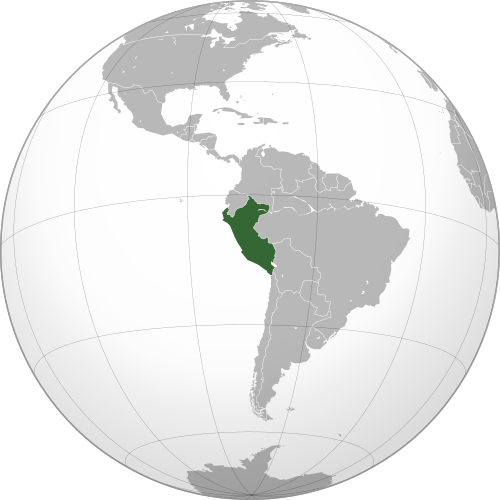
Photo by Addicted04, Connormah, CC BY-SA. Source.
.svg)
Peru’s Cup of Excellence is a blind national cupping competition ending in an online auction: judges score every entered lot, the top lots are published with the farmer’s name, and roasters worldwide bid on them. The Alliance for Coffee Excellence lists a Peruvian competition for every year from 2017 to 2026, which makes it one of the ten programmes ACE currently counts as active.2
Three consecutive auctions, straight from ACE’s own published tables:
| Year | Top lot | Producer | Region | Variety / process | Score | Price | Buyer | |
|---|---|---|---|---|---|---|---|---|
| 1 | 2025 | La Catarata | Angel Antonio Manosalva Palomino | Cajamarca | Washed Geisha | 90.64 | $80.10/lb | La Cabra Coffee8 |
| 2 | 2024 | El Mirador | Miguel Padilla Chinguel | Cajamarca | Washed Caturra/Bourbon/Geisha | 90.54 | $72.20/lb | Angelino’s Coffee9 |
| 3 | 2023 | Alto Mirador | Yoniser Mego Silva | Cajamarca | Washed Geisha | 90.74 | $80.20/lb | Kaldi Coffee Farm / Camel Coffee (Japan)7 |
Three things jump out of that table.
Cajamarca wins. All three winners come from the same northern department, on the Ecuadorian border. That is not a coincidence of one season — it is three years running, and it makes Cajamarca to Peru roughly what Santa Bárbara is to Honduras.
The whole auction is remarkably steady. The 2025 sale moved 18,571.48 lb for $495,379.91 across 30 lots, a weighted average of $26.66/lb, with the cheapest winning lot at $11.50/lb.8 The year before: 15,278.49 lb for $403,426.24 over 25 lots, average $26.38/lb, floor $17.20/lb.9 In 2023 it was ~18,140 lb for $431,106.26 over 30 lots at $21.39/lb.7 Three years, three near-identical averages. Compare that with Honduras, whose top price swung from $62 to $136.50 to $88.40 over the same span.
The ceiling is low, and the scores don’t explain it. Peru’s best lots score 90.5–90.75 — within a rounding error of the Ethiopian lot that set the all-time COE record of $445/lb at 90.50 points, and of the Honduran Geisha that cleared $136.50/lb at 91.21. Peru’s equivalent coffees fetch about $80. What separates them is not the cup; it is how many buyers had already decided they wanted that country’s name on the bag. This is the same pattern documented on Premiumisation and across the Cup of Excellence records by country ledger.
The same verdict shows up in the bulk market. The C-market note records Peru at par on ICE’s origin differentials — no premium, no discount, the same tier as Mexico, Nicaragua and Honduras, and 1,000 points below Colombia.
The 2026 competition has not happened yet: ACE has jury week booked for 3–6 November 2026 and the auction for 8 December 2026, judged in three categories — traditional washed and honey, traditional naturals, and an experimental category — with the top ten coffees per category scoring 87 or above going through.10
To verify — is $80.20 actually Peru's record?
The $80.20/lb figure above is the highest price found in the 2023, 2024 and 2025 ACE tables, which are the three editions read here. The Peruvian programme also ran in 2017–2022, and those results pages were not opened.2 Treat $80.20 as the highest price seen on this page, not as a confirmed national record, until the earlier auctions are checked.
Where it grows, and how much
Coffee in Peru follows the eastern slope of the Andes, in the transition country between the mountains and the Amazon basin — the same Yungas cloud-forest belt that continues south into Bolivia. The names that recur across every source are Cajamarca, Amazonas, San Martín, Junín — home of the Chanchamayo valley — plus Cusco and Puno in the south.314 About three-quarters of the planted area sits between 1,000 and 1,800 m, and roughly 2,000 plants per hectare is typical in the shaded zones.1
Almost none of it is drunk locally. Peru exported 264,343 tonnes in 2012 against domestic consumption of about 10% of the crop.1 An origin that exports nearly everything it grows has very little internal market to cushion a price crash — the opposite of Brazil.
To verify — how much land is under coffee
The area figure is genuinely unsettled, and the three numbers in circulation are far apart:
- 399,523 ha, with 256,241 t produced, from FAO statistics for 2013 as summarised on Wikipedia.1
- 350,000 ha across 210 rural districts in 10 departments, per Peru’s government-facing Superalimentos del Perú portal.11
- 233,000 ha across up to 15 regions, per an SCA news history published in May 2024.3
These probably reflect different years and different definitions of “under coffee” rather than one being wrong, but no reconciliation was possible here — and the SCA article’s URL returned 404 when checked, so its figure rests on the research report that quoted it rather than on the page itself. Quote a range, not a number.
To verify — the smallholder numbers
Widely repeated and not confirmed here: that Peru has roughly 220,000 coffee-farming families, mostly on 1–3 hectare plots, and that it is South America’s third-largest producer at 210,000–230,000 tonnes a year. All of that traces to a single unofficial origin-profile compilation.6 The smallholder character of Peruvian coffee is agreed on by every source; the specific counts are not verified.
Varieties and processing
Peru is an Arabica country (see Arabica vs Robusta), and its planted stock is unusually old-fashioned. Independent sources converge on roughly 70% Typica, 20% Caturra, and about 10% everything else — mostly Catimor and Pachè.145 Bourbon is also present; World Coffee Research names Peru as one of only four countries where original Bourbon is still cultivated at scale, as recorded on the Bourbon page, and it names Peru alongside Jamaica and the Dominican Republic as a surviving stronghold of pure Typica.
That matters because Typica is the ancestral variety of nearly all Latin American coffee and was abandoned almost everywhere else for its low yields. A country where seven plants in ten are still Typica is, in variety terms, a living museum — and a fragile one, since Typica has no resistance to disease.
Processing is almost entirely washed: the fruit is stripped off, the beans fermented to loosen the sticky layer, then rinsed and dried. Much of that work happens at cooperative wet mills rather than on individual farms,6 which is the practical consequence of a country farmed in one- and two-hectare pieces. See Producer cooperatives.
To verify — the rust epidemic and the Catimor switch
One origin compilation states that the 2012–2013 coffee leaf rust (roya) epidemic hit about 70% of Peru’s productive area, that recovery ran to 2017–2018, and that this is why Catimor was planted widely afterwards.6 The regional rust crisis of those years is well documented across Latin America, but these specific Peruvian percentages and dates come from that one unofficial source and were not confirmed against a Peruvian government or SCA document.
Organic, Fairtrade, and cooperatives
Peru’s real distinction in the trade is certification. Its coffee is grown by cooperatives of smallholders at altitude with little chemical input, which is close to the ideal starting point for organic certification, and the country has leaned into it hard. The scale of it is visible at cooperative level: about 92% of the coffee marketed through the CENFROCAFE cooperative is organic, and 100% of it is Fair Trade certified.1
Whether that pattern holds nationally is a different question — see the flag below.
To verify — "the world's largest exporter of organic Arabica"
The claim that Peru is the largest exporter of organic Arabica coffee globally comes from Sucafina, a green-coffee trading company, on its own origin page4 — a knowledgeable source, but a commercial one with an interest in its origins sounding important. A second compilation repeats the same idea in weaker form (“one of the leading exporters of certified organic coffee”).6 No independent trade statistics were checked here, and no national percentage of certified organic production was found in any source. Peru is unambiguously a major organic origin; the superlative is not verified. Sucafina also gives average production as 3,041,300 sixty-kilogram bags — a figure not cross-checked against FAO or ICO data.
How coffee got there
The early history is thinner than the production data, and the sources disagree with each other in a way worth stating plainly rather than smoothing over.
The account that can be checked is the export one: Peru’s first coffee exports, to Germany and England, began in 1887, and by 1893 production had reached about 1,500 tonnes.1 The regions named in that early record are the ones still growing coffee today — Chanchamayo, Sandia, Carabaya and Huánuco.1
To verify — when coffee actually arrived
Two accounts contradict each other on Peru’s starting date, and this note takes neither as settled.
- Wikipedia’s summary says coffee cultivation in Peru began in the 1800s.1
- The SCA’s May 2024 history places the first reference to coffee cultivation in the mid-18th century, in the district of Chinchao in Huánuco, spreading to Chanchamayo in Junín in the nineteenth century.3 That page returned 404 when fetched here, so the claim is reported at second hand from the research behind this note.
A century separates those two answers. Also unverified, from a secondary historical monograph: that coffee developed commercially in Chanchamayo from 1876, and that the price rises of 1887 turned Peru into an exporter shipping mainly to Chile, England and Germany. The Chile destination in particular appears in no other source read here.
Related
- Cup of Excellence · Cup of Excellence records by country · Alliance for Coffee Excellence — the competition Peru has run since 2017, and where its ~$80/lb ceiling ranks
- Angelino’s Coffee — bought the 2024 Peruvian winner, and the all-time COE record lot in Ethiopia
- Typica · Caturra · Bourbon · Geisha · Catimor — what is planted here, and what wins the auctions
- Washed process · Natural process · Honey process — the processing mix, and the 2026 competition’s three categories
- Producer cooperatives — how a country of one-hectare farms gets its coffee milled and sold
- Coffee leaf rust — the disease that reshaped Latin American variety choices in 2012–13
- C-market — where Peru’s zero origin differential is recorded
- Premiumisation — why a 90.7-point Peruvian coffee sells for a fifth of a 90.5-point Ethiopian one
- Colombia · Brazil · Honduras — the neighbours it is measured against, and the origin with the same reputation problem
- Coffee Belt · Arabica vs Robusta · Coffee scoring · Green coffee auctions
- Climate change and coffee — the pressure on an origin defined by its altitude band
Official links
- Official results — Alliance for Coffee Excellence, Cup of Excellence Perú — the index listing every Peruvian edition from 2017 to 2026
- Official results — Alliance for Coffee Excellence, Perú 2025
- Official site — Junta Nacional del Café (Peru’s national coffee growers’ body) — unconfirmed: the site timed out on an automated check here, so nothing on this page rests on its text
Footnotes
-
Coffee production in Peru — Wikipedia — confirmed via WebFetch ↩ ↩2 ↩3 ↩4 ↩5 ↩6 ↩7 ↩8 ↩9 ↩10 ↩11 ↩12 ↩13 ↩14 ↩15 ↩16
-
Alliance for Coffee Excellence — competition & auction results archive — confirmed via WebFetch ↩ ↩2 ↩3 ↩4
-
Specialty Coffee Association — A Brief History of Peru’s Specialty Coffee Production and Consumption (May 2024) — returned HTTP 404 when fetched here ↩ ↩2 ↩3 ↩4
-
Genuine Origin — Peruvian coffee demystified: a complete origin report ↩ ↩2
-
Alliance for Coffee Excellence — Perú 2023 results and auction — confirmed via WebFetch ↩ ↩2 ↩3
-
Alliance for Coffee Excellence — Perú 2025 results and auction — confirmed via WebFetch ↩ ↩2
-
Alliance for Coffee Excellence — Perú 2024 results and auction — confirmed via WebFetch ↩ ↩2
-
Alliance for Coffee Excellence — Perú 2026 competition and auction — confirmed via WebFetch ↩