Bolivia
Bolivia is one of the smallest origins the specialty trade takes seriously. It exports somewhere around 30,000 sixty-kilo bags a year, which makes it roughly the 38th largest coffee producer in the world — less than a rounding error against Brazil or Colombia.1 Almost all of it comes from one place: the Yungas, the steep, wet eastern shoulder of the Andes above La Paz, which grows about 95% of the country’s coffee.12
Two facts define the country. The first is that it is landlocked — Bolivian coffee usually leaves South America through the Chilean port of Arica, not a Bolivian one.34 The second is that the crop is shrinking. Production has fallen sharply over the last decade under aging trees, leaf rust and low yields, and export volumes twenty-odd years ago were “considerably higher” than today’s.1
And yet Bolivia’s short run at the Cup of Excellence produced two lots scoring above 93 points — numbers that almost nothing in the modern competition touches.
| Position | ~38th largest producer worldwide1 |
| Exports | ~30,000 × 60 kg bags/year, recent harvests1 |
| Main region | Yungas of La Paz — ~95% of the crop; Caranavi the biggest province12 |
| Other regions | Cochabamba, Santa Cruz (incl. Samaipata), Teoponte, Inquisivi354 |
| Farm structure | 85–95% smallholder, plots of 1–8 ha1 |
| Altitude | Specialty typically 1,200–2,000 m; commodity coffee below 1,000 m in Santa Cruz5 |
| Varieties | Typica, Catuai (often Red Catuai), Caturra, Catimor, “Criollo”354 |
| Processing | Mostly washed, dried on raised beds; some natural for specialty lots54 |
| Port | Arica, Chile (Bolivia is landlocked)34 |
| Competition | Cup of Excellence Bolivia — 2004, 2005, 2007, 2008, 2009 only6 |
| Highest COE price | $35.05/lb — Agrotakesi, 20097 |
| Highest COE score | 93.52 — Calama Marka, 20058 |
The Cup of Excellence years, 2004–2009
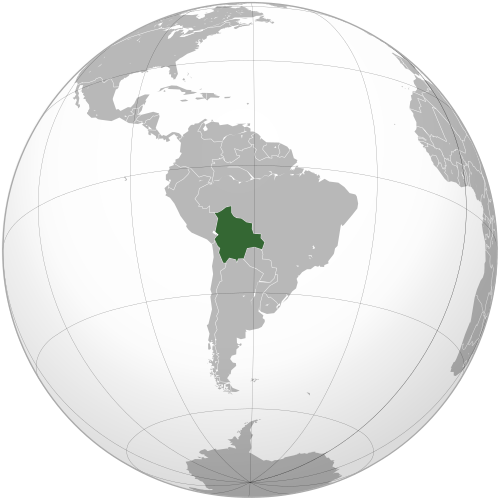
Photo by Connormah, CC BY-SA. Source.
.svg)
Bolivia ran a national Cup of Excellence — a blind cupping competition ending in a public online auction — in five editions only: 2004, 2005, 2007, 2008 and 2009. The Alliance for Coffee Excellence archive shows nothing before or after.6 There was no 2006 competition, and the programme has not returned in the sixteen years since. That makes Bolivia one of the dormant countries on the Cup of Excellence records by country ledger.
The five winners, straight from ACE’s own published tables:
| Year | Top lot | Producer | Region | Score | Price | Buyer | |
|---|---|---|---|---|---|---|---|
| 1 | 2009 | Agrotakesi SA | Mauricio Ramiro Diez de Medina | Yanacahi, Yungas of La Paz | 93.36 | $35.05/lb | Maruyama Coffee for Mikatajuku Group, Itoya Coffee, Orsir Coffee7 |
| 2 | 2008 | Café de Cordillera | Zenovia R. Charca de Huayhua | San Lorenzo, Caranavi | 92.03 | $12.15/lb | Maruyama Coffee for Mikatajuku, Honey Coffee, Adati Coffee, Orsir Coffee9 |
| 3 | 2007 | Flor de Café San Ignacio | Mario Mamani Mamani, Raymundo Yanarico | Carrasco La Reserva, Caranavi | 91.50 | $21.10/lb | Invalsa Coffee, Orsir Coffee, Cafe Valverde10 |
| 4 | 2005 | Agricabv BV Calama Marka | Juan de Dios Blanco | Calama | 93.52 | $12.55/lb | Small Axe Coffee Alliance (a consortium of 15 roasters)8 |
| 5 | 2004 | CENAPROC | (cooperative lot) | Caranavi, La Paz | 90.44 | $11.25/lb | Solberg & Hansen (Norway)11 |
Three things are worth pulling out of that table.
The scores are extraordinary and the prices are not. A 93.52 in 2005 and a 93.36 in 2009 are higher than the winning score of any Ethiopian, Honduran, Guatemalan or Peruvian edition recorded on this wiki — and the 2005 lot sold for $12.55 a pound. The Ethiopian lot that set the all-time COE record of $445/lb scored 90.50. Whatever Bolivia’s problem was, it was not the cup. This is Premiumisation in its purest form: the price follows the country’s name on the bag, not the number on the score sheet.
The buyers were Japanese, and then Nordic. Maruyama Coffee and its Mikatajuku partners took the top lot in both 2008 and 2009; Orsir Coffee appears in three of the five years; Solberg & Hansen took the very first winner. Bolivia’s short auction history was carried by a handful of the same buyers who chase green coffee auctions everywhere else — Stumptown Coffee Roasters, Mercanta, 49th Parallel, Café Imports, Terroir and Sweet Maria’s all appear in the top five of one edition or another.781011
Caranavi wins nearly everything. Four of the five winners, and the overwhelming majority of the ranked lots, come from Caranavi province in the Yungas. The exception is the 2009 champion, Agrotakesi, from Yanacahi — an estate rather than a smallholding, in a country where estates are rare.
To verify — is $35.05/lb Bolivia's record?
All five Bolivian editions were opened here, but only the top three to five lots of each were read. A lower-ranked lot in an unread part of a table could in principle have sold higher, though that is unusual. Treat $35.05/lb (2009) as the highest price seen across the five winners, not a confirmed national ceiling. The auction totals shown on the 2004 and 2009 pages were also unreadable in a way that made them internally inconsistent (pound counts that do not multiply out to the stated totals), so no total-auction volume or weighted-average figure is quoted here.
To verify — are 2005 scores comparable to 2025 scores?
This note puts a 93.52 from 2005 next to a 90.50 from 2024 and treats them as the same measurement. That comparison is not verified. Cupping protocols, jury training and score calibration have all changed across twenty years of Coffee scoring, and it is entirely possible that mid-2000s COE scores ran higher than today’s for reasons that have nothing to do with the coffee. Nothing consulted here confirms or rules that out. The prices are directly comparable; the scores should be quoted with the year attached.
The Rodríguez collection, and a claim that does not check out
ACE’s Bolivia page also lists “Los Rodriguez Collection Nº1 2022” under Private Collection Auctions — a separate ACE format in which one producer’s lots are sold without a competition or a jury ranking.6 It is not a Cup of Excellence result, and it should not be described as one.
This matters because a widely repeated seller claim says the Rodríguez family’s Batian lots from Finca Floripondio in Samaipata “have appeared in Cup of Excellence auctions.” They cannot have: the farm was established in 2014, five years after Bolivia’s last COE.6 The full unpicking of that claim lives on the Batian note.
Where it grows
Coffee in Bolivia is concentrated to an unusual degree. The Yungas — the humid transition belt where the Andes fall away toward the Amazon basin, on the eastern side of the La Paz department — accounts for around 95% of the national crop.12 Within it, Caranavi province became the country’s biggest coffee region after land grants settled farming families there in the 1960s.1
Beyond the Yungas the map thins out fast: Cochabamba, Teoponte, Inquisivi, and lower-altitude Santa Cruz — including Samaipata and Mairana, where commodity-grade coffee grows below 1,000 m and where the Rodríguez family’s experimental farms sit.354
Specialty coffee sits between roughly 1,200 and 2,000 metres, and because the growing zones are high and cold, cherries are dried mostly on raised beds rather than patios — a slower, more controllable dry that suits an environment where the sun cannot be relied on.54
To verify — the smallholder counts and farm sizes
Two different pictures of the same sector circulate, and they do not quite line up:
- 85–95% of coffee grown by smallholders on plots of 1–8 ha, per Perfect Daily Grind.1
- A “mosaic” of farms of about 3–20 ha, per Coffee Hunter.5
- Around 12,000 coffee-farming families nationally — a figure repeated by two importer origin pages (Café Imports and La Bodega) that read as versions of the same source rather than independent counts.34
Everyone agrees Bolivian coffee is smallholder coffee. No official national statistic — from the Bolivian government, the ICO or FAO — was found for family counts, farm sizes or export volume. Quote ranges, not numbers.
How coffee got there, and why it is shrinking
Coffee arrived in Bolivia in the late 18th and early 19th centuries and stayed marginal for a long time; large-scale cultivation only began in the 1920s.1 The institutional landmarks come later: an agricultural reform decree in 1953, the producer association ANPROCA in 1976, the exporters’ federation FECAFEB in 1991, and the country’s own national competition, Taza Presidencial, first held in 2014 — five years after Cup of Excellence left.1
The arrival of Cup of Excellence in 2004 coincided with international development money aimed at giving farmers an alternative to growing coca, and it did what COE usually does: it introduced a set of unknown producers to buyers in Japan, Norway and the United States.56 The relationship did not last.
What has happened since is a straightforward decline. Perfect Daily Grind’s reporting attributes it to aging farms that were never renewed, leaf rust and other disease pressure, and low productivity, compounded by the fact that organic farming — widespread in the Yungas — leaves growers fewer tools against pests. In the regions where both crops grow, coca is simply more profitable.1 See Climate change and coffee for the wider version of the altitude squeeze this sits inside.
To verify — the 1991 land reform story
One origin profile states that a 1991 government land reform forced large landowners to return land to families and communities, fragmenting the estates into today’s smallholdings.5 Perfect Daily Grind’s timeline instead puts the agricultural reform decree at 1953, and records 1991 as the year FECAFEB was founded.1
These are two different events being told as one, and this note does not resolve which account is right. Bolivia’s landmark agrarian reform is usually dated to the 1950s; the 1991 date may be a confusion with the federation’s founding, or may refer to a later, separate measure. Do not state a land-reform year for Bolivia without a Bolivian government or academic source.
Varieties, processing and the calendar
Bolivia is planted old-fashioned. Typica and Catuai — usually Red Catuai — are the varieties named most often, with Caturra, Catimor and locally-named “Criollo” (generally a Typica selection) also present.354 There is no signature Bolivian cultivar and no Geisha story here; what makes the good lots good is altitude and careful picking, not an exotic seed.
Processing is predominantly washed: the fruit is stripped, the beans fermented in open tanks to loosen the sticky layer, then rinsed and dried.54 Naturals — cherries dried whole in the fruit — appear increasingly on specialty lots, and the Santa Cruz experimental farms have pushed further into carbonic maceration and lactic fermentation. Much of the milling happens through cooperatives rather than on individual farms, which is the usual consequence of a country farmed in one- and two-hectare pieces; see Producer cooperatives.
To verify — harvest and arrival dates
Importer origin pages give two different harvest windows — roughly June–October in one and July–November in another — with arrival to buyers typically from January to April.354 The difference plausibly reflects regional and altitude variation rather than an error, but no source read here is authoritative on the national calendar. Treat these as approximate ranges.
Where else Bolivia shows up on this wiki
- The 2023 Coffee Masters champion, Jānis Podiņš, competed with a Bolivian coffee roasted by Coffee Collective — the only edition of that competition for which any competitor’s coffee is documented at all.
- Project Origin lists Bolivia among the South American origins it sources from.
- Batian, the Kenyan disease-resistant composite, is grown in Santa Cruz by the Rodríguez family — one of very few documented plantings of that variety outside Kenya.
Related
- Cup of Excellence · Cup of Excellence records by country · Alliance for Coffee Excellence — the five-edition programme and where Bolivia’s $35.05/lb sits in the ledger
- Yungas · Caranavi · Agrotakesi — the region, the province and the estate that won 2009
- Taza Presidencial · FECAFEB — the national competition and the exporters’ federation that replaced COE’s role
- Typica · Catuai · Caturra · Catimor · Batian — what is planted here
- Washed process · Natural process · Carbonic maceration — the processing mix
- Maruyama Coffee · Orsir Coffee · Stumptown Coffee Roasters · Mercanta · Cafe Imports — the buyers who showed up at the Bolivian auctions
- Peru · Colombia · Brazil · Ecuador — the Andean and South American neighbours
- Premiumisation — why a 93.5-point coffee sold for $12.55
- Coffee leaf rust · Climate change and coffee — what is eating the crop
- Producer cooperatives · Green coffee auctions · Coffee scoring · C-market · Coffee Belt
Official links
- Official results — Alliance for Coffee Excellence, Cup of Excellence Bolivia — the country archive listing all five editions and the Rodríguez private collection
- (no official Bolivian national coffee body website confirmed — the obvious candidate domain for FECAFEB did not resolve when checked here)
Footnotes
-
Perfect Daily Grind — Exploring the Bolivian coffee sector (February 2022) — confirmed via WebFetch ↩ ↩2 ↩3 ↩4 ↩5 ↩6 ↩7 ↩8 ↩9 ↩10 ↩11 ↩12 ↩13 ↩14
-
La Bodega — coffee growing countries ↩ ↩2 ↩3 ↩4 ↩5 ↩6 ↩7 ↩8 ↩9 ↩10 ↩11
-
Coffee Hunter — Bolivia ↩ ↩2 ↩3 ↩4 ↩5 ↩6 ↩7 ↩8 ↩9 ↩10 ↩11 ↩12
-
Alliance for Coffee Excellence — Bolivia results archive — confirmed via WebFetch ↩ ↩2 ↩3 ↩4 ↩5
-
Alliance for Coffee Excellence — Bolivia 2009 results and auction — confirmed via WebFetch ↩ ↩2 ↩3
-
Alliance for Coffee Excellence — Bolivia 2005 results and auction — confirmed via WebFetch ↩ ↩2 ↩3
-
Alliance for Coffee Excellence — Bolivia 2008 results and auction — confirmed via WebFetch ↩
-
Alliance for Coffee Excellence — Bolivia 2007 results and auction — confirmed via WebFetch ↩ ↩2
-
Alliance for Coffee Excellence — Bolivia 2004 results and auction — confirmed via WebFetch ↩ ↩2