African drying beds
An African drying bed is a table. A wooden or metal frame, roughly waist high, with a taut mesh top, standing in the open sun. Wet coffee — either whole cherry or the bare parchment-covered seed — is spread across the mesh and left there for days or weeks until it is dry enough to store.
They are also called raised beds, raised drying beds, African beds or simply elevated beds. All four names describe the same object, and none of them requires the coffee to be African.
Why lifting it off the ground matters
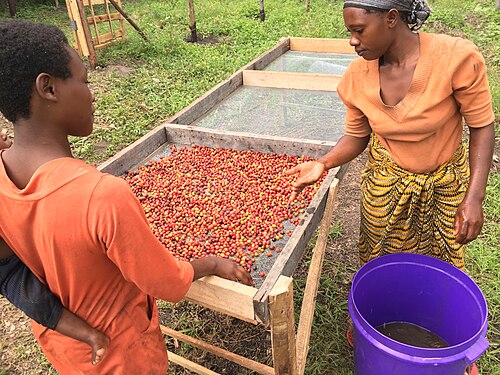
Photo by PHILIP ASEDRI DRADRIO, CC BY-SA. Source.

A patio dries coffee from one side. The sun hits the top of the layer, the concrete underneath holds heat and moisture, and the beans touching the ground dry differently from the beans on top. A bed dries it from both sides: air moves above and below the coffee at the same time, which is the entire point of the design.12
Three things follow from that:
- More even drying. Nothing sits in its own trapped moisture, so a batch finishes closer to uniform rather than as a mix of over-dried and still-damp seeds.12
- Less mould and less accidental fermentation. Wet fruit lying flat on a warm surface is where things go wrong. Airflow underneath is the cheapest defence there is.1
- It stays clean. The coffee never touches soil, grit or whatever the yard is used for the rest of the year — one guide’s plain summary is “clean cherries that dry evenly, creating a more consistent coffee”.1
The trade-off is capacity, not quality. Beds cover far less coffee per hectare of yard than a concrete patio and have to be built and repaired by hand, which is why patios remain the most widely used drying surface in the world by volume while beds are the default in quality-focused lots.2
What one is actually made of
The design is deliberately unsophisticated — that is its virtue. One published build guide gives these specifications:1
| Part | Specification |
|---|---|
| Posts | 2×4 lumber, set in holes at least 46 cm (1’6”) deep, levelled with a string line |
| Height | Set slightly above waist level |
| Spacing | Posts every 1.22 m (4 ft) |
| Bed size in that build | 12.20 m long × 1.22 m wide |
| Frame | 2×2 lumber, with 1×4 side rails to stop coffee rolling off |
| Surface | Chicken wire for strength, topped with black or dark plastic mesh for the coffee to sit on |
| Fixings | Nails or screws, fence staples, metal wire |
| Treatment | Wood sealer (and diesel, in that build, against insects) |
The waist-height figure is not a quirk of one guide. ISIC, the coffee industry’s scientific information body, describes the same object independently as “matting raised to waist height on trestles” — the height is chosen so a worker can rake the coffee without bending double.3
That materials list is the whole reason the technique spread. A wet mill needs a pulper, tanks and running water. A drying bed needs lumber, wire and an afternoon.
Working a bed
Building it is the easy half. What a bed actually demands is attention:
- Spread thin. Roughly 3–5 cm for washed parchment; naturals go deeper in the early stages when the fruit is still heavy with water.2
- Turn it constantly. Coffee is raked “often multiple times per day in the early wet phases”, so it dries evenly and does not clump or ferment in pockets.2
- Cover it. At night, and whenever rain threatens, the beds get covered so partly dried coffee does not re-wet — the fastest way to ruin a lot that has already had two weeks of work put into it.2
- Stop at the right moisture. ISIC gives a maximum of 12.5% moisture before coffee is safe to store, washed and natural alike; the working export target quoted for bed drying is 10–12%.32
Dry it too fast and the outside case-hardens while the middle stays wet. Dry it too slowly and it moulds. The bed does not solve either problem — it just widens the margin for error, which is exactly what a producer without a mechanical dryer needs.
To verify
How long drying on a bed actually takes. The sources conflict, and the gap is large. Coffeester says naturals spread on raised beds “may take two to six weeks” in ideal conditions.2 Coffee Hat gives 10–12 days for naturals on African beds depending on weather.4 ISIC, which does not distinguish surfaces, gives 8–10 days for sun-drying washed parchment and “up to 4 weeks” for whole cherries.3 The honest reading is that washed parchment finishes in roughly one to two weeks and naturals take substantially longer, but no source consulted publishes a bed-specific figure that the others confirm. Individual lots documented elsewhere in this wiki span the same wide range — Esayas Beriso’s naturals dry in 7–10 days, a JARC 74158 washed lot took 25 days under shade.
Where they are used
Raised beds are the standard drying surface across East Africa. Coffeester names them “the dominant drying method in East African origins such as Ethiopia, Kenya, and Rwanda”, and TechnoServe’s wet-mill processing guide is cited as saying most coffee in East Africa is dried on raised beds.25
But the name has outrun the geography. Across this wiki, beds turn up wherever someone is chasing cup quality, on every continent that grows coffee:
| Where | How they show up |
|---|---|
| Ethiopia — Bensa | Washed lots pulped, fermented 36–48 hours, then dried on raised “African beds” |
| Rwanda | Central washing stations built around shared bed fields |
| Panama — Finca Deborah | A three-tier African bed system for naturals |
| Panama — Finca Sophia | Washed parchment dried on beds at 1,900 m |
| Bolivia — Caranavi, Yungas | Beds rather than patios, because the sun cannot be relied on |
| Papua New Guinea | Sun drying on raised beds or tarps |
| Mount Elgon, Uganda | Beds under a clear plastic roof, to dry through a rainy harvest |
| Nicaragua — Finca El Cambalache | African beds behind a Cup of Excellence placing |
So “African bed” today names a design, not an origin. A Panamanian Geisha and a Sidama natural dry on the same piece of furniture.
To verify
Where the design came from. Several explainer sources describe raised-bed drying as originating in Ethiopia, and the name obviously points that way. No primary record — no agricultural extension document, dated programme, or research institute publication — was found to confirm who built the first beds, where, or when.67 Treat the Ethiopian attribution as a widely repeated trade belief rather than an established fact. The same sources are also the origin of the claim that the beds are now standard at specialty washing stations outside Africa, including Central America; that part is at least consistent with the farm records above.
Why it matters
Of all the equipment specialty coffee has invented, the drying bed is the least impressive-looking and among the most consequential. It costs almost nothing, needs no power and no water, and it moves the single most failure-prone stage of post-harvest — getting a wet seed dry without spoiling it — from luck towards control.
That is also why the phrase shows up on so many bags and competition entries. When ACE records for a winning lot list “drying on African beds” alongside selective picking and controlled fermentation, they are describing a producer who decided the batch was worth the extra labour. The bed is not what made the coffee good. It is evidence that somebody was watching it.
Related
- What gets dried on them: Natural process · Washed process · Honey process · Pulped natural · Anaerobic fermentation
- Where they stand: Washing station · Coffee fermentation · Dry milling
- What drying is measured by: Water activity · Green coffee grading · Quaker
- Origins built on them: Ethiopia · Bensa · Rwanda · Bolivia · Caranavi · Mount Elgon · Papua New Guinea
- Farms and people using them: Finca Deborah · Finca Sophia · Mama Cata · Finca El Cambalache · Graciano Cruz · Esayas Beriso
Official links
- Official site — TechnoServe, Coffee Wet Mill Processing Guide (PDF)
- Official site — ISIC, the institute for scientific information on coffee (initial processing)
Footnotes
-
Perfect Daily Grind — Coffee Processing: How to Build African Raised Beds — all construction specifications confirmed via WebFetch ↩ ↩2 ↩3 ↩4 ↩5
-
Coffeester — Drying Coffee — East African dominance, layer thickness, turning, covering, 10–12% target and the two-to-six-week figure confirmed via WebFetch ↩ ↩2 ↩3 ↩4 ↩5 ↩6 ↩7 ↩8 ↩9
-
ISIC (institute for scientific information on coffee) — Initial coffee bean processing — industry scientific body; “matting raised to waist height on trestles”, the 12.5% moisture ceiling and the 8–10 day / up-to-4-week drying figures confirmed via WebFetch ↩ ↩2 ↩3
-
Coffee Hat — Coffee Processing — source of the 10–12 day figure; cited in the research report, not independently fetched ↩
-
TechnoServe — Coffee Wet Mill Processing Guide (PDF) — the document exists and was retrieved, but its text was not machine-readable, so the East Africa statement is quoted at second hand from the research report ↩
-
Green Coffee Collective — Raised Drying Beds in Coffee: How They Work — cited in the research report; returned HTTP 429 to automated access, not independently confirmed ↩
-
A Coffee Solution — Ethiopian Coffee Drying Beds — cited in the research report, not independently fetched ↩