Mount Elgon
Mount Elgon is a mountain that produces coffee under two different names. Geographically it is an extinct shield volcano straddling the Uganda–Kenya border, topped by a peak called Wagagai at 4,321 m (14,177 ft), which sits entirely inside Uganda, and wrapped around one of the largest intact calderas in the world.1 Commercially, though, the coffee off its Ugandan flank is usually sold as “Bugisu” — the name of the region and its people — and Uganda’s own coffee authority still quotes daily prices in grades called Bugisu AA, A, PB and B.2
That split matters when you go looking for the coffee. Search for “Mount Elgon” and you find roaster pages and development projects; search the trade paperwork and you find Bugisu.
| What it is | Extinct shield volcano, Uganda–Kenya border1 |
| Highest point | Wagagai, 4,321 m — in Uganda1 |
| Coffee side | Almost all specialty attention is on the Ugandan slopes |
| Ugandan districts | Mbale, Bulambuli, Bududa, Kween, Sironko and neighbours |
| Species | Arabica — see Arabica vs Robusta |
| Reported growing altitudes | roughly 1,260–2,200 m, depending on the source (see below) |
| Common varieties | SL14, SL28, SL34, Nyasaland, local “Bugisu” material34 |
| Processing | **[[Washed process |
| How it is sold | Overwhelmingly through **[[Producer cooperatives |
| Uganda’s Arabica regions | Mount Elgon, the Rwenzori Mountains and West Nile2 |
Uganda as a whole is a Robusta country — the government reported 8.6 million 60 kg bags exported in the twelve months to May 2026, a 16% rise year on year, most of it Robusta.2 Mount Elgon is where the Arabica half of the story lives.
Where it is, and how high
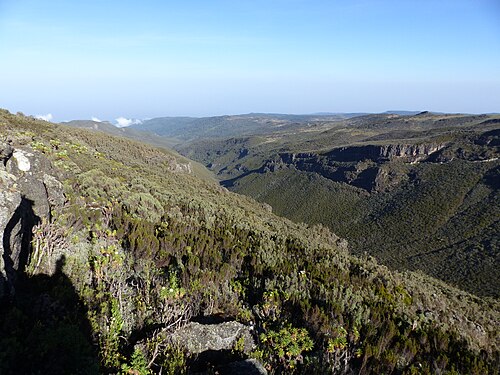
Photo by Gilles Bassière, CC BY. Source.

The Ugandan coffee sits on the western and south-western slopes, in Bugisu — eastern Uganda, home of the Bamasaba (Gishu) people — spreading across Mbale, Bulambuli, Bududa and Sironko districts, and north into Kween in the Sebei area.356
Altitude is the one number everybody quotes and nobody agrees on:
| Source | Altitude given | What it describes | |
|---|---|---|---|
| 1 | Slow Food Presidia3 | 1,260–1,550 m | Miale village, Mbale district — Nyasaland variety |
| 2 | Belco6 | 1,900–2,000 m | Sipi Farmers Group lot, Kween district |
| 3 | Carico Cafe Connoisseur7 | 1,300–2,200 m | The company’s own Bugisu sourcing range |
| 4 | Rehm Coffee8 | 1,750–2,100 m | Named farms in its Mount Elgon project |
| 5 | CoffeeAM9 | ~1,524 m (5,000 ft) | General description of Mount Elgon coffee |
Only the first two were read directly. The honest span is roughly 1,300–2,200 m, which is what you would expect on a mountain 4,300 m tall: farms sit at wildly different heights depending on which district and which village you are in.
To verify
Do not quote a single “Mount Elgon altitude.” The research behind this note inferred a core band of 1,700–2,100 m from roaster listings. That inference is contradicted by the one verified elevation figure available — Slow Food’s 1,260–1,550 m for the Presidium villages in Mbale district,3 which is several hundred metres lower. Both can be true on the same mountain, but no survey, government or exporter document giving an authoritative range for Mount Elgon coffee was located. Treat any single figure on a bag as a claim about that farm, not about the region.
The varieties
Mount Elgon grows the Kenyan research-station selections that crossed the border, plus one genuine oddity.
- SL14 — the drought- and cold-tolerant Scott Labs selection that is now more important in Uganda than in Kenya. MEACCE, the largest cooperative here, lists it as one of just two Arabica varieties it grows.4
- SL28 and SL34 — the famous pair, also present, generally in smaller quantity.10
- Nyasaland — the interesting one. It is an Arabica that reportedly originated in the Geisha area of western Ethiopia, travelled to Malawi (then the British protectorate of Nyasaland, hence the name), and was brought to Uganda by British colonialists in the early 20th century.3 Plants cultivated since the 1940s still stand on Elgon, despite many trees being destroyed during Idi Amin’s rule (1971–1979).3 Slow Food describes its cup as more intense and floral than the hybrids around it, sometimes with almond notes.3
To verify
“Bugisu” is a place, not a cultivar. At least one roaster lists “Bugisu” alongside SL28, SL34, SL14 and Nyasaland as though it were a variety name.10 No variety register — World Coffee Research or otherwise — records a cultivar called Bugisu. The likeliest reading is that it is a regional landrace descriptor covering mixed old material, the same way “Ethiopian heirloom” is used. That reading is an inference, not something any source consulted states outright.
Who actually grows it
There are almost no named estates here. Mount Elgon coffee reaches the market through secondary cooperatives, washing-station schemes and a handful of small family companies — which is why the wiki cannot give you farm-level records for it the way it can for Panama.
MEACCE
Mt Elgon Agroforestry Communities Cooperative Enterprise Ltd (MEACCE) is the biggest name on the mountain. It is a farmer-owned secondary cooperative — a cooperative whose members are themselves cooperatives — founded in 2017, and by its own account it represents 14 primary cooperatives and 3,832 farmer members, 796 of them women.4
Its production, again from its own site:4
| Arabica | Robusta | |
|---|---|---|
| Region | Mt Elgon | Source of the Nile |
| Area | 1,970 ha | 450 ha |
| Certification | Fairtrade and Organic | Conventional |
| Processing | Washed | Natural |
| Varieties | Nyasaland, SL14 | Elite, Clonal, Kitunza |
| Harvest | September–March |
The “agroforestry” in the name is the point: the coffee is grown under shade inside a mixed farming system rather than in open rows.
To verify
MEACCE’s own numbers do not fully agree with each other, or with third parties. The site headlines 14 primary cooperatives while its fact file says 12.4 The research behind this note also found an Algrano profile giving MEACCE around 3,000 members against the site’s 3,832,11 and describing MEACCE’s Arabica as “washed and natural,” where the cooperative’s own page lists Arabica as washed and Robusta as natural.4 The Algrano page returned HTTP 404 when checked and could not be read. Membership figures for a cooperative change every season, so none of this is necessarily a contradiction — but the exact current count is not settled, and the “3,000 members” figure should not be repeated as fact.
Mount Elgon Coffee and Honey Cooperative Society Ltd
A smaller, separate cooperative — founded 2017, based in Mbale district on the Mbale–Tororo road — that pairs coffee farming with beekeeping, selling both green and roasted coffee and honey. It reports 952 members in 11 groups, including 391 women and 157 young people, and works with the Bamasaba/Gishu communities.5
Beekeeping next to coffee is not decoration: bees pollinate the coffee, honey gives farmers a second income in the months when there is no cherry to sell, and both depend on the same shade trees.
Masha Quality Holdings and the Sipi Farmers Group
On the western slopes in Kween district, in the Sebei area, Masha Quality Holdings is a family business founded in 2016 by Sylvia Achebet and Dr Alfred Boyo, who both work in public health and grew up in coffee-farming families. They began planting in 2001 and now farm about 8 hectares.6
Their Sipi Farmers Group lot — 11 farmers, 1,900–2,000 m, heirloom Arabica, natural, dried in solar greenhouses under transparent polyethylene, packed in 60 kg jute bags — is one of the few Mount Elgon coffees with a documented, traceable group behind it rather than an anonymous washing-station catchment.6
To verify
The award claim rests on one source. Belco’s listing states that Masha Quality Holdings won the Uganda Coffee Development Authority’s “Best of the Pearl” award for Honey Arabica in 2021 and has been a finalist for washed and natural coffees across three years.6 Belco is a green-coffee importer relaying producer information, not a competition organiser. The Uganda Coffee Development Authority’s own site, read directly, carried no results page for “Best of the Pearl” at the time of writing.2 Recorded as a producer claim.
Others
To verify
Three further operators appear in the research with only single, weak sources behind them.
- Bushika Integrated Area Cooperative Enterprise Ltd (BIACE) — reportedly founded 2010 in Bududa district, east of MEACCE, with just over 500 active members.11 Source URL returned 404.
- Carico Cafe Connoisseur — described in a UK trade directory as a smallholder-focused company growing, buying and producing Arabica in Bugisu, using regenerative methods and having planted over 12,000 trees to curb erosion and add shade.7 Single directory listing, company-supplied.
- Kyagalanyi Coffee — named as the operator of a “Mt. Elgon Washed Arabica Scheme” covering 934 farmers in Gibuzale, Buginyanya sub-county, Bulambuli district.10 Named only in a roaster’s product page.
All three are plausible and none is confirmed. They are listed here so a future pass can research them properly.
Processing
The regional default is washed — Uganda’s Arabica trade is built on it, and MEACCE’s entire Arabica programme is washed.4 But the coffees that get specialty attention off this mountain are increasingly naturals: Belco’s Sipi lot is a greenhouse-dried natural,6 and the Do Good Coffee lot below is a natural too.10
Greenhouse drying — raised beds under a clear plastic roof — is the practical answer to Elgon’s problem, which is that the harvest overlaps with rain. It slows drying, protects the cherry, and is what makes a clean natural possible somewhere that would otherwise ferment badly.
To verify
“Drugar” and “wugar.” One roaster source glosses Uganda’s trade shorthand as drugar = dry-processed Ugandan Arabica and wugar = washed Ugandan Arabica.8 The terms are widely used in the green trade, but no Uganda Coffee Development Authority or grading document defining them was located, and whether they map cleanly onto Mount Elgon microlots is not established.
Scores, prices and records
This is the thin part, and the thinness is structural.
There is no Cup of Excellence programme in Uganda — the Alliance for Coffee Excellence competition list does not cover it — and no Specialty Coffee Association or Coffee Quality Institute record isolating Mount Elgon lots was found. Coffee here is aggregated across hundreds or thousands of smallholders into cooperative lots, so the paperwork that generates auction records and named winners mostly does not exist. What exists instead is grade-and-region pricing — Bugisu AA, A, PB, B — published daily by the national authority.2
To verify
The one cupping score found comes from a roaster’s own page, which could not be read. Do Good Coffee (UK) lists a Mount Elgon single origin from Gibuzale, Buginyanya sub-county, Bulambuli district, from 934 farmers in Kyagalanyi’s washed-Arabica scheme, variety SL28, SL34, some SL14, Nyasaland and “Bugisu,” process natural, with a Specialty Coffee Association score of 84.10 Two problems: the page returned HTTP 429 on the attempt to read it, so none of this was confirmed at source; and a natural-process lot sourced from a scheme named the “Washed Arabica Scheme” is internally odd — it may simply mean the same farmers supply both. An 84 is a plausible, unremarkable specialty score for a regional cooperative lot. Treat it as a roaster’s claim, not a verified score.
To verify
Cherry prices could not be confirmed. An Algrano report is cited as saying that in the 2022–23 season farmers around MEACCE were paid 2,000–2,500 Ugandan shillings per kilo of cherry, about US$0.52–0.65/kg.11 That URL returned 404. The figures are in a believable range for East African cherry in that season, but nothing here verifies them, and cherry prices move every year.
Why it matters
Mount Elgon is the clearest example in East Africa of an origin that is excellent and almost unciteable. The mountain has real altitude, volcanic soil, an unusual heritage variety, organised farmer ownership and a genuine agroforestry tradition. What it does not have is a competition circuit, an auction, or estates with names — so the specialty world knows it mainly through whichever importer happened to publish a lot sheet.
It is also the place where SL14 stopped being a Kenyan footnote. The variety was selected at Scott Labs in Kenya in the 1930s for drought and cold tolerance rather than flavour, went nowhere at home, and found its commercial life on the Ugandan side of this volcano — where a plant that survives bad weather on low inputs is worth more to a smallholder than one that wins cupping tables.
Related
- SL14 — the Scott Labs selection whose centre of gravity moved here
- SL28 · SL34 — the other two Scott Labs varieties grown on the mountain
- Scott Agricultural Laboratories — where all three were selected
- Kenya — the other side of the border; Mount Elgon appears in its regional lists too
- Uganda — the country note: a Robusta giant with two Arabica highlands
- Rwenzori Mountains — Uganda’s other Arabica highland
- Uganda Coffee Development Authority — the national body that publishes Bugisu grade prices
- African Fine Coffees Association — the pan-African body headquartered in Kampala
- Producer cooperatives — the ownership model almost all Elgon coffee passes through
- Washed process · Natural process — the two processing routes off this mountain
- Arabica vs Robusta · Robusta — why Uganda is a Robusta country with an Arabica mountain
- Green coffee grading — what “Bugisu AA” actually measures
- Coffee scoring · Cupping — how the one score quoted here would be produced
- Cup of Excellence · Alliance for Coffee Excellence — the competition circuit Uganda sits outside of
- Terroir · Coffee Belt — the geography frame
- Climate change and coffee — why drought- and cold-tolerant varieties matter here
- Ethiopia — where the Nyasaland variety is said to have started
Official links
- Official site — Uganda Coffee Development Authority — the national regulator; publishes daily Bugisu Arabica grade prices
- Official site — Mt Elgon Agroforestry Communities Cooperative Enterprise (MEACCE)
- Official site — Mount Elgon Coffee and Honey Cooperative Society Ltd
- Official — Slow Food Presidia: Mount Elgon Nyasaland Coffee
Footnotes
-
Uganda Coffee Development Authority — official site ↩ ↩2 ↩3 ↩4 ↩5
-
Mount Elgon Nyasaland Coffee — Slow Food Presidia ↩ ↩2 ↩3 ↩4 ↩5 ↩6 ↩7
-
Mt Elgon Agroforestry Communities Cooperative Enterprise (MEACCE) — official site ↩ ↩2 ↩3 ↩4 ↩5 ↩6 ↩7
-
Mount Elgon Coffee and Honey Cooperative Society Ltd — official site ↩ ↩2
-
Belco — Uganda, Mount Elgon, Sipi Farmers Group, AA, Natural ↩ ↩2 ↩3 ↩4 ↩5 ↩6
-
Carico Cafe Connoisseur — producer listing, Guild of Fine Food ↩ ↩2
-
Do Good Coffee — Uganda, Mount Elgon single origin — page returned HTTP 429 and could not be read directly ↩ ↩2 ↩3 ↩4 ↩5
-
Algrano — Ugandan coffee: the Mount Elgon farmers giving trees to women — URL returned HTTP 404 and could not be read ↩ ↩2 ↩3