Uganda
Uganda is one of the few places on earth where coffee did not have to be introduced. Robusta grows wild around Lake Victoria, and the country’s coffee industry is built on a plant that was already there.1 Everything else — the Typica-descended Arabica on the mountains, the grading vocabulary, the export machinery — arrived later and sits on top of that fact.
The shape of the industry follows from it. Uganda is a volume origin: roughly seven in every eight bags it exports are Robusta,2 sold into blends and instant coffee, priced off the C-market rather than off a cupping table. The specialty story is the minority report — Arabica from two highland areas, Mount Elgon in the east and the Rwenzori Mountains in the west, which between them account for the small share of the crop that reaches a single-origin bag.
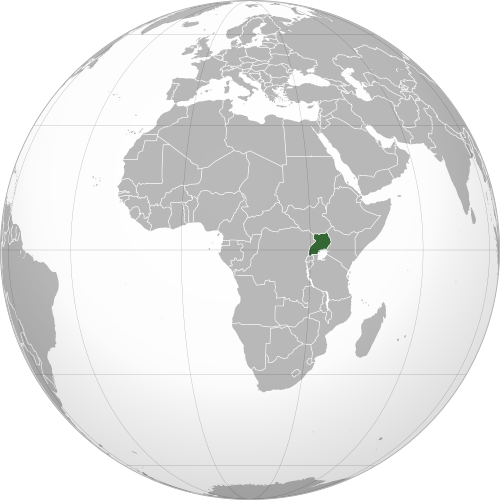
| Region | East Africa, landlocked; equatorial |
| Global production rank | 7th — 384,000 tonnes in 20233 |
| African rank by production | 2nd, behind Ethiopia (559,400 t)3 |
| Recent exports | 8.6 million 60 kg bags, June 2025 – May 2026, worth US$2.3 billion2 |
| Year-on-year change | +16% volume, +11% earnings2 |
| Species split | Overwhelmingly Robusta — see below |
| Robusta status | Indigenous, growing wild around Lake Victoria1 |
| Arabica origin | Introduced from Ethiopia, naturalised on Mount Elgon1 |
| Arabica regions | Mount Elgon (Bugisu), Rwenzori Mountains, West Nile21 |
| Regulator | Uganda Coffee Development Authority (UCDA), created 199114 |
| Protected name | Rwenzori Mountains of the Moon Coffee, Uganda’s first geographical indication, 2023 |
A Robusta country, in numbers
.svg)
The scale is easy to underrate. In the twelve months from June 2025 to May 2026, Uganda exported 8.6 million 60-kilogram bags, up from 7.4 million the year before, earning US$2.3 billion — a 16% rise in volume and an 11% rise in earnings.2 Coffee is one of the country’s largest single foreign-exchange earners.
The species split shows up cleanly in the monthly export returns. In October 2025 Uganda shipped 597,925 bags of Robusta worth US$151.51 million against 87,795 bags of Arabica worth US$34.04 million2 — about 87% Robusta by volume, but only around 82% by value, because Arabica sells for more per bag.
That price gap is visible in the authority’s own daily quotations. On 24 July 2026, Robusta Screen 18 was quoted at 184.53 US cents per pound, while Arabica Bugisu AA — the top grade off Mount Elgon — was quoted at 304.40 cents.2 Arabica from the mountains fetches roughly 1.65 times what the best-graded Robusta does, which is the whole economic argument for Uganda’s highland Arabica programmes in a single ratio.
Screen 18 refers to bean size: beans that stay on a screen with holes 18/64ths of an inch across. Bigger beans are graded higher, which is a proxy for careful growing and sorting rather than a direct measure of flavour — see Green coffee grading.
To verify — "Africa's leading coffee exporter"
The research behind this note cites a coffee blog summarising USDA data as calling Uganda “Africa’s leading coffee exporter” with an 85% Robusta / 15% Arabica split.5 Two problems. First, by production Uganda is second in Africa, behind Ethiopia’s 559,400 tonnes against Uganda’s 384,000.3 Exports and production are genuinely different things — Ethiopia drinks a large share of its own crop and Uganda drinks almost none — so both statements can be true at once, but no export-side source was verified here. Second, the 85/15 figure is close to, but not the same as, the ~87/13 that UCDA’s own October 2025 export returns imply.2 Treat the split as “roughly seven-eighths Robusta” rather than a precise percentage.
Where the coffee grows
Robusta occupies the low and middle ground — the Lake Victoria basin and the forested country around Kampala1 — which is also where the wild populations are. Arabica is confined to the two mountain areas high enough to grow it, plus the north-western West Nile area.
The wiki has full notes on both Arabica highlands, and they are quite different animals:
- Mount Elgon — the extinct volcano on the Kenyan border, whose Ugandan flank is the Bugisu region. This is the older, larger Arabica area, sold almost entirely through cooperatives rather than named farms, and the source of the Bugisu AA / A / PB / B grades quoted daily by UCDA.2 It grows the Scott Labs selections SL14, SL28 and SL34, plus a heritage Arabica called Nyasaland.
- Rwenzori Mountains — the western range on the Congolese border, and the holder of Uganda’s first geographical indication, registered in 2023 as Rwenzori Mountains of the Moon Coffee. A geographical indication is a legally protected place-name, like Champagne: only growers inside the defined area may use it.
The engine report behind this note also names Buganda, Busoga, Ankole, Kigezi, Sebei and Lango among the country’s coffee areas.5 Sebei is part of the Mount Elgon complex; the others are predominantly Robusta country.
To verify — regional altitudes and the variety list
A single coffee blog is the source for the full regional list above and for the claim that Uganda’s Arabica varieties include Typica, SL14, SL28, Kent and “Bugisu”, with Robusta varieties Nganda and Erecta.5 Three cautions:
- “Bugisu” is a place, not a cultivar. No variety register records it. The wiki’s Mount Elgon note reaches the same conclusion independently — it is most likely a regional landrace descriptor, the way “Ethiopian heirloom” is used.
- Nganda and Erecta are widely used names for Uganda’s two Robusta plant types (spreading versus upright growth habit), but no UCDA or agronomic document defining them was read for this note.
- Kent in Uganda is unconfirmed here; the variety is best documented in India. No agronomic survey giving the varietal mix by region was located, and district-level altitude figures for Robusta do not appear in UCDA’s export catalogues.
Processing
Both routes are in use for both species. Arabica off Mount Elgon is predominantly washed, with naturals as the specialty growth area; the Rwenzori does both.
The green trade has its own shorthand for the two, which is worth knowing because it appears on contracts rather than on bags: “drugar” for dry-processed Ugandan Arabica and “wugar” for washed. The Mount Elgon note flags that no official UCDA definition of these terms was located, so they are trade usage rather than a published standard.
More unusually, Uganda also produces washed Robusta — Robusta pulped and fermented like Arabica rather than dried in the cherry, which is one of the main routes to the quality tier the industry calls Fine Robusta. Given that the species is native here, Uganda has a reasonable claim to being the natural home of that category.
To verify — prices and cupping scores from a single commercial supplier
A large block of the research behind this note — FOB export prices, farmgate cherry prices and cup scores — comes from one green-coffee supplier’s own sales page,6 which is a seller quoting its own numbers, not an auction record or a government statistic. None of it was independently confirmed. Recorded as claims:
- Bugisu AA/AB/PB Arabica at 1,500–2,300 m, scoring 82–85 points under SCAA protocol, with jasmine, dark chocolate and berry notes.6 The score is a vendor’s description of lots it is selling, not an SCA or CQI panel result — compare Coffee scoring.
- March 2025 FOB prices: Robusta Screen 18 at US$2.90–3.10/kg exporter-side; Bugisu AB at US$4.10–4.50/kg; Bugisu AA at US$5.00–5.80/kg; washed Robusta reaching US$5.65/kg; and a premium Mt. Elgon A+ Arabica at US$7.55/kg.6
- 2025 farmgate cherry prices: Robusta 2,800–3,300 UGX/kg across central and western districts, up to 3,800 UGX/kg for low-defect Screen 18 material; Arabica cherry 4,500–5,200 UGX/kg on Mount Elgon and 4,200–4,800 UGX/kg in the western highlands, with organic certification adding 500–800 UGX/kg.6
- A second, secondary source gives 2025 farmgate figures of US$0.41–0.83/kg for Robusta cherry and US$2.48–3.93/kg for Arabica.5 These are the same order of magnitude as the UGX figures, but the currency-conversion assumptions are undocumented.
The verified alternative is UCDA’s own daily grade prices,2 quoted above — those are published by the regulator and are the figures to use.
Who runs it: the Uganda Coffee Development Authority
UCDA is the statutory body that regulates the sector. It was created by an Act of Parliament in 1991, amended in 1994, and sits at Cap. 325 of Uganda’s laws,4 formed as part of the liberalisation of the coffee industry1 — the dismantling of the state marketing monopoly that had controlled buying and export. It is administered under the Ministry of Agriculture, Animal Industry and Fisheries.14
Its mandate is to “regulate, promote and oversee the quality of coffee along the entire value chain, support research and development, promote production, and improve the marketing of coffee.”4 In practice, the parts a reader outside Uganda meets are the daily grade price quotations2 and the exporter and roaster catalogues it publishes.
| Created | 1991, amended 1994; Cap. 3254 |
| Head office | Coffee House, Plot 35 Jinja Road, Kampala74 |
| Postal | P.O. Box 7267, Kampala7 |
| Contact | info@ugandacoffee.go.ug; +256 312 260 4707 |
| Managing Director | Emmanuel Iyamulemye Niyibigira74 |
| Parent ministry | Agriculture, Animal Industry and Fisheries14 |
UCDA’s exporter catalogue lists the private companies that actually move the coffee. The largest named there include UGACOF, the Ugandan arm of the Swiss trading house Sucafina, based at Bweyogerere in Wakiso District,7 and Rwenzori Coffee Company / Agri Evolve in the west.8 The catalogues are contact directories, not corporate registries: they do not record ownership structures, shareholdings or farm-level estate histories, so this wiki cannot give named-estate records for Uganda the way it can for Panama.
Competitions and records
Uganda sits outside the international green-coffee auction circuit. There is no Cup of Excellence programme here — the Alliance for Coffee Excellence country list does not cover Uganda — and no auction archive comparable to Best of Panama exists. Coffee is aggregated across hundreds of thousands of smallholders into cooperative and exporter lots, so the paperwork that produces named winners and per-lot records mostly is not generated.
Where Uganda does appear is the barista side and the pan-African circuit run by the African Fine Coffees Association, which is headquartered in Kampala. At the 2026 AFCA Conference, Uganda took both the overall winner and the first runner-up positions in the Africa barista competition, and was announced as the host of the AFCA Conference and Expo 2027.2
Domestically, UCDA runs a national roasting award — it publishes a brochure titled “Ugandan Coffee Roasted at Origin Award Winners Profiles” with GOLD and other medal categories.9 “Roasted at origin” means the coffee is roasted in Uganda rather than shipped green and roasted in a consuming country, which is one of the few ways value stays in the producing country — see Premiumisation.
To verify — no winners, scores or dates for the national awards
The accessible portion of the UCDA award brochure shows the organiser’s contact details and a GOLD category heading, but does not show winner names, cupping scores or competition dates.9 Which roaster won what, for which coffee, in which year, is unknown from the sources consulted. Separately, the Mount Elgon note records a producer’s claim to a UCDA “Best of the Pearl” award for Honey Arabica in 2021, relayed by an importer; no UCDA results page for that competition was found either. Uganda evidently runs national competitions; their results are not publicly indexed in a form this wiki could verify.
Why it matters
Uganda is the strongest counter-example to the specialty world’s default map. That map runs on named farms, auction results and scores — the Panama model — and Uganda has almost none of them. What it has instead is a native species, enormous smallholder volume, and a regulator publishing a daily price for a grade called Bugisu AA.
It is also the place to watch on Robusta’s rehabilitation. If Fine Robusta becomes a real quality category rather than a marketing tier, it will be built partly on coffee from the country where the plant grows wild — and, unusually for coffee, on genetics that never had to be imported from anywhere.
Related
- Mount Elgon — the eastern Arabica highland, source of the Bugisu grades
- Rwenzori Mountains — the western Arabica highland and Uganda’s first protected coffee name
- Robusta · Fine Robusta · Arabica vs Robusta — the species that defines Uganda’s crop and the quality tier it is reaching for
- SL14 · SL28 · SL34 — the Scott Labs Arabica selections grown on Uganda’s mountains
- Scott Agricultural Laboratories — where those selections were made
- Kenya — the neighbouring origin the SL varieties were bred for, sharing Mount Elgon
- Ethiopia — Africa’s largest producer, and where Uganda’s Arabica came from
- Tanzania · Rwanda · Burundi — the other East African origins
- African Fine Coffees Association — the Kampala-headquartered pan-African body
- Producer cooperatives — how nearly all Ugandan specialty coffee reaches market
- Washed process · Natural process — the two processing routes, used for both species
- Green coffee grading — what “Bugisu AA” and “Screen 18” actually measure
- Coffee scoring · Cupping — how the disputed 82–85 scores would be produced
- C-market — the exchange price most Ugandan Robusta is sold against
- Cup of Excellence · Alliance for Coffee Excellence · Green coffee auctions — the competition circuit Uganda sits outside of
- Premiumisation · Direct trade — the value-at-origin question behind roasting at origin
- Coffee Belt · Terroir — the geographic frame
- Climate change and coffee — why an equatorial origin with a native species matters
Official links
- Official site — Uganda Coffee Development Authority — the national regulator; publishes daily Robusta and Bugisu Arabica grade prices and monthly export reports
Footnotes
-
Coffee production in Uganda — Wikipedia — confirmed via WebFetch; source of Robusta growing wild around Lake Victoria, Arabica being introduced from Ethiopia and naturalising on Mount Elgon, the Robusta and Arabica growing areas, and UCDA’s 1991 formation under liberalisation ↩ ↩2 ↩3 ↩4 ↩5 ↩6 ↩7 ↩8 ↩9
-
Uganda Coffee Development Authority — official site — confirmed via WebFetch; source of the June 2025 – May 2026 export figures (8.6 million bags, US$2.3 billion, +16% / +11%), the October 2025 Robusta and Arabica bag and value split, the 24 July 2026 Robusta Screen 18 and Bugisu AA/A/PB/B grade prices, and the 2026 AFCA barista competition result and 2027 hosting announcement ↩ ↩2 ↩3 ↩4 ↩5 ↩6 ↩7 ↩8 ↩9 ↩10 ↩11 ↩12
-
List of countries by coffee production — Wikipedia — confirmed via WebFetch; source of Uganda’s 7th global rank, its 384,000 tonnes in 2023 and Ethiopia’s 559,400 tonnes ↩ ↩2 ↩3
-
Uganda Coffee Development Authority — Wikipedia — confirmed via WebFetch; source of the 1991 Act amended 1994 at Cap. 325, the mandate wording, the Coffee House head office, the Managing Director’s name and the parent ministry ↩ ↩2 ↩3 ↩4 ↩5 ↩6 ↩7 ↩8
-
Uganda Coffee: Growing Regions, Production, and Best Brands — Colipse Coffee — secondary blog summarising USDA data; source of the “Africa’s leading exporter” and 85/15 species-split claims, the regional list, the variety list and the US-dollar farmgate ranges ↩ ↩2 ↩3 ↩4
-
Green Coffee Beans Suppliers Uganda — Damex — commercial green-coffee supplier page; source of the Bugisu altitude and 82–85 score claims, the March 2025 FOB price grid and the 2025 UGX farmgate cherry prices ↩ ↩2 ↩3 ↩4
-
Uganda Coffee Exporting Company Profiles Catalogue — UCDA — source of UCDA’s head office and postal address, contact details, the Managing Director’s name, and the UGACOF / Sucafina Uganda exporter entry ↩ ↩2 ↩3 ↩4 ↩5
-
Uganda Coffee and Cocoa Directory — UCDA — source of the Rwenzori Coffee Company / Agri Evolve listing ↩
-
Ugandan Coffee Roasted at Origin Award Winners Profiles — UCDA — source of the national roasted-at-origin award and its GOLD category; winner names and scores were not visible ↩ ↩2