Rwenzori Mountains
The Rwenzori Mountains are the reason Uganda has a protected coffee name at all. Uganda is normally described as a robusta country — big volume, low prices, sold as a commodity. The Rwenzori is the counter-example: high, cool, Arabica ground on the country’s western edge, farmed almost entirely by smallholders, and in 2023 the source of Uganda’s first registered geographical indication.12
The range sits in western Uganda on the border with the Democratic Republic of Congo, and carries the old European name “Mountains of the Moon.”34 Coffee grows on the foothills and lower slopes, not the glaciated peaks.
A geographical indication, or GI, is a legally protected place-name for a product — the same machinery behind Champagne, or behind Café de Huila in Colombia. Only growers inside the defined area, meeting the defined rules, may sell under the name.
| Country | Uganda |
| Location | Western Uganda, DRC border34 |
| Protected name | Rwenzori Mountains of the Moon Coffee, registered 2023 — Uganda’s first GI12 |
| GI districts | Kasese, Bundibugyo, Kabarole, Bunyangabu, Ntoroko12 |
| Growers in the GI body | 9 cooperatives, 11,000+ farmers15 |
| Producer association | Rwenzori Geographical Indication Association (RGIA), formed 202225 |
| Species | Arabica1 |
| Varieties reported | SL14, SL28, Typica, Bourbon67 |
| Processing | [[Washed process |
| Registrar | Uganda Registration Services Bureau (URSB)1 |
Uganda’s first protected coffee name
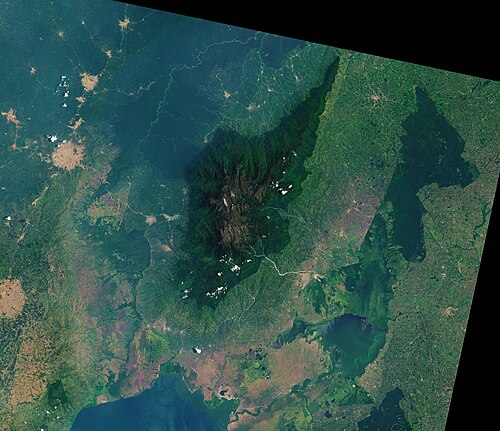
Photo: public domain. Source.
.jpg)
This is the load-bearing fact on the page, and it is the one with real sources behind it. Uganda Registration Services Bureau — the government body that runs the country’s trademark and IP registers — states plainly that Rwenzori Mountains of the Moon Coffee is Uganda’s first Geographical Indication, “officially registered in 2023 with support from the French Government.”1 The growers’ own association says the same thing, adding that it was also the first GI in East Africa.2
The people behind it are the Rwenzori Geographical Indication Association (RGIA), formed in 2022 out of nine local cooperatives representing more than 11,000 coffee growers.25 The protected area covers five districts — Kasese, Bundibugyo, Kabarole, Bunyangabu and Ntoroko — with an altitude floor written into the specification.12
The name was publicly launched on 13 May 2025 at a marketing and control workshop in Kasese, run with URSB and attended by the World Intellectual Property Organization.1 A separate EU-supported GI Support Fund grant of €272,000, running 1 July 2024 to 30 June 2027, is paying for governance, production capacity and market access work behind the name.5
Why this matters more than it sounds: a GI is one of the few tools a smallholder region has for keeping value at origin. It makes the place-name property. Whether the premium actually reaches the farm is the same unresolved question as everywhere else in specialty sourcing — but without the registration there is nothing to argue over.
To verify — the registration year and the "East Africa first" claim
- 2023 vs 2022. URSB and the growers’ association both give 2023 as the registration year.12 The EU-supported project page describing the same GI says it was “officially registered in 2022.”5 The 2022 date may be the association’s founding rather than the registration; treat 2023 as the figure, since it is the one the national registrar gives.
- “First in East Africa” appears only on the growers’ association’s own site.2 URSB confirms “first in Uganda” but does not make the regional claim.1 No regional IP-office source was checked here.
Where it grows — and why the altitude figures disagree
Every source agrees this is high ground. None of them agree on the numbers, because they are describing different things: the legal minimum written into the GI, the range where the best lots actually come from, and individual roasters’ single-lot elevations.
| Source | Altitude given |
|---|---|
| URSB (national registrar)1 | “altitudes exceeding 1,200 metres” |
| Rwenzori GI Association — GI specification2 | ”above 1200m ASL” |
| Rwenzori GI Association — historical description2 | 1,500–2,000 m |
| EU GI Support Fund project page5 | 1,400–2,200 m |
| Roaster lot pages678 | 1,300–2,100 m across lots |
The honest statement is roughly 1,200 m as the legal floor, with specialty lots typically quoted between 1,300 and 2,100 m.
To verify — the "1200 feet" wording in the GI text
The growers’ association’s page describes the protected area as covering land “above 1200 feet ASL” in one sentence, while the rest of the same page and the registrar both say 1,200 metres.12 1,200 feet is about 366 m, which is below the coffee-growing slopes entirely and inconsistent with the same document’s own 1,500–2,000 m description. Read this as a typo for metres, but the official GI specification document itself was not obtained here.
Varieties, processing and the cup
The varieties reported for Rwenzori lots are the East African standards: SL14 and SL28 — two of the Scott Labs selections bred in Kenya in the 1930s — plus Typica and Bourbon.67 The wiki’s SL14 note already treats the Rwenzori as one of the two Ugandan highland regions where that variety matters most, alongside Mount Elgon on the Kenyan border.
Both major processing routes are in use. Roaster descriptions of Rwenzori lots cover naturals — cherry dried whole — and fully washed coffee, with a washed workflow of floating, pulping, fermentation, washing and drying on raised African beds.678 Cherry is described as being collected at village receiving stations and moved to a centralised wet mill,7 which is the normal shape of a smallholder origin: no farm has enough cherry to justify its own machinery.
URSB’s own summary describes the coffee as 100% Arabica scoring above 80 points on the cupping scale, with “sweet, fruity aroma and rich chocolate undertones.”1 The EU project page describes “notes of red fruits and citrus, lively acidity, and great aromatic complexity.”5 Those two are broadly consistent, and 80+ is simply the specialty threshold rather than a distinguishing claim.
To verify — specific cup scores, flavour notes and harvest timing, all single-sourced
- Cup scores of 85.75 (natural) and 84.25 (washed) come from one roaster’s product pages for its own lots.67 A vendor’s score for a bag it is selling is not an independent grading result, and it describes those lots, not the region.
- Flavour notes — berry, blackberry, brown sugar, caramel, plum and merlot for naturals; dark chocolate, dried fruit, stone fruit and citrus for washed — come from the same vendor pages,67 with a regional page adding strawberry, winey fruit and dark chocolate for naturals against plum and bright citrus for washed.8
- Two harvest windows, roughly April–July and October–January, come from a single regional profile page.8 No national coffee authority calendar was checked. Uganda straddles the equator and two-crop rhythms are normal there, so this is plausible but unconfirmed.
History, and what this note does not have
The growers’ association dates the arrival of Arabica in the Rwenzori Highlands to the early 20th century, under colonial-era agriculture in western Uganda.2 No independent history was consulted for this note, so treat the century as reported rather than established.
To verify — no competition, auction or price record exists here
This wiki carries no verified Rwenzori competition placement, auction lot, price or named buyer. The research behind this note found no official results page, auction archive or SCA/CQI document naming a Rwenzori lot, producer or award. One roaster page states that farmers are paid “significantly higher” than the standard Ugandan drugar price but gives no number and no buyer,7 which is not enough to record as a price fact. Likewise, no individual farm, mill or exporter ownership in the region was verifiable from primary sources.67
The place to look for African competition and auction results is the African Fine Coffees Association, which runs national competitions and auctions including two in Uganda.
Why it matters
Uganda’s coffee reputation is a volume reputation. It is one of the largest robusta producers on earth, and the arabica–robusta hierarchy has meant that for most of the last century the country was a price-taker selling into blends. The Rwenzori is the argument against that: high-altitude Arabica, a defined place, a named growers’ association, and a legally protected name that did not exist before 2023.
It is also a test of whether a GI does anything for people farming a hectare or two. Eleven thousand growers now share a piece of intellectual property. What that is worth per kilo is the number nobody has published yet — see Premiumisation for why the gap between a famous name and a farm-gate price is the whole game.
Related
- SL14 — the Scott Labs variety whose centre of gravity moved from Kenya to Ugandan highlands including the Rwenzori
- SL28 · Typica · Bourbon — the other varieties reported in Rwenzori lots
- Scott Agricultural Laboratories — where the SL selections came from
- Kenya — the neighbouring origin the SL varieties were bred for
- Uganda — the country note: production, exports, grades and the UCDA
- Mount Elgon — Uganda’s other Arabica highland, on the Kenyan border
- Robusta · Arabica vs Robusta — the species split that defines Uganda’s coffee reputation
- African Fine Coffees Association — the pan-African body running the competitions and auctions where Rwenzori results would appear
- Washed process · Natural process · Coffee fermentation — how Rwenzori coffee is made
- Producer cooperatives — the nine cooperatives behind the GI association are an example
- Huila — a protected regional coffee name elsewhere, and the closest comparison for what a GI does
- Coffee scoring · Green coffee grading · Specialty coffee — how the 80+ claim is assessed
- Direct trade · Premiumisation — where the value of a protected name does or does not land
- Coffee Belt — the global band this sits in
Official links
- Official site — Rwenzori Mountains of the Moon Coffee (RGIA) — the growers’ association behind the geographical indication
- Official site — Uganda Registration Services Bureau — the national registrar that granted the GI
Footnotes
-
URSB and partners champion Uganda’s first Geographical Indication — Rwenzori Mountains of the Moon Coffee — Uganda Registration Services Bureau, confirmed via WebFetch; source of the 2023 registration, “Uganda’s first GI”, the five districts, 11,000+ farmers, altitudes exceeding 1,200 m, the 13–15 May 2025 Kasese workshop, WIPO attendance, and the 100% Arabica / 80+ score description ↩ ↩2 ↩3 ↩4 ↩5 ↩6 ↩7 ↩8 ↩9 ↩10 ↩11 ↩12 ↩13 ↩14
-
Rwenzori Mountains of the Moon Coffee — About (RGIA) — the growers’ association’s own site, confirmed via WebFetch; source of the 2023 registration and “first in East Africa” claim, the nine cooperatives and 11,000+ growers formed in August 2022, the five districts, the “above 1200m ASL” and “1200 feet ASL” wordings, the 1,500–2,000 m historical figure, and the early-20th-century arrival of Arabica ↩ ↩2 ↩3 ↩4 ↩5 ↩6 ↩7 ↩8 ↩9 ↩10 ↩11 ↩12 ↩13
-
Rwenzori Kisinga — Coffee Hunter — origin profile; corroborates the western Uganda location on the DRC border and the Kasese-area growing districts ↩ ↩2
-
Rwenzori Mountains Coffee Region — All About Coffee — reference page; corroborates the “Mountains of the Moon” name, the DRC border location and the 1,300–2,100 m altitude band ↩ ↩2
-
Uganda — Rwenzori Mountains of the Moon Coffee GI, Facilité IG (EU-supported GI Support Fund) — confirmed via WebFetch; source of RGIA created 2022, nine cooperatives and 11,000+ producers, the 1,400–2,200 m range, the red-fruit and citrus cup description, the €272,000 grant and the 1 July 2024 – 30 June 2027 project window, and the conflicting “registered in 2022” wording ↩ ↩2 ↩3 ↩4 ↩5 ↩6 ↩7
-
Mbingo Mountain Coffee — Uganda Rwenzori Natural — roaster product page; source of the Typica / SL14 / SL28 variety list for a natural lot, the 85.75 score, and the berry, blackberry, brown sugar, caramel, plum and merlot notes ↩ ↩2 ↩3 ↩4 ↩5 ↩6 ↩7
-
Mbingo Mountain Coffee — Uganda Rwenzori Washed — roaster product page; source of the SL28 and Bourbon variety list for a washed lot, the 84.25 score, the dark chocolate / dried fruit / stone fruit / citrus notes, the receiving-station and centralised wet mill description, and the unquantified “significantly higher than drugar” payment claim ↩ ↩2 ↩3 ↩4 ↩5 ↩6 ↩7 ↩8 ↩9
-
Rwenzori Mountains Coffee Region: Altitude, Harvest & Cup Profile — Volcana Coffee — regional profile page; source of the two harvest windows (April–July, October–January) and the strawberry / winey fruit / dark chocolate versus plum / bright citrus split ↩ ↩2 ↩3 ↩4