Robusta
Robusta is not a variety in the sense that Geisha or Bourbon are. It is a separate species: Coffea canephora, the second of the two coffees that matter commercially, alongside Arabica and well ahead of Liberica. The plant is native to western and central Africa, from Liberia to Tanzania and south to Angola, and it has naturalised in Borneo, French Polynesia, Costa Rica, Nicaragua, Jamaica and the Lesser Antilles.1
Two things define it against Arabica. It is tougher — it shrugs off pests and disease that flatten Arabica, and it tolerates heat and low ground. And it is stronger — roughly twice the caffeine, a heavier, more bitter, less aromatic cup. That combination made it the workhorse of the commodity trade: most of the world’s instant coffee is Robusta, and most espresso blends that want crema and body reach for it.
It is processed to match. “Almost all Robusta’s are processed by” the dry method — that is, dried whole in the sun as naturals rather than washed.2 Wet mills are capital the Robusta trade has never had a reason to spend.
It is also the reason a large share of the world’s Arabica farms are still standing. Robusta’s resistance genes are what breeders spliced into Arabica through the Timor Hybrid, producing the Catimor and Sarchimor families.
Names and taxonomy
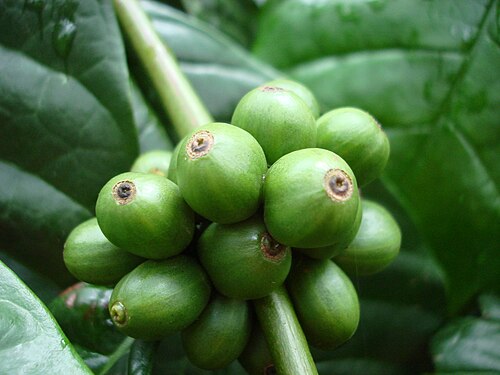

The species is Coffea canephora Pierre ex A.Froehner, in the family Rubiaceae. Two botanical varieties are recognised: var. robusta, the commercially important one, and var. nganda, a name that is formally illegitimate (nomen illegitimum). “Coffea robusta” is an older synonym, not a current name — so Robusta is a variety of canephora that gave its name to the whole species in everyday trade talk.
In the field the two are told apart by shape, not paperwork. Erecta is a tall, upright shrub; Nganda is a wide-spreading one.3 That is the whole practical distinction most growers make.
The other thing worth knowing about this species is what it produced. Arabica is not a separate lineage from Robusta — it is partly descended from it. Coffea arabica arose as a natural cross between C. canephora and C. eugenioides, which makes this species one of Arabica’s two parents.3 The full genetics are on Arabica vs Robusta.
To verify
The taxonomic authority was not checked at source. The author citation “Pierre ex A.Froehner” and the status of var. nganda above come from a single encyclopedia page, confirmed by fetching it. Kew’s Plants of the World Online — the database that would settle both, and which blocked automated access when this wiki checked it for Liberica — was not consulted here. No source consulted gives the year of formal description. Do not state a description date. “Erecta” and “Nganda” are presented differently by different sources. Sprudge, fetched and read here, calls them the species’ two main varieties.3 Wikipedia, the source for the paragraph above it, treats var. nganda as a formally illegitimate name. Both can be true at once — a name can be in universal trade use and still not be valid botanically — but no source consulted says so explicitly. Use Erecta and Nganda as plant shapes growers recognise, not as settled botanical ranks.
Where it came from, and when people started farming it
Robusta is an African forest plant, and it was a wild one for a very long time before anyone planted it. World Coffee Research places its origins in the humid, understory evergreen forests of central and western sub-Saharan Africa, across a range running from Guinea to Uganda to Angola, at elevations of 50–1,500 m above sea level — mostly low-elevation evergreen forest, with some presence in seasonally dry humid forest and gallery forest.4
That is a much wider and much lower band than Arabica’s wild range, which is confined to the highland forests of southern Ethiopia, South Sudan and Yemen. It is the whole reason the two species ended up in different parts of the world map.
Cultivation is recent — barely a century and a half old:
| When | What happened |
|---|---|
| Hundreds of thousands of years | The species exists in African forest understory, uncultivated4 |
| ~1870 | First documented cultivation, in the Congo, from genetic material taken from the Lomani River region of what is now the Democratic Republic of Congo4 |
| Late 19th century | The species becomes known to European planters, opening lowland country to commercial coffee for the first time |
| Early–mid 20th century | Colonial plantations expand; production is disrupted by the Second World War |
| Post-independence | Growing shifts toward smallholders, notably in Cameroon and Côte d’Ivoire |
| Today | Grown commercially in about 20 countries4 |
The 1870 date, the Lomani River provenance, the 50–1,500 m wild elevation band and the “about 20 countries” figure are all from World Coffee Research’s own robusta pages, read directly here.45
To verify
The colonial and post-war rows of that table rest on one roaster’s history page. The sequence of colonial plantation expansion, Second World War disruption and a post-independence shift to smallholders in Cameroon and Côte d’Ivoire comes from a single Austrian coffee-roasting company’s education page — a commercial source, not a historical one — and it was not fetched.6 No archival trade record, colonial agricultural report or academic history was consulted. Treat the shape of the story as plausible and the specifics as unsourced. No estate names or exact dates exist here for the first Congo plantations. The research report behind this note says explicitly that its sources do not name them. Do not fill that gap from memory.
How much of the world’s coffee it is
Robusta accounts for roughly 45–46% of world coffee production, with Arabica making up most of the remainder. By country, the same source puts Vietnam at over 40% of global Robusta production, then Brazil, Indonesia, India and Uganda.
A second, independent line of evidence now sits alongside that. Sprudge, citing World Coffee Research, puts Robusta at “a little more than 40% of coffee grown worldwide.”3 Read together with the International Coffee Organization export figures recorded on Arabica vs Robusta — which work out to about 42% Robusta by export volume — the honest summary is that Robusta is somewhere in the low-to-mid 40s and rising, not the “30%” the older trade shorthand still repeats.
To verify
No primary production statistics were obtained. The 45–46% share and the country breakdown rest on one encyclopedia page. The two authoritative sources — the International Coffee Organization and USDA Foreign Agricultural Service (“Coffee: World Markets and Trade”) — both blocked automated access, so neither figure was cross-checked against an official dataset.7 The country list also mixes metrics: the same passage gives Vietnam as a share of Robusta but Brazil as “25% of the world’s total coffee,” which is a different denominator and cannot be compared directly. Treat every percentage in this section as unconfirmed, and treat “Vietnam is the world’s largest Robusta producer” as very widely reported but not verified here against ICO or USDA data. A “30–40%” figure is also in circulation and is the weakest of the three. The research report behind this update gives Robusta as 30–40% of world production, sourced to a Nespresso brand page and a roaster blog. It also attributes that range to Sprudge — but Sprudge, fetched and read directly here, actually says “a little more than 40%.”3 The report misread its own source. Prefer the 40%+ reading. A country ranking by volume is also unconfirmed. The same roaster page ranks Robusta producers as Vietnam, Brazil, Indonesia, India, Côte d’Ivoire, Uganda, Malaysia, Thailand, Cameroon, Togo.6 Plausible and broadly consistent with the Wikipedia list, but single-source, commercial, and not fetched. Vietnam’s internal Robusta share is given two different ways in this wiki. The research report says about 90% of Vietnamese coffee production is Robusta;8 this wiki’s Vietnam coffee market note says about 97%, sourced to Wikipedia. Neither has been checked against a Vietnamese government or VICOFA release. Both agree on the point that matters — Vietnam grows almost nothing but Robusta — but do not quote either number as exact.
How it grows
Robusta is a lowland plant. It is grown well below the 1,500–2,000 m band where prized Arabica lives, which is exactly why it exists in the places it does: hot, humid, low country where Arabica sulks or dies.
The one altitude figure that is now sourced is for the wild plant, not the farmed one: World Coffee Research puts robusta’s natural habitat at 50–1,500 m.45 That is a habitat range, not a cultivation recommendation, and the top of it overlaps Arabica country — so it does not settle where Robusta is best grown.
To verify
Commercial altitude and temperature figures remain unsourced at any level above trade writing. A single roaster education page gives a cultivation range of 0–700 m, an optimal temperature band of 20–30 °C for Coffea canephora, and 10–11 months from flower to ripe cherry — noticeably slower than Arabica.6 All three are plausible and all three come from the same commercial page, unfetched. The commonly quoted 200–800 m range appears in trade writing with no source at all. No rainfall, temperature-maximum or drought-tolerance metric from an agronomic bulletin was found. “Lower and hotter than Arabica” is safe; a number is not.
Genetically the plant is diploid — two sets of chromosomes, 2n = 2x = 22 — against Arabica’s tetraploid 44, as recorded in this wiki’s Timor Hybrid note. That difference is why the two species do not normally interbreed, and why the one time they did by accident it changed coffee breeding permanently.
Caffeine and cup
Green Robusta beans carry roughly 2.2–2.7% caffeine by weight, against about 1.2–1.5% for Arabica — this wiki’s Laurina note gives the range, Wikipedia’s Coffea canephora page gives the top of it at 2.7% against Arabica’s 1.5%. Two independent sources, same picture: Robusta has about twice the caffeine of Arabica.
Caffeine is bitter, and it is part of why Robusta reads as harsher on the cupping table. The species’ standard reputation — rubbery, woody, grain-like, flat — comes from a century of it being grown as bulk commodity, harvested by stripping, dried carelessly and roasted dark for instant. Whether that reputation is about the plant or about the treatment is the whole argument behind Fine Robusta.
Caffeine also does the plant a favour: it is an insecticide the bush makes for itself, which is a large part of why Robusta needs less spraying than Arabica does.
To verify — the per-cup caffeine figure and the acrylamide comparison
“Up to 265 mg of caffeine in an 8 oz cup.” A retail coffee blog gives that figure for Robusta against 80–100 mg for a comparable Arabica cup.9 The green-bean percentages higher up this page are well corroborated; this brewed-cup number is single-source, commercial and unfetched, and per-cup caffeine depends on dose, grind and brew method far more than on species. Do not quote it as a species property. “About 60% less sugars and fats than Arabica.” A Vietnamese roaster’s blog gives that single combined figure.8 This wiki’s Arabica vs Robusta note separates the two, sourced to Lavazza: Arabica has roughly twice the sugar and about 60% more lipids. Those are not the same claim, and the combined version should not be used. Acrylamide: ~500 μg/kg in medium-roast Robusta against ~230 μg/kg in medium-roast Arabica. Acrylamide is a compound that forms when food is roasted or fried at high heat, and it is regulated as a contaminant in the EU. The figures come from a ScienceDirect topic overview, which returned HTTP 403 and could not be read here.10 No food-safety authority document — EFSA, FDA or an EU regulation — was consulted. Treat the numbers as reported, not established, and note that no source consulted gives a health interpretation of the gap.
Fine Robusta — a separate specialty track
Arabica and Robusta are not graded on the same sheet. This wiki’s Q Grader note records that the Coffee Quality Institute licenses a Q Robusta Grader (usually written R Grader) separately from the Q Arabica Grader, working to Fine Robusta standards that CQI developed for C. canephora — while Arabica grading follows Specialty Coffee Association standards.
To verify
CQI’s public pages consulted here do not document the Fine Robusta programme. The CQI homepage returned no mention of Fine Robusta, the R Grader or a Robusta cupping protocol, and the Q Exam Program Guidebook v8 (2024-05) — CQI’s own procedural document — covers Arabica grading only, with no Robusta section, no Fine Robusta score threshold and no green-grading rules for C. canephora.1112 This does not show the programme doesn’t exist; it shows the specific documents reachable here don’t describe it. The claim as stated on Q Grader is unconfirmed at source, and no Fine Robusta score threshold (the “80 points” figure quoted in trade writing) was verified. If you need the protocol, request it from CQI directly.
What the standard actually asks for — an 80-point minimum on a Robusta-specific cupping form, zero primary defects in a 350 g green sample, and tight moisture, quaker and odour limits — is now set out in this wiki’s Fine Robusta note, sourced from third parties citing CQI rather than from CQI itself. The caveat above still stands.
Amazonian Robustas — Brazil’s specialty canephora push
The most concrete specialty-Robusta breeding programme in the record is Brazilian. A peer-reviewed paper, “Amazonian Robustas — new Coffea canephora coffee cultivars for the Western Brazilian Amazon,” describes ten clonal cultivars released by EMBRAPA (Brazil’s national agricultural research corporation) for Rondônia and Acre:
| Cultivar group | Cultivars | Average yield (3-year trials) | Stated potential |
|---|---|---|---|
| Group 1 | BRS 1216, BRS 2336, BRS 3210, BRS 3213 | 80.75 bags/ha | — |
| Group 2 | BRS 2299, BRS 3137, BRS 3220 | 66.00 bags/ha | >110 bags/ha |
| Group 3 | BRS 2314, BRS 2357, BRS 3193 | 61.00 bags/ha | >100 bags/ha |
The clones are registered individually but designed to be planted in multi-clone combinations. At publication, 11 nurseries were authorised to propagate them commercially — 10 in Rondônia, 1 in Amazonas — and 30 demonstration plots had been established across 10 other Brazilian states, covering every region of the country. All figures in this section are from that single paper.
To verify
The paper could not be read, and the cupping figures it reports contradict each other as relayed. The SciELO page returned HTTP 403, so nothing here was confirmed at source.13 As summarised in the research report, the Amazonian Robustas group averaged 83.8 points on the Fine Robusta protocol (range 80.0–87.2) — but BRS 1216, a member of that group, is separately given an average of 79.6 (range 78.3–80.0, described as medium sweetness with chocolate flavour and aroma), and a further 79.1 average (range 76.0–82.0) is reported without naming which cultivar it belongs to. A group average of 83.8 cannot sit comfortably above members scoring 79.6 and 79.1 unless the remaining clones score far higher, and the summary does not resolve which figure covers what. Do not quote any of these scores as a cultivar’s score. The yield and nursery figures in the table above are also single-source and unfetched.
Where Robusta is priced
Robusta has its own futures contract, separate from the Arabica “C” contract. The Robusta Coffee Future trades on ICE Futures Europe — historically LIFFE, the London exchange ICE absorbed, which is why older writing calls it the LIFFE contract.14 Confirmed specifications:15
| Contract size | 10 tonnes |
| Quotation | US$ per metric tonne |
| Delivery months | January, March, May, July, September, November |
| Deliverable grade | Class 1 Robusta, other qualities at set premiums and discounts |
| Origin | Robusta from any origin freely exportable to any destination |
ICE describes the contract as “the global benchmark for the pricing of physical Robusta Coffee.” The “any origin” clause is the important part for a specialty reader: the world price for Robusta is set on a fungible, origin-blind basis, which is precisely the market structure that Premiumisation and specialty auctions like Cup of Excellence exist to escape.
To verify
Indian auction prices from 2007 are single-source and undated. A Business Standard report on an Indian Coffee Trade Association auction lists Robusta Parchment lots at Rs 3,298–4,320 per 50 kg bag (PB 3,950; AA 4,320; AB 4,242; C 3,600; BBB 3,298) and Robusta Cherry lots at Rs 3,243–3,700 (PB 3,395; AA 3,700; AB 3,429; BBB 3,243), with lot sizes from 198 kg to 13,712 kg. The article is a newspaper report, not an ICTA auction bulletin, and the auction date is inferred as around May 2007 from the article URL, not stated. This page was not fetched.16 Treat the whole table as reported, not established, and note that the grade letters (PB, AA, AB, C, BBB) are Indian bean-size screen grades, not quality scores.
Why it matters
Every argument in specialty coffee about climate resilience runs into Robusta. It already produces reliably at temperatures and altitudes that are becoming normal in origins built for Arabica, it resists Coffee leaf rust — the disease whose SH6–SH9 resistance genes come from this species, per the peer-reviewed work cited in that note — and it yields more per hectare. What it has never had is a cup anyone would pay a premium for.
That is the open question. The Brazilian clonal programme, the CQI grading track and a slow trickle of single-origin Robusta on specialty menus are all bets that the reputation is a farming-and-processing problem rather than a botanical ceiling. This wiki has no verified cupping score, competition placing or auction result for any Robusta lot — nothing from Cup of Excellence, nothing from Best of Panama, nothing from an Alliance for Coffee Excellence or CQI record. The same gap the Liberica note documents applies here, for the same reason: the major competitions are built around Arabica.
Related
- Arabica vs Robusta — the side-by-side comparison: genetics, chemistry, price and which competitions each species is eligible for
- Liberica — the third commercial species, which Robusta displaced in Indonesia
- Timor Hybrid — the accidental Arabica × Robusta cross that carried this species’ resistance into Arabica
- Catimor · Sarchimor — the introgressed Arabica families built on that cross
- Coffee leaf rust — the disease Robusta resists and Arabica does not
- Fine Robusta — the specialty grading standard written for this species
- Q Grader · Coffee Quality Institute — the R Grader licence and the body that issues it
- Laurina — the caffeine comparison point at the opposite extreme
- Natural process — the dry method almost every Robusta goes through
- Amazonian Robustas · EMBRAPA — Brazil’s specialty canephora breeding programme
- Indian Coffee Trade Association — the Indian auction platform where the parchment and cherry grades above trade
- Vietnam coffee market — the origin that dominates world Robusta supply
- World Coffee Research — the breeding body whose variety catalogue documents this species’ wild origin and cultivation history
- Uganda · Coffee Belt — the African Robusta origin and the wider band the species’ wild range sits in
- Premiumisation · Cup of Excellence — the specialty price mechanisms Robusta sits outside
- Cupping · Coffee scoring — how the cup-quality argument would have to be settled
- Geisha · Bourbon · Typica — Arabica varieties, for contrast
Official links
A species has no owner and no homepage. These are the bodies whose official records govern it:
- Official site — ICE Futures Europe, Robusta Coffee Futures — the exchange that sets the world Robusta price
- Official site — Coffee Quality Institute — the body that runs Robusta grading and the Fine Robusta standards
- Official site — World Coffee Research, Robusta variety catalogue — the breeding body’s own species and cultivar pages, including its history of robusta
- The taxonomic authority for the species would be Kew’s Plants of the World Online, which was not consulted for this note; no verified species-page URL is given here rather than guess one.
Footnotes
-
ISIC (institute for scientific information on coffee) — Initial coffee bean processing ↩
-
Sprudge — What is Robusta coffee? — confirmed via WebFetch; source of the Erecta and Nganda plant forms, the canephora × eugenioides parentage of Arabica, and the “a little more than 40% of coffee grown worldwide” figure attributed to World Coffee Research ↩ ↩2 ↩3 ↩4 ↩5
-
World Coffee Research — History of Robusta — confirmed via WebFetch; source of the wild range (Guinea to Uganda to Angola), the 50–1,500 m habitat elevation, the ~1870 Congo / Lomani River first cultivation, and the “about 20 countries” figure ↩ ↩2 ↩3 ↩4 ↩5 ↩6
-
World Coffee Research — Robusta variety catalogue — confirmed via WebFetch; restates the 50–1,500 m elevation range and the humid evergreen understory habitat, but carries no species-level agronomic data ↩ ↩2
-
Beans.at — The Robusta bean: characteristics, origin and appearance — Austrian roaster education page; not fetched. Sole source for the colonial and post-war history, the 0–700 m cultivation range, the 20–30 °C optimum, the 10–11 month cherry maturity and the ten-country production ranking ↩ ↩2 ↩3
-
USDA Foreign Agricultural Service — Coffee: World Markets and Trade ↩
-
Nguyen Coffee Supply — What is Robusta coffee? — roaster blog; not fetched. Source of the “90% of Vietnamese production” and “60% less sugars and fats” claims ↩ ↩2
-
Colipse Coffee — Robusta coffee: definition, growing, taste and best brands — retail blog; not fetched. Source of the ~265 mg per 8 oz cup caffeine claim ↩
-
ScienceDirect — Robusta coffee, topic overview — returned HTTP 403; not read. Cited only as the reported origin of the acrylamide figures ↩
-
Coffee Quality Institute — Q Exam Program Guidebook v8, May 2024 (PDF) ↩
-
SciELO — Amazonian Robustas: new Coffea canephora coffee cultivars for the Western Brazilian Amazon, Crop Breeding and Applied Biotechnology ↩
-
Business Standard — Robusta coffee rules high at ICTA auction ↩