Decaffeination
Decaffeination is the removal of caffeine from coffee. It happens to green (unroasted) coffee, at a specialist plant, long before the beans reach a roaster — so a decaf lot has already made an extra journey, been soaked, dried a second time, and handled by a third company before anyone tastes it. That detour is why decaf costs more and why it behaves differently in the roaster.
Every method rests on the same trick. Caffeine is water-soluble, so water pulls it out of a bean easily — but water pulls out everything else that makes coffee taste like coffee at the same time. The whole craft of decaffeination is taking the caffeine and leaving the flavour behind. The three methods the specialty trade actually talks about are three different answers to that one problem.
How much has to come out
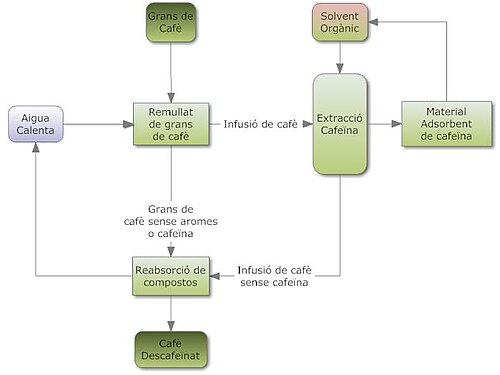
Photo by Danicta, CC BY. Source.

“Decaf” is a regulated word, and the two big markets set the bar in different places:
| Market | Requirement |
|---|---|
| United States (FDA) | at least 97% of the caffeine removed |
| European Union | 99.9% caffeine-free by mass |
Both figures come from the same overview of the field.1 Note what this means in practice: decaf is not caffeine-free. A cup of decaf still carries a small residual dose, and a US-standard decaf can legally carry more of it than an EU-standard one.
Also worth knowing before the methods: Robusta carries roughly twice the caffeine of Arabica (see Arabica vs Robusta), so what a plant has to strip out depends on what went in. And there is a fourth route that skips the factory entirely — varieties like Laurina that are naturally low in caffeine, and IAC’s work on near-zero-caffeine Arabica selections. Those are breeding, not processing.
The three methods
Swiss Water Process — water, temperature, time
Swiss Water is the only decaf method with a consumer-facing brand name on the bag, and it is the one specialty roasters lean on hardest. It uses no added solvent at all — the company’s own description of the process is “only water, temperature, and time,” with “no esters or solvents.”2
The clever part is a liquid called Green Coffee Extract (GCE) — water that has already been loaded with everything soluble in green coffee except caffeine. Swiss Water calls it “a 100% caffeine and chemical-free symphony of water and coffee’s essential compounds.”2 Because the GCE is already saturated with flavour compounds, when fresh beans are soaked in it there is nowhere for their flavour to go — the only thing with room to diffuse outward is the caffeine.23 The company’s four steps run:
- Hydration — beans are cleaned and swelled with water so their pores open.
- Caffeine migration — beans sit in GCE and, by diffusion, “only caffeine molecules migrate outward, while all the precious flavor and other compounds remain.”2
- Drying — beans go back to green-coffee moisture using “high air flow and low temperatures.”2
- Filtration and renewal — the now caffeine-loaded GCE is passed through carbon filters that “selectively trap caffeine molecules while preserving all other coffee components,” and the refreshed extract goes back round again.2
The soak runs 8–10 hours to hit the residual target.1 Coffees processed this way are marketed as 99.9% caffeine-free — the EU threshold, not the looser US one.24
Two practical consequences for a specialty buyer. First, because nothing is added, the coffee keeps its organic certification through decaffeination2 — which is why so much certified-organic decaf is Swiss Water. Second, it is a single company: the process runs out of a plant at 7750 Beedie Way, Delta, British Columbia, Canada, operated by Swiss Water Decaffeinated Coffee Inc., which also owns Seaforth Supply Chain Solutions, a green-coffee handling and storage facility in Vancouver.25 The company says it serves roasters in the United States and 56 other countries and describes itself as “the only consumer-branded decaffeination process.”5
Ethyl acetate (EA) — the “natural” solvent
Ethyl acetate is a solvent, and EA decaf works the way solvent decaf has always worked: steam the beans open, wash them with the solvent so the caffeine dissolves into it, drain it off, and dry the beans. In the direct method the wash “is repeated between 8 and 12 times until the caffeine content meets the required standard.”1
The word “solvent” alarms people, so it is worth being precise about what ethyl acetate actually is. It is an ester that occurs naturally in fermentation — “the most common ester in wine,” formed from acetic acid and ethanol during fermentation — and it turns up in ripe fruit, where it contributes “a characteristic sweet smell (similar to pear drops).”6 Its acute toxicity is low (the WHO sets an acceptable daily intake of 25 mg per kg of body weight), though concentrated vapour irritates eyes, nose and throat.6 Coffee beans and tea leaves are both routinely decaffeinated with it.6
This matters commercially because EA can be made from sugarcane, and EA decaf has become the house style of decaffeination at origin — the coffee never leaves the producing country. Descafecol S.A.S., in Manizales, Caldas, Colombia, runs exactly this model, marketing coffee decaffeinated “naturalmente y en origen” — naturally, and at origin — from 100% Colombian Arabica.7 Keeping the step in-country shortens the supply chain and keeps the value there rather than in Europe or Canada.
Unlike Swiss Water, no one owns EA decaf; multiple plants worldwide offer it, so there is no single brand to look for on a bag.
Supercritical CO₂ — the industrial workhorse
The third route uses carbon dioxide pushed past its critical point, where it stops behaving like a gas or a liquid and starts behaving like both — a fluid that flows through the bean like a gas but dissolves things like a liquid. It was developed by Kurt Zosel at the Max Planck Institute.1
Green beans are moistened and held in a pressure vessel with CO₂ at 300 atmospheres and 65 °C (149 °F). Under those conditions “caffeine dissolves into the CO₂; but compounds contributing to the flavour of the brewed coffee are largely insoluble in CO₂ and remain in the bean.”1 The caffeine is then stripped out of the CO₂ in a second vessel and the gas is recycled.
CO₂ decaf is selective and leaves no solvent residue, but the pressure vessels are expensive — which pushes it toward large commercial volumes rather than the small lots specialty roasters buy.
One more, rarely seen
There is also a triglyceride process, in which beans are soaked in hot water and coffee solution and then immersed in coffee oils recovered from spent grounds; “the triglycerides in the oils remove the caffeine, but not the flavor elements, from the beans.”1 It is a footnote in the trade rather than something you will meet on a bag.
Why it matters
Decaf used to be where bad coffee went to die: whatever was cheapest, stripped and scorched. The specialty trade’s shift — sending genuinely good green coffee through Swiss Water or an origin EA plant — is what made “decaf worth drinking” a real category rather than a punchline. It also changed who does the work: an EA plant in Manizales keeps a processing step, and its margin, inside a producing country instead of exporting the job.
For a reader standing in front of a bag, the short version:
- “Swiss Water” or “SWP” — water only, no solvent, organic-compatible, EU-standard 99.9%.
- “EA,” “sugarcane,” or “natural decaf” — a naturally-occurring solvent, usually done at origin, often Colombian.
- “CO₂” — high-pressure gas, no residue, mostly large commercial volumes.
And in all three cases, the coffee has been wetted and re-dried before it ever met a roaster, which is why decaf greens roast faster and darker than their caffeinated equivalents and why roast profiles for decaf are built separately.
To verify
When and where Swiss Water actually started. The sources contradict each other. A general encyclopedic overview and a UBC technical write-up both say the water process was developed in Switzerland in 1933 and commercialised by Coffex S.A. in 1980;13 the UBC document adds that the “Swiss Water Method” was introduced to market in 1988 at a facility near Vancouver.3 A separate educational PDF instead claims it was created in 1979 in Canada by a group of Canadian coffee industry professionals and developed in the early 1980s,8 and a Swiss Water–affiliated explainer says only “created in Switzerland in the 1930s, scaled commercially in the 1980s.”9 The Swiss Water site’s own process page gives no founding date at all.2 Treat any single founding year as unconfirmed. What is consistent: a Swiss origin for the concept, commercialisation in the 1980s, and a British Columbia plant.
To verify
The sugarcane-EA link, and who uses it. The trade routinely markets EA decaf as “sugarcane decaf,” on the basis that the ethyl acetate is fermented from sugarcane rather than made petrochemically. Ethyl acetate is confirmed to occur naturally in fermentation,6 and it is confirmed to be manufactured industrially by Fischer esterification, the Tishchenko reaction, and alkylation of acetic acid with ethylene6 — but no source consulted here establishes that the EA used in coffee plants is sugarcane-derived, and Descafecol’s own site does not name ethyl acetate or sugarcane at all, only “naturally and at origin.”7 Treat “sugarcane decaf” as a marketing term whose chemistry has not been verified here.
To verify
Swiss Water’s exclusivity to organic coffee. The UBC technical document states the process is used “almost exclusively for decaffeination of organic coffee.”3 Swiss Water’s own materials say only that organic certification survives the process2 — a much weaker claim. Single-sourced and not corroborated.
To verify
Corporate structure, and the absence of competition data. Swiss Water Decaffeinated Coffee Inc. maintains an investor-relations site, but neither it nor the main site consulted here states an exchange listing or ticker,5 so ownership and listing status are unconfirmed. Separately, no cupping scores, auction prices, or competition results for decaffeinated lots were found in any source consulted. Decaf lots do trade — but no Cup of Excellence, Best of Panama or auction record for one is established here, and none should be assumed.
Related
- Caffeine — the compound being removed: what it is, how much is in a bean, and what it does
- Laurina — the naturally low-caffeine variety, decaf’s genetic alternative
- Arabica vs Robusta · Robusta — why the starting caffeine load differs
- Instituto Agronômico — breeding near-zero-caffeine Arabica
- Coffee roasting — why decaf greens roast differently
- Green coffee buying · Green coffee auctions — where decaf sits in the trade
- Washed process · Natural process · Honey process — what happens to the coffee before it gets here
- Dry milling — the step that precedes shipping to a decaf plant
- Specialty coffee · Coffee scoring · Cupping — how the resulting cup gets judged
- Specialty Coffee Association
Official links
- Official site — Swiss Water Decaffeinated Coffee Inc.
- Official site — Descafecol S.A.S. (Manizales, Colombia)
- Official site — Specialty Coffee Association (coffee standards)
Footnotes
-
Swiss Water — Our coffee decaffeination process (official) ↩ ↩2 ↩3 ↩4 ↩5 ↩6 ↩7 ↩8 ↩9 ↩10 ↩11
-
UBC Green Chemistry — Which process for the extraction of caffeine does the Swiss Water Process use? (PDF) ↩ ↩2 ↩3 ↩4
-
Sweet Maria’s — Understanding Swiss Water Process decaf — cited in the research report; the site refused automated access, so not independently fetched ↩
-
Swiss Water Decaffeinated Coffee Inc. — investor relations (official) ↩ ↩2 ↩3
-
Saint Mary’s College archive — Swiss Water Method of Decaffeination (PDF) ↩
-
Medium — How chemical-free decaf coffee is made: the Swiss Water Process ↩