Natural process
Natural process — also called dry process — means the coffee cherry is dried whole, in the sun, with the skin and fruit still wrapped around the seed. Nothing is stripped off first. Only once the fruit has dried into a hard, dark husk is it cracked off in a single mechanical step called hulling, which finally reveals the green seed inside.12
That single choice — leave the fruit on — is the whole method. Everything else about a natural coffee follows from it.34
How it actually happens
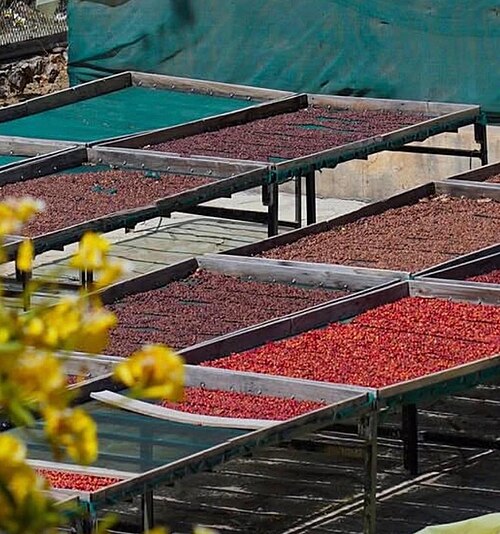
Photo by Luai Al-Mamari, CC BY-SA. Source.

- Pick ripe. Cherries are harvested, usually selectively, for fully red fruit. Unripe cherry has no sugar to give the seed.
- Sort and float. The fruit is tipped into water; underripes, overripes and insect-damaged cherries float off.5
- Spread it out. Whole cherries go onto patios or raised beds. Counter Culture notes that raised beds are preferred “because they increase the airflow around the whole fruit to enable more even drying”.6
- Turn it, constantly. The fruit is raked and turned through the day so it dries evenly and does not rot or bruise. Barista Magazine gives the reason: turning “reduce[s] fermentation speed” and prevents mould and rot.7
- Store it. Dried cherries are held in silos until they go to the dry mill.8
- Hull it. The whole husk — skin, pulp, sticky mucilage and parchment together — comes off in one pass, and the green coffee is sorted and bagged. See Dry milling for what that shed full of machines actually does.
What it dries on has changed. Historically the cherries simply went on the ground; Barista Magazine notes they “may [now] be loaded onto raised beds, bricks, tables, or cement squares”. ISIC, the coffee industry’s scientific information body, describes the same two mainstream setups — “large concrete or brick patios, or … matting raised to waist height on trestles” — and adds the industrial shortcut: on larger operations “machine drying is used to speed up the process after the coffee has been pre-dried in the sun for a few days”. So “sun-dried” is the honest description of a smallholder’s patio and only half the story on a big estate.
Drying takes weeks, not days. Counter Culture gives three to six weeks; Barista Magazine says cherries are spread in thin layers and left “for two to six weeks”; Coffeester gives two to six, with two to three typical and four to six in cooler, higher, more humid places; Sprudge says “two weeks or longer”. ISIC is the outlier on the short side at “up to 4 weeks”. Four sources land in the same window, so the honest answer is roughly two to six weeks, depending on climate and altitude.
The contrast with washed coffee is stark, and it is the practical heart of the method. ISIC’s timings for the wet method: the mucilage is broken down and washed off in 24 to 36 hours, then sun-drying of the bare parchment takes 8 to 10 days. A washed coffee is finished in under a fortnight because only a bare seed has to lose water. A natural is a whole piece of wet fruit lying in the open for up to a month.
Both methods aim at the same finish line. ISIC gives a maximum moisture content of 12.5% before storage, for washed and natural alike. Everything above is just different routes to a seed dry enough to keep.
To verify
The tighter numbers. Coffeester alone gives turning four to six times a day, concentrated “during the hottest midday hours,” and a target final moisture of approximately 11–12% by weight; Carrabassett Coffee cites a similar 11–12% target.9 These sit inside ISIC’s confirmed 12.5% ceiling rather than contradicting it, but no standards body publishes them as a specification. The SCA’s green coffee standard (SCA-110 Green Coffee: Grading, Specifications, and Test Methods) is listed as still “under review and development” on the association’s own standards page,10 so there is no published SCA moisture figure to check them against.
Why it tastes the way it does
The seed spends weeks sitting inside its own sugar. Fruit sugars and fermentation compounds work their way in, and the cup arrives loud.
Counter Culture describes naturals as fruitier and fuller in body than washed coffees, with “a ton of sweetness, body, and berry-like flavors”; washed coffees, by contrast, carry “flavors more inherent to the seed itself” — “higher acidity, with brighter fruit flavors, lighter body, and classic nutty flavors”. Sprudge calls naturals “earthy and intense in flavor, often with notes of deep fruit and complex sweetness”. Coffeester lists blueberry, strawberry, cherry, dried fig, chocolate and wine, over a heavy body and low-to-moderate acidity.
The same article that praises them records the complaint: some drinkers find naturals “too intense, funky, and ferment-y”. This is not a minor quibble — for decades naturals were treated in the trade as the cheap, defective option, and a producer choosing natural today is deliberately courting the flavour that once got their coffee marked down.
The three-way split
| Method | What happens to the fruit | Typical result |
|---|---|---|
| Washed | Skin and sticky mucilage removed before drying | Clean, bright, higher acidity, lighter body |
| Honey | Skin off, mucilage left on during drying | Sweeter, fuller body, moderate fruit |
| Natural | Whole cherry dried with fruit intact | Heaviest fruit, jammy, lowest acidity, most divisive |
Read the table as a dial rather than three boxes: the more fruit you leave touching the seed while it dries, the more fruit and body you get and the less clarity. Natural sits at the far end. Honey process is the deliberate middle, and Brazil’s pulped natural style sits alongside it.
Why it is hard
Sprudge is blunt: natural process is “very difficult to do well because of the challenges posed by fermentation and mold, inconsistency, the potential for defects to be included”.
The reason is physical. A washed coffee dries as a bare seed and is largely out of trouble within days. A natural is a piece of wet fruit lying in the open air for a month, hosting a fermentation nobody can fully steer. Turn it too little and the bottom layer moulds; dry it too fast and the outside case-hardens while the inside stays wet; stop too early and it will not store. That is why naturals were historically the low-grade option in most origins — and why a competition-winning natural is a genuine display of skill rather than just good farming.
Where it came from
Natural is the original method. Barista Magazine calls it “the oldest and perhaps most intuitive method of coffee processing”. Sustainable Harvest states plainly that it is “the oldest and most basic way that coffees have been processed” and that “prior to the advent of de-pulping machines, this was how coffee was processed for hundreds of years”. Sprudge agrees on the logic: it “has simply been around for a long time, from when coffee was first grown—in extremely arid regions—and this was the most logical way to get the fruit off of the beans”. Coffeester names Ethiopia and Yemen as the origin, Ethiopia “widely regarded as the birthplace of Coffea arabica”.
Two sources also agree on where it stayed: Sustainable Harvest says natural processing is now used mainly in water-scarce regions, particularly Ethiopia, and Coffeester adds that Brazil, the world’s largest producer, adopted it at scale. No source consulted here gives a first date, so this note does not claim one — “centuries old” is as specific as the evidence allows.
How much of the world’s coffee this actually is
It is easy to read the auction results below and conclude natural process is a boutique specialty trick. The opposite is true: most of the world’s natural coffee is cheap coffee, and there is a lot of it.
ISIC sets out where the dry method dominates:
| Coffee | How much of it is dry-processed |
|---|---|
| Robusta, everywhere | ”Almost all Robusta’s are processed by this method” |
| Arabica in Brazil | ”the majority” |
| Ethiopia, Haiti, Paraguay | ”most of the coffees produced” |
| India, Ecuador | ”some Arabica’s” |
That list explains the economics. Robusta is the world’s instant-coffee and blend-filler crop, and effectively all of it is dried whole. Brazil is the largest producer on earth and its Arabica is mostly natural — the wiki’s own Cerrado Mineiro note reaches the same conclusion from the other direction, that a hard dry season at harvest makes natural the regional default rather than a stylistic choice.
The reason is capital. A washed coffee needs a wet mill: a pulper, fermentation tanks, channels, and a lot of clean water. A natural needs a flat surface and sunshine, with a hulling machine only at the very end, and ISIC records mechanical dryers as something larger operations add rather than a requirement. Where there is no money for a wet mill, or no water to run one, drying whole cherry is not the interesting option — it is the only one.
So the word “natural” on a bag carries two completely different meanings depending on the price. At the bottom of the market it means nobody built a wet mill. At the top it means someone chose the harder path deliberately. Same process; opposite intent.
To verify
The global share figure. A 2020 UC Davis master’s thesis by Neil Rotta states that natural processing “may represent more than 40% of all coffee produced” worldwide.11 The claim is single-sourced, the thesis itself hedges it with “may,” and the PDF was too large to retrieve for direct confirmation. Treat 40% as one researcher’s estimate, not a measured figure. No source consulted breaks natural’s share down year by year or country by country.
To verify
Natural as the commodity default. Sweet Maria’s coffee library is reported to describe dry processing as requiring minimal investment and therefore being the usual way to make cheap commodity-grade coffee in arid regions.12 The page refused automated access (HTTP 403), so this specific wording is unconfirmed. The underlying economics above are supported by ISIC; the commodity-grade framing is not independently verified.
Why it matters
Natural process is not a rustic survival. It owns the top of the auction market.
- Panama. Hacienda La Esmeralda’s natural Geisha set the Best of Panama record at roughly $601/lb in 2017 — the first natural-process record. Elida Estate then took the natural category to $1,029/lb in 2019 (the first coffee ever over $1,000/lb, bought by a Saza Coffee-led consortium) and to $10,013/kg in 2024 with the “Torre” lot. In 2025 Esmeralda’s natural Geisha went to JD.com of China at about $10,709/lb. See Best of Panama results archive for the full run.
- Ethiopia. Basha Bekele’s natural lot from Bensa, Sidama won the 2024 Ethiopia Cup of Excellence and sold at $445/lb — the highest price paid at any COE auction anywhere. The Alliance for Coffee Excellence’s own Ethiopia 2024 page records that the winning coffees were “naturally processed”.13 See Cup of Excellence records by country.
- On the farm. Best of Panama runs Geisha Natural as one of its three standing categories, alongside Geisha Washed and Varietals — the method is baked into the competition’s structure. Farms such as Finca Sophia and El Velo run natural lots beside washed ones from the same trees, which is the clearest demonstration there is that processing, not just the plant, decides the cup.
For a reader, the useful shortcut: “natural” on a bag is a promise of fruit and body, not of clean brightness — and the fact that a farm risked it at all usually means they thought that batch of cherry was good enough to survive a month in the sun.
Related
- The other processes: Washed process · Honey process · Pulped natural · Anaerobic fermentation
- What happens after drying: Dry milling — hulling, sorting and grading, the ending every method shares
- Where the volume is: Robusta · Cerrado Mineiro · Sidama · Daterra
- Where the money is: Best of Panama · Best of Panama results archive · Cup of Excellence · Cup of Excellence records by country · Echoes of the Peak · Geisha
- Farms and people: Hacienda La Esmeralda · Elida Estate · Finca Sophia · El Velo · Basha Bekele · Daye Bensa · JD.com · Saza Coffee
- Judging it: Cupping · Coffee scoring · Q Grader
Official links
- Official site — Specialty Coffee Association (coffee standards, incl. the in-development green coffee standard)
- Official site — ISIC, the institute for scientific information on coffee (initial processing)
Footnotes
-
Sustainable Harvest — Understanding Coffee Processing: The Traditional Methods ↩
-
Fratello Coffee — What Are the Main Coffee Processing Methods? — cited in the research report, not independently fetched ↩
-
Roastopedia — Natural Process (Dry Process) — cited in the research report, not independently fetched ↩
-
Barista Magazine — Understanding the Process, Part One: Natural/Dry (Tanya Nanetti, 19 August 2022) — drying duration, drying surfaces and “oldest method” confirmed via WebFetch ↩
-
ISIC (institute for scientific information on coffee) — Initial coffee bean processing — industry scientific body; countries, species, moisture ceiling, silos, machine drying and the washed-method timings all confirmed via WebFetch ↩
-
Carrabassett Coffee Company — Natural (Dry-Process) — cited in the research report, not independently fetched ↩
-
Neil Rotta — master’s thesis, University of California, Davis (2020) — source of the “>40% of all coffee produced” estimate; PDF exceeded the fetch size limit, so quoted at second hand ↩
-
Sweet Maria’s Coffee Library — What is Dry Processed Coffee? — cited in the research report; returned HTTP 403 to automated access, not independently confirmed ↩