Maragogipe
Maragogipe — also spelled Maragogype — is the coffee plant that grew everything too big. It is a natural mutation of Typica, and one gene in it enlarges the whole plant: the leaves, the gaps between them, the cherries, and above all the seeds. The beans are so obviously outsized that the trade simply calls them “elephant beans.”
It was found in 1870, in a field of Typica near the town of Maragogipe in Bahia, north-east Brazil, and named after the place.12
Nobody grows it for a living. It yields badly, it catches every major coffee disease, and it wants to be planted high up where the diseases are worst. What kept it in the catalogue is what it passed on: crossed with Pacas it became Pacamara, and crossed with Caturra it became Maracaturra — two of the most decorated competition varieties in Central America.1
What World Coffee Research records
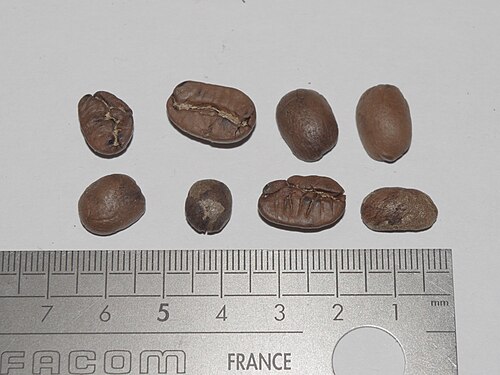
Photo by Raminagrobis, CC BY-SA. Source.

Every figure in this table is from the World Coffee Research variety catalogue entry, read directly.1
| Trait | Maragogipe |
|---|---|
| Species | Coffea arabica |
| Genetic group | Bourbon–Typica group (Typica related) |
| Origin | Natural mutation of Typica, near Maragogipe, Brazil, 1870 |
| Breeder | None — it was found, not bred |
| Stature | Tall |
| Leaf tip colour | Bronze |
| Bean size | Very large |
| Yield potential | Low |
| Optimal altitude | High — above about 1,300 m, depending on latitude |
| Nutrition requirement | Low |
| First production | Year 4 after planting |
| Quality potential | Very good at high altitude |
| Coffee leaf rust | Low resistance / susceptible |
| Coffee berry disease | Susceptible |
| Nematodes | Susceptible |
Read that table top to bottom and the variety’s whole problem is on it. The one thing it does exceptionally is grow large. The yield is low, the tree is tall — which means more ladder work at harvest and more pruning — it takes a year longer than most to start producing, and it has no meaningful defence against the three things most likely to kill a coffee plant. The cup is rated “very good,” which is a rung below the “exceptional” that Geisha and its own child Pacamara hold.
The catalogue’s own verdict is blunt: because Maragogipe is so unproductive, Pacamara is the better plant to grow if you want the bean size.1
To verify
Two small conflicts with what this wiki already says.
This wiki’s Typica note quotes World Coffee Research calling Maragogipe “very low yielding.” The catalogue’s structured yield field, read directly, says “Low” rather than “very low.”1 The difference is trivial in practice — both mean a farmer loses money on volume — but don’t quote “very low” as the catalogue’s wording.
The formal botanical name is not on the catalogue page. The name Coffea arabica L. var. maragogipe A. Fern. ex A. Frohner circulates on Wikipedia and in trade writing,3 but World Coffee Research does not publish a scientific name for the variety, and no botanical description was located to confirm the authorship string. Treat it as unconfirmed.
The bean
The bean is the entire reason anyone remembers this plant. Roasters and sellers routinely describe Maragogipe beans as about twice the size of an ordinary arabica bean, with plum-sized cherries to match.42
That size is a mixed blessing on the roaster’s side. As this wiki’s Maracaturra note records for the other elephant-bean coffee, a very large bean heats unevenly — the outside browns before the middle is done — so a curve built for normal beans will scorch the surface and leave the centre grassy. Perfect Daily Grind’s account puts it more diplomatically: the size “ultimately has an impact on how you process and roast it.”2
To verify
The precise measurements come from sellers, not from a grading authority. One roaster gives typical bean dimensions of 11.69 mm × 7.25 mm;4 a Nicaraguan producer advertises “giant seeds larger than size 20” — screen size 20 being roughly 8 mm, the top of the normal arabica grading range — and estimates a harvest of about 3 tonnes of ripe cherry per hectare from the fourth year.5 Every one of those numbers is single-sourced marketing copy for a coffee being sold. The hectare figure in particular is one farm’s, not the variety’s.
Why almost nobody plants it
Maragogipe’s decline is the plainest economics in the variety catalogue. It produces less coffee per tree than its neighbours, takes longer to start, and dies more easily. Brazil replaced it after the 1950s and 1960s with higher-yielding Bourbon and Mundo Novo plantings, and Brazilian production today is limited to a handful of farms.2
There is a second, less flattering reason. Coffee Review — a long-running independent review publication — states that Maragogipe “produces a thinner and less acidy cup than other traditional arabica varieties grown under the same conditions,” and that this weakness in the cup, combined with the low productivity, is what discouraged replanting and made it “a rather rare, difficult-to-find coffee.”6
That sits awkwardly beside World Coffee Research’s “very good at high altitude,” and the honest reading is that both are true of different lots. Coffee Review itself says the flavour depends heavily on where it is grown, and singles out Chiapas in Mexico and the Cobán district of Guatemala as having the best reputation for it.6 A variety this sensitive to site will cup thin on ordinary land and well on good land — which is exactly what the competition results below show.
It does actually win things
The research brief behind this note concluded that no competition or auction records for Maragogipe could be found. That is wrong, and the primary records say so. The Alliance for Coffee Excellence publishes variety alongside score and price in its Cup of Excellence tables, and Maragogipe appears in them repeatedly — almost all of it Nicaraguan.
Nicaragua 2025 — six Maragogype lots placed, more than any other year found:7
| Category | Rank | Farm | Producer | Region | Score | Price | Buyer | |
|---|---|---|---|---|---|---|---|---|
| 1 | Washed | 3 | El Porvenir | Martha Margarita Marin Rodriguez | Nueva Segovia | 90.45 | $27.10/lb | Brew92 Cafe & Roastery |
| 2 | Washed | 6 | Los Granadillos | Francisco Ponce | Nueva Segovia | 87.73 | $12.10/lb | honu 加藤珈琲店 |
| 3 | Washed | 12 | El Poste | Guillermo Montenegro Ayestas | Nueva Segovia | 87.27 | $12.60/lb | Wataru & Co. |
| 4 | Natural & Honey | 7 | De La Finca Coffee Farm | Heberto Arturo Rivas | Madriz | 88.18 | $15.30/lb | Saerin Co. |
| 5 | Natural & Honey | 9 | San Jose Nº 1 | Gloria Lydia Molina Sanchez | Matagalpa | 88.00 | $12.00/lb | 1895 by Lavazza |
| 6 | Natural & Honey | 14 | El Porvenir | Claudia Maria Rivera Siles | Jinotega | 87.09 | $12.20/lb | Brew92 Cafe & Roastery |
Nicaragua 2024 — two lots, both washed:8
| Rank | Farm | Producer | Region | Score | Price | Buyer | |
|---|---|---|---|---|---|---|---|
| 1 | 16 | De La Coffee Farm | De La Finca Coffee / Casa Rivas Gurdian | Madriz | 87.85 | $8.50/lb | Savaya Coffee |
| 2 | 18 | El Porvenir | Martha Margarita Marin Rodriguez | Nueva Segovia | 87.75 | $9.10/lb | Wataru & Co. |
Nicaragua 2026 — four lots, all washed:9
| Rank | Farm | Producer | Region | Score | Price | Buyer | |
|---|---|---|---|---|---|---|---|
| 1 | 5 | El Poste | Guillermo Montenegro Ayestas | Dipilto | 87.89 | $13.30/lb | Ecofarm Coffee (China) |
| 2 | 8 | La Laguna | José Edilberto Ubeda Zeledón | Jinotega | 87.39 | $11.40/lb | Wataru & Co., for Ogawa Coffee |
| 3 | 9 | Santa María 2 | Favio Odorico Monzón Monzón | San Rafael del Norte | 87.17 | $14.10/lb | Fadie Sasaguri Roastery |
| 4 | 10 | El Renacer | Warner De Jesús Ubeda Zeledón | San Rafael del Norte | 87.00 | $12.10/lb | Wataru & Co. |
Guatemala 2025 — one lot, in the Exotic Washed category: Plan de la Vega, Erwin Humberto Argueta Herrera, Unión Cantinil, 87.66, sold at $21.10/lb to Angelino’s Coffee.10
Three things fall out of those tables.
The ceiling is real but rare. One Maragogipe has crossed 90 in these records — Marin Rodriguez’s 90.45 washed lot, third in the whole washed category of Nicaragua 2025, at $27.10 a pound.7 Everything else clusters between 87 and 88.2, which is a good specialty coffee and not a great one. That is a fair picture of a variety that cups well on the right land and ordinarily elsewhere.
It is a Nueva Segovia and Jinotega coffee. Almost every placing sits in Nicaragua’s northern highlands, and the buyers are overwhelmingly Japanese, Korean and Chinese importers and roasters. Maragogipe’s market is East Asian far more than it is North American.
It does not win outright. The top lot of Nicaragua 2025 was a honey-processed coffee at 91.77, and Nicaragua 2026’s was a washed Geisha at 91.44 from Finca El Cambalache.79 Maragogipe places; Geisha and Pacamara win. See Premiumisation for the mechanism — the score sets the floor on price, the variety’s reputation sets the ceiling, and “elephant bean” is a novelty reputation rather than a prestige one.
What it gave the world
This is Maragogipe’s real legacy, and it is documented by the catalogue rather than by trade lore.1
| Child variety | Cross | Where |
|---|---|---|
| Pacamara | Pacas × Maragogipe | Bred at the Instituto Salvadoreño de Investigaciones del Café, El Salvador |
| Maracaturra | Maragogipe × Caturra | A chance cross in Nicaragua; selection begun by INTA, never finished |
Both crosses were after the same thing: keep the giant bean, lose the giant plant’s problems. Pacamara borrowed the short frame of the dwarf Pacas; Maracaturra borrowed the short frame of Caturra. Neither fully escaped the fragility — both are badly rust-susceptible and both refuse to breed true — but both cup better and farm better than the parent, and both have won national Cup of Excellence competitions outright, which Maragogipe never has.
That is why World Coffee Research points growers at Pacamara instead.1 Maragogipe is best understood as a founder rather than a crop: the source of a trait that other varieties carry more successfully.
Where it grows
From Bahia it travelled to Colombia and then north through Central America, and today it turns up in small blocks rather than plantations.26 This wiki already records it planted in:
- Nicaragua — by far the strongest presence, and where the competition record sits
- Colombia, including Huila, among the traditional plantings
- El Salvador — at Mauricio Salaverria’s Finca Himalaya, alongside Pacamara
- Guatemala — Finca El Injerto sells it as “Giant Maragogype”
- Panama — the Hartmann family’s Santa Clara grows it among their varieties
Coffee Review adds that most Maragogipe sold in North America comes from Mexico, Nicaragua or Guatemala,6 and Perfect Daily Grind names specialty roasters in Australia, France and the United States as buyers, along with plantings in Hawaii.211
To verify
The flavour descriptions are seller copy and they contradict each other. Nicaraguan and specialty sellers describe Maragogipe as floral and smooth with spicy notes, melted chocolate and orange marmalade, and as mild and sweet with low acidity;52 Coffee Review describes the same variety as thinner and less acidy than comparable arabicas.6 Wikipedia adds that flavour varies strongly with soil, and that poor soils give it the reputation of having “not much flavour.”3
One claim should be treated with particular care: a Nicaraguan seller’s description of “minimal caffeine.”5 No research source consulted supports a low-caffeine claim for Maragogipe, and big beans are not the same as low-caffeine beans. Do not repeat it as fact.
The only defensible numbers on this page are the Cup of Excellence scores above and World Coffee Research’s “very good at high altitude” rating. None of the sources consulted publishes cupping data for the variety as such.
Related
- Typica — the parent variety it is a single-gene mutation of
- Pacamara — Pacas × Maragogipe, the deliberate Salvadoran cross the catalogue recommends over it
- Maracaturra — Maragogipe × Caturra, the Nicaraguan chance cross that was never finished
- Pacas · Caturra — the two dwarf mutations Maragogipe was crossed with
- Bourbon · Bourbon-Typica group — the genetic family it belongs to
- Mundo Novo — one of the higher-yielding varieties Brazil replaced it with
- Coffee leaf rust · Coffee berry disease — the two diseases it has no defence against
- World Coffee Research — keeper of the catalogue every agronomic figure here comes from
- Cup of Excellence · Alliance for Coffee Excellence — the competition and the body whose published tables verify the results above
- Nicaragua — where nearly all of its competition record lives
- Brazil — where it was found, and where it has almost disappeared
- Colombia · Huila · El Salvador · Guatemala — the other origins that grow it
- Finca El Injerto — the Guatemalan estate that sells it as “Giant Maragogype”
- Mauricio Salaverria · Kelly Hartmann — producers this wiki records growing it
- Premiumisation — why a good score on a novelty variety does not fetch a Geisha price
- Cupping · Coffee scoring — how the scores above are produced
- Washed process · Natural process — the processing categories the auction tables are split by
Official links
- Official site — World Coffee Research variety record: Maragogipe
- Official site — World Coffee Research variety catalogue
- Official results — Alliance for Coffee Excellence, Cup of Excellence results archive
A variety has no website of its own. The World Coffee Research record is the authoritative public entry, and the Alliance for Coffee Excellence archive is the primary record behind every score and price on this page.
Footnotes
-
Perfect Daily Grind — What is Maragogipe & how big is the market for it? ↩ ↩2 ↩3 ↩4 ↩5 ↩6 ↩7
-
Xliii Coffee — Maragogipe Coffee: The “Elephant Bean” Marvel of Nature ↩ ↩2
-
Coffee Review — Coffee Anomalies: Maragogipe (Elephant Beans) ↩ ↩2 ↩3 ↩4 ↩5
-
Alliance for Coffee Excellence — Nicaragua 2025 results and auction ↩ ↩2 ↩3
-
Alliance for Coffee Excellence — Nicaragua 2024 results and auction ↩
-
Alliance for Coffee Excellence — Nicaragua 2026 results and auction ↩ ↩2
-
Alliance for Coffee Excellence — Guatemala 2025 results and auction ↩
-
Big Island Coffee Roasters — The story behind our natural Ka’u Maragogipe ↩