Nicaragua
Nicaragua is a Central American Arabica origin of moderate size and unusually low profile. United Nations agricultural data puts it 15th in the world for coffee production — about 143,300 tonnes in 2023, roughly 2.39 million sixty-kilogram bags — between Laos above it and China below it.1 That is around a third of what neighbouring Honduras grows, and several times what Panama grows.
Two things make it worth its own page. Almost all of that coffee comes from smallholders, not estates. And the country has quietly become the place where a handful of things in this wiki were invented or are grown almost nowhere else — Maracaturra, Starmaya, and a Cup of Excellence auction that is one of the clearest illustrations anywhere of how little a cupping score explains about price.
| Position | 15th largest coffee producer worldwide (2023)1 |
| Volume | ~143,300 t / ~2.39 million 60 kg bags (2023)1 |
| Exports | 3 million quintals, about US$900 million, for 20252 |
| Main departments | Jinotega, Matagalpa, Nueva Segovia34 |
| Harvest | roughly October – March4 |
| Producers | ~44,000 (importer figure) to 50,000+ families (government figure) — see callout42 |
| National body | CONATRADEC (Comisión Nacional para la Transformación y Desarrollo de la Caficultura)2 |
| Competition | Cup of Excellence Nicaragua / Taza de la Excelencia — 22nd edition in 20262 |
| Record auction price | US$88.20/lb — Los Alpes, 20255 |
| C-market differential | par — no origin premium at all (see C-market) |
Where it grows
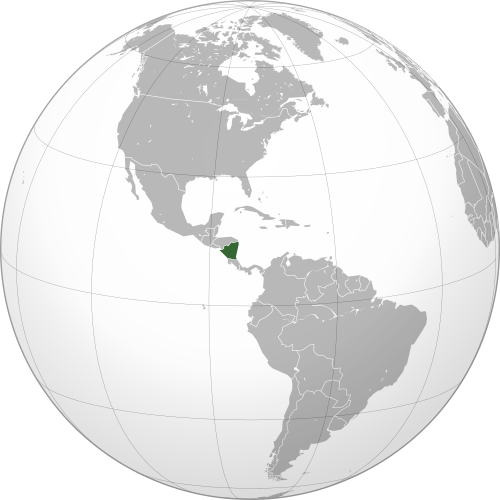
Photo by Addicted04, CC BY-SA. Source.
.svg)
Coffee sits in the northern and north-central highlands, along and behind the Honduran border. Three departments carry the specialty reputation: Jinotega, Matagalpa and Nueva Segovia.34 Older accounts add production around Managua, Diriamba, San Marcos, Jinotepe, Granada and Chontales,3 but those are not the names on specialty bags.
The border matters more than it looks. Nueva Segovia lies directly against El Paraíso in Honduras — the two are one continuous mountain range with a political line drawn through it, a point the Honduras note makes from the other side.
Within Nueva Segovia, two municipalities show up over and over in competition results: Dipilto and Mozonte. Between them they produced both category winners of the 2025 auction and, according to Nicaragua’s official government gazette, all six podium places in 2026.2 The farms behind those results already have notes here — Finca La Esperanza (Dipilto), Finca El Cambalache and Finca Elite — while Matagalpa supplies the counter-example, Ramón Jarquín’s three-hectare Finca Solidaridad.
To verify — altitude, and what "SHG" means here
Nicaraguan coffee is routinely sold as SHG (Strictly High Grown) or HG (High Grown), the Central American convention of grading by elevation rather than bean size.46 The existence of the system is well attested. The numbers behind it are not, and the sources actively disagree:
- One importer origin report defines Nicaraguan SHG as 1,200 m and above.6
- Another reference gives a national growing range of 1,100–1,600 m.7
- The importer Cafe Imports says the opposite in tone, describing “relatively low altitude (800–900 masl)” as a standing challenge for the origin, with Nueva Segovia the higher exception.4
- The encyclopedia entry gives the optimal cultivation altitude as 800 m.3 No national export-authority or CONATRADEC grading document was read here. Do not quote a metre figure for Nicaraguan SHG as if it were regulation. The safe statement: elevation varies widely by department, and Nueva Segovia is the high end.
What is planted
The planted stock is the Central American standard plus one local speciality. Importer and trade profiles consistently list Bourbon, Caturra, Catuaí, Catimor, Maracaturra and Maragogipe.467
Maracaturra is the one that is effectively Nicaraguan. It is a giant-beaned cross of Maragogipe and Caturra — the same idea as El Salvador’s Pacamara, made independently — and almost all of the world’s Maracaturra grows here, in small blocks planted for the cupping table rather than for yield. It has never been entered in the World Coffee Research variety catalogue, and its Nicaraguan competition record is documented on the Maracaturra page.
At the top of the auction table the picture changes. Geisha now wins here, as it does almost everywhere, and the 2026 podium also included Parainema — the rust-resistant Sarchimor bred in Honduras by IHCAFE — and an Ethiopian selection entered simply as “Etiopía 74158”.2
Nicaragua is also where Starmaya came from. The first-generation hybrid bred by CIRAD and ECOM was developed on Nicaraguan ground: the seed garden went in at La Cumplida farm in 2009 at 950 m, and the variety was trialled across seven Nicaraguan environments between 2013 and 2018. Details are on the Starmaya page. Marsellesa, the Sarchimor that is one of Starmaya’s parents, is also a CIRAD–ECOM Nicaraguan line.
Processing
Nicaragua is a washed origin. The fruit is stripped off, the beans fermented to loosen the sticky mucilage layer, rinsed and dried. Every trade profile read here describes washed coffee as the default, with other methods as exceptions — Cafe Imports puts it as “washed, some select other processes on occasion”.478
The competition is where the exceptions live. Cup of Excellence Nicaragua judges in two categories — washed, and natural & honey — and crowns a winner in each, so naturals and honeys get half the podium by construction.5 In 2026 the natural category drew 18 of the 29 lots sent to auction, against 11 washed.2 Erwin Mierisch of Fincas Mierisch, one of the country’s better-known producing families, is quoted on this wiki’s Anaerobic fermentation page describing Nicaraguan fermentation gear that runs from blue plastic barrels to temperature-controlled stainless tanks.
The Cup of Excellence auction
This is the part of Nicaraguan coffee with a real paper trail, and the sibling note Cup of Excellence records by country carries the full ledger. A Cup of Excellence is a blind national cupping competition ending in an online auction: judges score every entered lot, the top lots are published with the farmer’s name, and roasters worldwide bid.
2025 was judged 5–9 May and auctioned 19 June. Thirty winning lots sold 20,106.15 lb for $367,380.19 — a weighted average of about $18.27 a pound. The top price was $88.20/lb for a washed Geisha from Los Alpes (Inversiones Valladares Acevedo S.A., Dipilto); the bottom was $9.00/lb for a washed Maracaturra from Bella Aurora.5
Three results from that single auction, taken together, are the best short argument in this wiki against reading price off score:
| Lot | Score | Price | |
|---|---|---|---|
| 1 | Elite, honey Geisha (Olman Uriel Sauceda Chávez) — highest score of the whole competition | 91.77 | $54.80 and $56.10/lb |
| 2 | La Esperanza, washed Geisha (Abner Samuel Zavala) — winner, washed category | 90.73 | $64.40 and $66.00/lb |
| 3 | Solidaridad, washed Maracaturra (Ramón Jarquín) — second, washed category | 90.50 | $14.00/lb |
| 4 | Los Alpes, washed Geisha — highest price of the auction | not the top score | $88.20/lb |
The best-scoring coffee came fourth and fifth on price. A gap of 0.23 points separated La Esperanza from Solidaridad, and $52 a pound separated their cheques. Jarquín had been selling to intermediaries at around $1.50/lb, so even the $14 lot paid him roughly ten times his usual price — which is the other half of what this auction does. See Premiumisation and Green coffee auctions.
The same auction is also where the F1 hybrid varieties got their first proven competition result anywhere: Las Promesas de San Blas (Gonzalo Adán Castillo Moreno, Nueva Segovia) placed second nationally in both 2017 and 2018, scoring 90.50 and then 90.42 with a lot ACE’s 2018 table publishes simply as “Hybrid,” honey-processed — and both years it sold for about $15 a pound while the winner above it took double that. That record is set out in full on F1 hybrid.
2026 was the twenty-second edition. More than 190 samples were entered; 29 went to the international auction on 29 June 2026. Nueva Segovia took all six podium places. The washed category was won by Abner Samuel Zavala’s El Cambalache with a Maracaturra; the natural category by Los Alpes with a Geisha scoring 92.00 — the same Dipilto farm that set the 2025 price record.2 The Alliance for Coffee Excellence’s 2026 results table publishes rank, score, farm, farmer, variety, process, region and weight, but no prices and no buyers, so no 2026 Nicaraguan price is quotable yet; that reconciliation is recorded on Cup of Excellence records by country.
Nicaragua’s $88.20/lb sits well down the international COE table — below Honduras’s $136.50 and Guatemala’s $143.10, above Peru’s $80.20.
To verify — "Coffee Libre S.A." in the 2026 results
Second place in the 2026 washed category went to Coffee Libre S.A., for the farm La Furiosa in Mozonte.2 Coffee Libre is also the name of the well-known South Korean roaster that bought the 2023 Honduras COE winner. Whether the Nicaraguan company is that roaster’s producing arm, or an unrelated business sharing a name, was not established here. Do not merge them.
Who grows it
Nicaragua is a smallholder country, and every source agrees on that even where the numbers do not. Trade profiles put the average farm at 1–14 hectares and state that the overwhelming majority of the crop comes from small family holdings.49
Above the farmers sits CONATRADEC — the Comisión Nacional para la Transformación y Desarrollo de la Caficultura, the national commission for the transformation and development of coffee growing, named in the official gazette as the body that runs the national competition alongside the Alliance for Coffee Excellence.2 It is Nicaragua’s counterpart to IHCAFE in Honduras, ANACAFÉ in Guatemala and ICAFE in Costa Rica, and it does not yet have a note here.
To verify — how many producers, and how much land
The figures do not line up, and they come from different years and methods:
- ~44,000 producers and an average farm of 1–14 hectares, from an importer profile whose export figure is dated 2016/2017.4
- “More than 50,000 farming families”, “more than 500,000 direct and indirect jobs”, and a cultivated area given as 235,000 acres, from the official gazette’s 2026 report.2 Nicaraguan land is normally measured in manzanas (about 0.7 ha), so the unit behind that area figure is uncertain in translation and the hectare equivalent should not be computed from it.
- “95% of beans come from small, family-owned farms”, from a consumer coffee site — plausible and consistent with the rest, but not independently sourced.9 None of these came from a CONATRADEC census document.
On export volume the sources actually converge, which is worth saying because it is rare. An importer gives 2.3 million bags for 2016/2017;4 UN agricultural data implies about 2.39 million bags for 2023;1 and the government reports 3 million quintals exported in 2025 for about $900 million.2 Taking the Nicaraguan export quintal as 100 lb — an assumption stated here rather than sourced — that last figure works out at roughly 2.3 million bags. Three independent routes, one answer: Nicaragua ships a little over two million bags a year.
How coffee got there
Large-scale cultivation began in the 1850s, and by 1870 coffee was the country’s principal export crop — a position it held for the next century.3 A separate trade account attributes the mid-nineteenth-century start specifically to German immigrants, which is consistent on timing.8 The nineteenth-century state actively subsidised it, paying growers five cents per tree for plantations above 5,000 trees.3 By 1891 the country had over 31,000 hectares in coffee.3
To verify — a completely different origin story
One green-coffee platform states that coffee reached Nicaragua in the 18th century via Christian missionaries and that production did not begin in earnest until the 1950s.10 That contradicts the 1850s/1870 account above on both ends — a century early on arrival, a century late on scale. The encyclopedia version has the better sourcing and the specific corroborating detail (hectares, export duties, the per-tree subsidy), but the conflict is genuine and unresolved here.
To verify — the twentieth-century collapse and recovery
A single trade blog describes the sector being damaged by the political and social upheaval beginning in 1979 and reviving during mid-1990s economic liberalisation.8 This is the standard narrative and it is chronologically plausible, but it rests on one source with no primary documentation, and no production series covering 1979–1995 was read here. The one hard number nearby is the encyclopedia’s 42,000 tonnes in 19893 — under a third of the 2023 figure, which is at least consistent with a depressed sector.
Where Nicaragua sits in the wider wiki
The C-market note is blunt about the commodity market’s verdict: Nicaragua trades at par with the New York C price — no origin differential at all — in the same tier as Mexico, El Salvador, Honduras, Panama and Peru, and a full 500 points below Guatemala. That is the price of Nicaraguan coffee as a category, sitting alongside auction lots that clear $88 a pound. Both numbers are true; they describe different coffees, and the gap between them is what the Cup of Excellence exists to close for a handful of farms a year.
Three entries elsewhere make Nicaragua more important than its 15th-place ranking suggests: Maracaturra is essentially a Nicaraguan variety, Starmaya was bred and trialled here, and Finca La Esperanza (Dipilto) traces one family’s coffee from $3.55 a pound in 2006 to $66.00 in 2025 on the same hillside.
Related
- Cup of Excellence · Cup of Excellence records by country · Alliance for Coffee Excellence — the competition, and where Nicaragua’s $88.20/lb ranks
- Finca La Esperanza (Dipilto) · Finca El Cambalache · Finca Elite · Finca Solidaridad · Finca El Porvenir (San Fernando) — the Nicaraguan farms with notes here
- Abner Samuel Zavala · Ramón Jarquín · Olman Uriel Sauceda Chávez — the producers behind those results
- Maracaturra · Maragogipe · Caturra · Bourbon · Catuaí · Catimor · Geisha · Parainema — what is planted, and what wins
- Starmaya · Marsellesa · CIRAD · ECOM — the hybrid breeding programme run on Nicaraguan ground
- Washed process · Natural process · Honey process · Anaerobic fermentation — the processing mix and its two competition categories
- Honduras · Guatemala · El Salvador · Panama — the neighbours, and the same mountain range across the border
- IHCAFE · ANACAFÉ · ICAFE — the national coffee bodies CONATRADEC sits alongside
- C-market — where Nicaragua’s zero origin differential is recorded
- Premiumisation · Green coffee auctions · Green coffee buying — why 0.23 points was worth $52 a pound
- Climate change and coffee · Coffee leaf rust — the pressures on a smallholder origin at moderate altitude
Official links
- (no official website found for CONATRADEC — the domain
conatradec.gob.nidid not resolve when checked here; nothing on this page rests on CONATRADEC’s own text) - Official gazette — La Gaceta, Taza de la Excelencia Nicaragua 2026 (XXII edition)
- Official results — Alliance for Coffee Excellence, Nicaragua 2025
- Official results — Alliance for Coffee Excellence, Nicaragua 2026
Footnotes
-
List of countries by coffee production (FAOSTAT data for 2023) — Wikipedia — confirmed via WebFetch ↩ ↩2 ↩3 ↩4
-
La Gaceta (Nicaragua, official gazette) — Cafés de Nueva Segovia destacan en la XXII edición de la Taza de la Excelencia Nicaragua 2026 — confirmed via WebFetch ↩ ↩2 ↩3 ↩4 ↩5 ↩6 ↩7 ↩8 ↩9 ↩10 ↩11 ↩12
-
Coffee production in Nicaragua — Wikipedia — confirmed via WebFetch ↩ ↩2 ↩3 ↩4 ↩5 ↩6 ↩7 ↩8
-
Nicaragua — Cafe Imports — confirmed via WebFetch ↩ ↩2 ↩3 ↩4 ↩5 ↩6 ↩7 ↩8 ↩9 ↩10 ↩11
-
Alliance for Coffee Excellence — Nicaragua 2025 results and auction — confirmed via WebFetch ↩ ↩2 ↩3
-
Nicaraguan Coffee Origin Report 2023 — Genuine Origin ↩ ↩2 ↩3
-
The Struggles and Triumphs of Coffee in Nicaragua — CoffeeGeek ↩ ↩2 ↩3
-
Nicaragua Coffee: Everything You Need to Know — Coffeeness ↩ ↩2