Guatemala
Guatemala is one of Central America’s benchmark Arabica origins — the mountainous country between Mexico and the rest of the isthmus whose coffee is grown high, picked ripe, and almost always washed (the fruit stripped off and the beans fermented and rinsed clean before drying, the method that gives the cup its clarity).
Two of its region names do most of the work on a specialty menu:
- Antigua — the classic, historically famous coffee grown in a valley ringed by volcanoes near the old colonial capital. Full-bodied, chocolatey, with a gentle acidity and sometimes a faint smokiness.
- Huehuetenango (pronounced way-way-teh-NANG-go) — the highest and most remote of the well-known regions, up against the Mexican border in the northwest. Brighter, more complex, often described as wine-like or fruity.
The country’s coffee sits under a single national body, ANACAFÉ (the Asociación Nacional del Café, “National Coffee Association”), created by decree on 4 November 1960 and the Guatemalan counterpart of Costa Rica’s ICAFE or the Ethiopian Coffee and Tea Authority.123 Anacafé is also one of the six Central American institutes in the regional breeding consortium documented on the CATIE and ICAFE notes, and the breeder of the local Catimor-type variety Anacafe 14.
How coffee got there
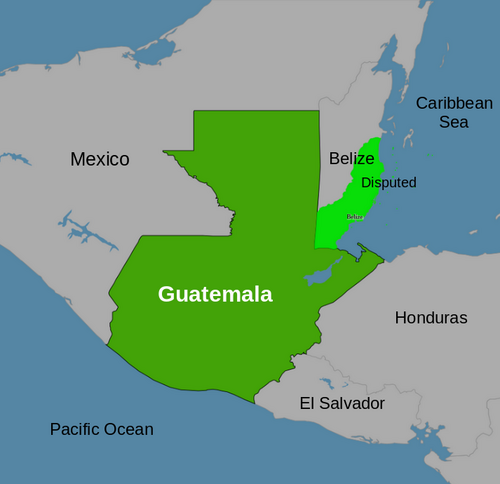
Photo by Thinker78, based on map by Sanjay Rao, CC BY. Source.

Coffee production began to develop in Guatemala in the 1850s and 1860s.1 Within a generation it dominated the economy: by 1880 coffee accounted for about 92% of the country’s export value.1 That export-crop history is why Guatemala today is a large, well-organised origin rather than a boutique one — coffee is national infrastructure, not a niche.
To verify — an earlier, unconfirmed arrival date
One secondary guide says coffee actually reached Guatemala earlier, in the mid-18th century, brought by Jesuit missionaries from Oaxaca, Mexico.4 No primary source in the material behind this note supports that, and it sits against the well-documented 1850s–1860s development of the industry above. Treat the mid-1700s arrival as trade lore until an official or archival source confirms it. (The two can both be true — a few plants in the 1700s, a real industry a century later — but the early date is not established here.)
The eight regions
Anacafé maps Guatemala’s coffee into eight officially recognised growing regions, each marketed as a named origin with its own flavour signature.12 They are:
| Region | Where | Reputation |
|---|---|---|
| Antigua Coffee | Volcanic basin around Antigua Guatemala | Full body, chocolate, spice, mild acidity |
| Highland Huehue (Huehuetenango) | Northwestern highlands, Mexican border | Bright, complex, wine-like / fruity |
| Acatenango Valley | Slopes of Acatenango volcano | Balanced, fine acidity |
| Traditional Atitlán | Around Lake Atitlán | Full body, bright, citric acidity |
| Rainforest Cobán | Northern Alta Verapaz, wet and cloudy | Fruity, complex |
| Fraijanes Plateau | Highlands near Guatemala City | Persistent acidity, full body |
| New Oriente (Nuevo Oriente) | Eastern mountains near Honduras | Balanced, chocolatey |
| Volcanic San Marcos | Southwestern volcanic slopes | Floral, delicate acidity |
The regional flavour descriptions above come from secondary origin guides rather than Anacafé’s own laboratory data, so read them as marketing shorthand for a tendency, not a guarantee — a specific lot from any region can cup very differently. The existence and names of the eight regions are the confirmed part.12
Antigua
Antigua is the coffee most people mean when they say “Guatemalan coffee.” It grows in a basin around Antigua Guatemala, the country’s colonial-era capital, hemmed in by three volcanoes — Agua, Fuego, and Acatenango — whose slopes and ash soils are the region’s selling point.45
To verify — Antigua's altitude and "Genuine Antigua" protection
Two frequently repeated Antigua facts could not be confirmed against a primary source here:
- Altitude of about 1,500–1,700 m. Several secondary guides give this band, and it is plausible for the basin, but no Anacafé or official figure was read at first hand.46
- “Genuine Antigua” as a legally protected denomination of origin, established in 2000. One country profile states this;7 Antigua is widely treated as a protected origin rather than a bare trade name, run by a local producers’ association, but the exact legal mechanism and its 2000 filing date were not verified from an official document. Do not state the protection more strongly than “widely described as a denomination of origin” without a direct citation from Anacafé or the producers’ association.
Huehuetenango
Huehuetenango is the outlier of the eight — the highest and most remote of Guatemala’s better-known regions, tucked into the northwestern highlands near the Mexican border.4 Its coffees are the ones reached for when a buyer wants brightness and acidity rather than Antigua’s rounder, chocolatey body: descriptions run to wine-like, fruity, floral, stone-fruit.48 Its best-known estate is Finca El Injerto in La Libertad, which has won the national Cup of Excellence outright. The region also lends its name to the smallholder association Guaya’b, noted on the Guayabita page — which despite the similar spelling has no connection to the Panamanian Guayabita variety.
To verify — Huehuetenango's altitude
One Spanish-language guide places Huehuetenango at 1,500–2,000 m.8 No primary source in the material behind this note confirms the exact range, so use it cautiously; the directional claim — that Huehue is Guatemala’s highest well-known region — is the well-supported part.
What is planted, and how it’s processed
Guatemala grows the Central American workhorses: the heirloom Bourbon and Typica, their compact descendants Caturra and Catuaí, and — where farmers needed resistance to Coffee leaf rust — Catimor-family selections including Anacafé’s own Anacafe 14, a cross of a rust-resistant Catimor with the big-bean Pacamara. Bourbon is still cultivated here, one of only a handful of countries where the original survives at scale.
Processing is overwhelmingly washed: ripe cherries are selectively picked, depulped soon after harvest, fermented to loosen the sticky mucilage, rinsed, and then dried on patios or mechanically. That is the country-wide default described across origin guides rather than a lot-specific record, but it matches Guatemala’s clean, structured reputation.45
To verify — the national production footprint
Several headline figures for Guatemala’s scale are single- or secondary-sourced and were not confirmed against Anacafé, the ICO, or agricultural-ministry data here:
- Coffee grown in 20 of Guatemala’s 22 departments, about 270,000 hectares under coffee, and 98% shade-grown.5
- Annual production around 3,620,000 sixty-kilogram bags.7 These are the right order of magnitude for a major Central American origin, but quote them as “reported” figures, not established ones, until an official source is checked.
Where Guatemala sits in the wider wiki
Guatemala runs a national Cup of Excellence competition, and has done since 2001 — one of the programme’s founding countries. Its 2025 auction was topped by a washed Geisha from La Gran Manzana at 91.15 points, selling at $143.10/lb to a Taiwanese buying group; the whole auction moved 23,972.6 lb for $656,953.17.9 Back in 2001 the top lot, Las Nubes, went for $11.00/lb.10 Both editions, and the country’s place in the wider price ladder, are on Cup of Excellence records by country. On the commodity side, the C-market note lists Guatemala at a 500-point differential over the New York C price, the second tier of origin premiums below Colombia, Costa Rica and Kenya — a marker of how the trade rates the country’s washed Arabicas as a group. And Guatemala has one World Barista Championship title: Raúl Rodas, who won in 2012 in Vienna.
To verify — competition and price specifics
The 2025 and 2001 figures above come straight from Alliance for Coffee Excellence results pages, but no other Guatemalan edition (2002, 2006–2024) has been checked, so $143.10/lb is not confirmed as the national record — only as the 2025 top price. Any other Guatemalan Cup of Excellence price, farm, or buyer should be sourced directly from an ACE results page before being stated as fact.
Related
- ANACAFÉ — Guatemala’s national coffee body, the source of the eight-region map and the breeder of Anacafe 14
- ICAFE · CATIE · Ethiopian Coffee and Tea Authority — counterpart national coffee institutes; ICAFE and CATIE are Anacafé’s co-breeders in the Central American consortium
- Cup of Excellence · Cup of Excellence records by country · Alliance for Coffee Excellence — the competition Guatemala runs, and the ledger that has no confirmed Guatemalan row yet
- C-market — where Guatemala’s 500-point origin premium is recorded
- World Barista Championship · Raúl Rodas — Guatemala’s one barista world title
- Washed process — the country’s default processing method
- Bourbon · Typica · Caturra · Catuaí · Pacamara · Anacafe 14 · Catimor — the varieties grown here
- Coffee leaf rust — the disease behind the rust-resistant selections
- Finca El Injerto — the Huehuetenango estate with the country’s best-known competition record
- Guayabita — the Panamanian variety not to be confused with Huehuetenango’s Guaya’b association
- Arabica vs Robusta — why Guatemala’s highlands grow Arabica
Official links
Footnotes
-
Anacafé — Asociación Nacional del Café (official site) ↩ ↩2 ↩3
-
Anacafé — “Anacafé, 59 años prestando servicios de calidad para una caficultura sostenible” ↩
-
Guatemalan Coffee: Antigua, Huehuetenango & More — My Coffee Explorer ↩ ↩2 ↩3 ↩4 ↩5 ↩6
-
Café de Guatemala: Antigua, Huehuetenango y Más Regiones — Cafés de Especialidad ↩ ↩2
-
Alliance for Coffee Excellence — Guatemala 2025 results and auction ↩
-
Alliance for Coffee Excellence — Guatemala 2001 results and auction ↩