Catuaí
Catuaí is what happens when a breeder sets out to combine two things farmers already wanted: the heavy cropping of Mundo Novo and the short, dense-plantable frame of Caturra. Unlike most of the famous coffee varieties, it was not stumbled upon in a field — it was deliberately made.
Brazil’s Instituto Agronômico (IAC) in São Paulo State crossed yellow Caturra with Mundo Novo in 1949, carried the offspring under the code name H-2077 through more than two decades of selection, and released it to farmers in 1972.1 Genetically it sits in the Bourbon-Typica group — and because both of its parents trace back to Bourbon, it is Bourbon-derived on both sides.
It comes in red-fruited and yellow-fruited types, with many further selections in different countries. That is why you see it sold as Catuaí Vermelho (red), Catuaí Amarelo (yellow), and as numbered selections like Catuaí 144.
Today it is one of the most planted Arabicas in Brazil and Central America — the coffee equivalent of a reliable estate car. Which makes the thing in the competition section below more interesting than it looks.
What the plant is like
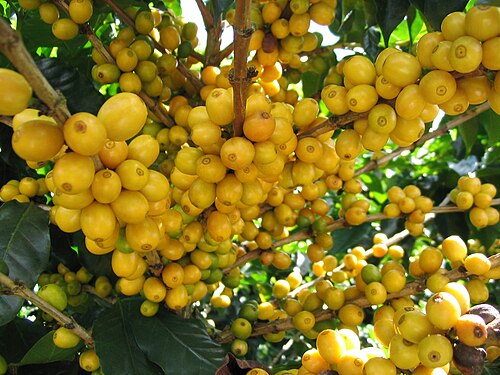
Photo by Fernando Rebêlo, CC BY-SA. Source.

All figures from the World Coffee Research variety catalogue entry, the specialty industry’s reference database, maintained by World Coffee Research.
| Trait | Catuaí |
|---|---|
| Genetic group | Bourbon-Typica group |
| Parentage | Mundo Novo × yellow Caturra |
| Stature | Dwarf / compact |
| Leaf tip colour | Green |
| Yield potential | Medium to very high |
| First production | Year 3 |
| Planting density | 5,000–6,000 plants/ha (single-stem pruning) |
| Nutrition requirement | High |
| Ripening period | Average |
| Bean size | Average |
| Optimal altitude | High (varies by latitude) |
| Coffee leaf rust | Very high susceptibility |
| Nematodes | Susceptible |
| Coffee berry disease | Susceptible |
| Quality potential at altitude | Good |
Read alongside the Caturra entry, that table is almost a carbon copy of its parent — same dwarf stature, same planting density, same “high” appetite for fertiliser, same “good” quality rating, same catastrophic vulnerability to leaf rust. The one row that moved is yield potential, which jumps from Caturra’s flat “medium” to “medium to very high.” That single upgrade is the entire commercial argument for Catuaí: you keep Caturra’s shape and gain Mundo Novo’s productivity.
The rust row is the same trap Caturra fell into. Catuaí inherited Bourbon’s worst weakness along with its sweetness, and no amount of yield fixes that — which is why the rust-resistant Catimor and Castillo lines exist at all.
The short frame is not something IAC invented — it was borrowed. Caturra is a single-gene dwarf mutation of Bourbon, confirmed on the Caturra note against World Coffee Research, and that one gene is what Catuaí was crossed to acquire. In plain terms: the plant is short because the spaces between its leaf nodes stop stretching, so it packs its fruit into a frame you can pick standing up.
To verify
The mechanism gets stated more precisely than the evidence supports. The Pour Over Wiki describes it as “the Caturra dwarfism gene, a single recessive locus that limits internode elongation”.2 That page cites no primary source, and World Coffee Research says only “Dwarf/Compactism” without naming a locus or its inheritance mode. The dwarfism itself is well established; the recessive single-locus specification is not confirmed here and should not be repeated as genetics.
“Optimal altitude: high (varies by latitude)” is not evasion — World Coffee Research deliberately refuses to publish one number, because the elevation that counts as “high” shifts as you move away from the equator. The same caution is recorded on the Caturra note. Don’t quote a single altitude band for Catuaí.
To verify
Did red or yellow Catuaí come first? Two sources flatly contradict each other. The Pour Over Wiki says “the yellow-fruited form was produced first; red-fruited selections were derived from subsequent progeny”. Perfect Daily Grind says the opposite — that they arrived together: “After years of research, the Red and Yellow Catuai group varieties were released in 1972”. World Coffee Research records both colour types without ordering them. There is a reason to expect some yellow-first story — the yellow-fruited parent is yellow Caturra — but that is reasoning, not a source. Don’t state an order.
Where it spread
World Coffee Research records the introductions directly:
| Country | Introduced | Released commercially | |
|---|---|---|---|
| 1 | Brazil | bred there, 1949 | 1972 |
| 2 | Guatemala | 1970 | — |
| 3 | Honduras | 1979 | 1983 |
| 4 | Costa Rica | 1985 | — |
Note the shape of that timeline: Guatemala had Catuaí planted two years before Brazil officially released it. Material moved between Latin American research stations well ahead of formal release dates.
Those four countries are the ones with dates attached. The variety travelled further than that: Perfect Daily Grind reports Catuaí “grown in countries such as Honduras, Costa Rica, Guatemala, Hawaii, Cuba, and many others”.3 Read that as a description of where the plant turns up, not a registry — no introduction dates, acreages or official varietal registrations back the Hawaii and Cuba entries.
To verify
How much of each country’s crop is Catuaí today is quoted constantly and sourced almost never — and the two figures for Brazil do not agree. The claims in circulation: nearly 50% of Brazil’s coffee acreage4 against approximately 60% of the country’s Arabica planting — note these are also measuring different things, acreage of all coffee versus Arabica planting, which may be part of the gap; 20% of Guatemala’s production and “almost half of all the Arabica cultivated” in Honduras; and Caturra and Catuaí together at roughly 90% of Costa Rican production.5 None trace to a government census or a national coffee institute. Treat all four as industry estimates, not statistics.
To verify
Honduras has two different arrival dates. World Coffee Research says introduced 1979, released commercially 1983. Perfect Daily Grind says simply “introduced in 1983.” A third source now states the reconciliation outright — “Honduras received it in 1979, with commercial release by IHCAFÉ in 1983” — which matches the WCR pair exactly and names IHCAFÉ, Honduras’s national coffee institute, as the releasing body. That reading is almost certainly right, but the page cites no primary source and IHCAFÉ’s own records were not checked. Give the WCR pair.
Where the name comes from
To verify
The near-universal claim is that “Catuaí” means “very good” in Tupi-Guarani.6 It appears only in roaster and educational material — no primary linguistic source or IAC document was found. This matters because the sibling name Caturra is confirmed as Guarani for “small” by World Coffee Research, so the pattern is plausible; plausible is not verified. A second, weaker story — that the name splits into Portuguese “cat” + “uai” describing a bean shaped like a small cat’s belly — is presented as a hypothesis even by the sites that repeat it, and should not be stated as fact.
To verify
The breeder is usually named as Dr. Alcides Carvalho, an IAC researcher, on the strength of a peer-reviewed history in Crop Breeding and Applied Biotechnology titled “Alcides Carvalho and the selection of Catuaí cultivar” (SciELO returned HTTP 403 again, so the text still could not be read directly).7 A Brazilian coffee-industry blog names him independently and in the same terms — “Alcides de Carvalho. Pesquisador do Instituto Agronômico de Campinas (IAC),” who “cruzou, em 1949, duas variedades do tipo arábica: mundo novo e caturra,” with the release “em 1972, após 23 anos de pesquisas e de testes”.8 World Coffee Research credits the institution — IAC — but names no individual. Two independent sources and a peer-reviewed paper title all point the same way, so this is close to settled; it stays flagged only because the one authoritative document remains unread.
What it tastes like
World Coffee Research rates Catuaí’s quality potential at altitude as “Good” — the same word it gives Caturra, and one notch below Bourbon’s “Very Good.” That is the only formal sensory rating available.
The Brazilian coffee professional João Batista Pavesi, quoted by Perfect Daily Grind, gives the working descriptors: “chocolate, caramel, caramelised sugar, honey, almonds, and spices [like] nutmeg and sweetgrass,” and recommends a light to medium roast to bring them out.9 That is one expert’s cupping-table impression, not a controlled sensory study — read it that way.
Processing style is not part of the variety. Whether a Catuaí arrives as natural, washed, honey or anaerobic is a decision made on the farm, and as the competition results below show, it changes the outcome enormously.
The competition record
This is where the “workhorse variety” framing breaks down. At the 2019 Cup of Excellence Brazil, the highest-scoring coffee in the country was a Yellow Catuaí:10
| Rank | Farm | Producer | Region | Variety | Process | Score | Price | Buyers | |
|---|---|---|---|---|---|---|---|---|---|
| 1 | 1a | Fazenda Paie Filho | André Luis Aguila Ribeiro | Sul de Minas | Yellow Catuaí | Natural | 92.23 | $60.10/lb | Maruyama Coffee, Goodboybob Coffee, Harrods |
| 2 | 1b | Fazenda Paie Filho | André Luis Aguila Ribeiro | Sul de Minas | Yellow Catuaí | Natural | 92.23 | $50.80/lb | Takamura Coffee Roasters |
| 3 | 2a | Fazenda Primavera | Leonardo Montesanto Tavares | Chapada de Minas | Geisha | Natural anaerobic | 92.15 | $30.50/lb | Saza Coffee, Maruyama Coffee, Proud Mary Coffee |
| 4 | 2b | Fazenda Primavera | Leonardo Montesanto Tavares | Chapada de Minas | Geisha | Natural anaerobic | 92.15 | $25.10/lb | Time’s Club, Coffee Libre, Proud Mary, Coffee Me Up |
| 5 | 3a | Sítio São Sebastião | Merce Jordan Araújo Silva | Chapada Diamantina | Red Catuaí | Pulped natural | 91.84 | $12.90/lb | Wataru for Nozy Coffee |
Source: Alliance for Coffee Excellence — Brazil 2019, confirmed via WebFetch.11 The full auction ran 27 winning lots, sold for $259,870.67 total at an average of $11.80/lb, with prices from $60.10/lb down to $7.00/lb.
Three things worth pulling out of that table. First, a Yellow Catuaí beat a Geisha — the variety that dominates trophy auctions everywhere — on its home ground. Second, the winning lot sold for double the Geisha behind it, which is not the usual ordering in specialty coffee. Third, note the gap between rank 1 at $60.10/lb and rank 3 at $12.90/lb, both Catuaí: the variety sets a ceiling, but farm, altitude and processing decide where inside it a lot lands.
Both top Catuaí lots were naturally processed — dried whole in the fruit, the style Brazil is built around. See Natural process.
To verify
Perfect Daily Grind states that Catuaí lots were “awarded the Cup of Excellence for the past two consecutive years in Brazil” as of 2019, implying a 2018 Brazilian win as well. Only the 2019 result is confirmed here against an Alliance for Coffee Excellence results page. Check ACE’s Brazil archive before repeating the 2018 half.
Catuaí also turns up in the specialty world far from Brazil. Finca Sophia, at extreme altitude in Panama’s Volcán region, grows it alongside Geisha and its own Guayabita — a workhorse variety deliberately pushed somewhere it was never bred to go.
How big a deal it was
There is a real claim buried in Catuaí’s history, and it is easy to overstate. Almost every famous coffee variety on this wiki was found: Bourbon and Typica are old landraces, Caturra and Pacas and Villa Sarchi are mutations somebody spotted in a field, Mundo Novo is a cross that happened on its own, and Geisha was collected in Ethiopia. Catuaí is one of the first that a scientist sat down and designed — a specification (Mundo Novo’s cropping, Caturra’s frame) turned into a plant over 23 years of selection.
To verify
How far to push that framing is contested. A Brazilian industry blog goes all the way, calling Catuaí “considerado o primeiro cultivar arábica produzido pelo homem” — considered the first Arabica cultivar produced by humans — and “líder de produção nas lavouras arábica do Brasil e uma das variedades mais produzidas do planeta”. The peer-reviewed history in Crop Breeding and Applied Biotechnology is more measured, describing Catuaí as among the most successful cultivars in Brazilian agriculture and on the market for more than 40 years — but its text returned HTTP 403 and could not be read, so even that phrasing reaches this note secondhand. “First man-made Arabica” is the load-bearing word and it is unverified: deliberate Arabica crossing programmes existed elsewhere before 1949, and no source consulted defines what would disqualify them. Say “one of the first deliberately bred Arabica cultivars,” not “the first.”
Who owns it
To verify
No source consulted mentions plant variety protection, a patent, or private ownership of Catuaí, and it is bred by a public research institute, released in 1972, and planted across at least four countries — so in practice it behaves as a free, open cultivar that anyone may propagate. That reading is an inference from the absence of any restriction, not a documented legal status. If ownership matters for a decision, check IAC’s own cultivar registry rather than relying on this note.
Related
- Caturra · Mundo Novo — its two parents, and the whole reason it exists
- Bourbon · Typica — the ancestors standing behind both parents
- Pacas · Villa Sarchi — the other dwarf mutations found by accident, against which Catuaí’s deliberate breeding stands out
- Alcides Carvalho — the IAC researcher credited with the 1949 cross
- IHCAFÉ — the Honduran institute named as releasing Catuaí there in 1983
- Catimor · Castillo · Timor Hybrid — the rust-resistant lines bred to fix the flaw Catuaí shares with Caturra
- Coffee leaf rust — the disease it is very highly susceptible to
- Instituto Agronômico · World Coffee Research — the institute that bred it and the body that catalogues it
- Cup of Excellence · Alliance for Coffee Excellence · Cup of Excellence records by country — where its 2019 Brazil win sits
- Geisha — the variety it outbid at that competition
- Finca Sophia · Guayabita — Catuaí grown at extreme altitude in Panama
- Natural process · Honey process · Anaerobic fermentation — the processing choices that decide what a Catuaí lot becomes
- Coffee scoring · Cupping — how that 92.23 was arrived at
Official links
-
Official site — World Coffee Research variety record: Catuai
-
Official site — Instituto Agronômico (IAC), the breeding institute
(iac.sp.gov.br did not respond when first, but answered normally later the same day while the Instituto Agronômico note was being written — the domain appears to be intermittent.)
Footnotes
-
Perfect Daily Grind — Catuai & Yellow Bourbon: exploring Brazil’s coffee varieties ↩
-
Ozone Coffee — Catuai coffee: origins, flavour and why it matters ↩
-
XLIII Coffee — Discover the outstanding potential of the Catuai coffee variety ↩
-
Crop Breeding and Applied Biotechnology — Alcides Carvalho and the selection of Catuaí cultivar ↩
-
uCoffee — Café catuaí: aprenda tudo sobre essa variedade 100% brasileira ↩
-
Alliance for Coffee Excellence — Brazil 2019 results and auction ↩