Rwanda
Rwanda is the origin that was rebuilt on purpose. Most coffee countries drifted into specialty. Rwanda was pointed at it — by a national strategy, foreign aid money, and a very specific piece of infrastructure: the central washing station, a shared wet mill where hundreds of families deliver cherry that they could never have processed properly at home.
Before that, Rwandan smallholders pulped and dried coffee in their own yards, and the country sold an ordinary commodity crop. After it, Rwanda started producing lots that score 90+ and win national competitions. The whole story of this origin is what happens when you move one processing step off the farm and into a shared building.
Two things make Rwanda unusual among African origins:
- The variety is a monoculture, and it’s a good one. Rwanda grows Bourbon and very little else — the exporter Sucafina puts it at 95% of all coffee trees in the country.1 Most origins hedge across several varieties; Rwanda essentially bet everything on the older, tastier, more fragile one.
- The farms are tiny. Over 400,000 smallholders,21 each on a plot Sucafina describes as less than a quarter hectare — roughly half a tennis court’s worth of trees.1
| Annual production | 20,000–22,000 tonnes2 — Sucafina gives an average of 332,500 60 kg bags,1 which is the same figure |
| Global production rank | roughly 22nd1 |
| Species split | 97% Arabica, 3% Robusta2 |
| Dominant variety | Bourbon — Red Bourbon, French Mission Bourbon, Mibirizi, plus some Caturra and Catuaí1 |
| Dominant processing | Washed process, at central washing stations |
| Who grows it | 400,000+ smallholders, under a quarter hectare each21 |
| Harvest | March–June1 |
| Regulator | National Agricultural Export Development Board (NAEB)3 |
| Competition history | Cup of Excellence in 2008, 2010–2015 and 20184 |
How coffee got there
.svg)
Coffee is not native to Rwanda. It arrived with European colonisation in the early 1900s, introduced by the Germans, and under the Belgian administration that followed, planting it became compulsory for farmers.2
That compulsion matters more than it sounds. A crop farmers are ordered to grow is a crop they have no reason to grow well — and for most of the twentieth century Rwandan coffee was exactly that: a mandatory, low-paid, semi-washed commodity, processed at home and sold into the bottom of the market. The quality story does not begin until the 2000s.
To verify
The precise introduction date and who did it. Several secondary coffee guides give 1904 and specify German Catholic missionaries.56 The encyclopedia entry consulted here says only “the early 1900s” and “the Germans.”2 No German colonial or Rwandan government record was located. Treat early 1900s, German colonial introduction as the safe statement.
The washing-station rebuild
After the 1994 genocide against the Tutsi, the coffee sector was rebuilt more or less from scratch, and the rebuild had a specific shape.
USAID funded the PEARL project — Partnership for Enhancing Agriculture in Rwanda through Linkages — investing about US$10 million between 2001 and 2006 in washing stations, farmer training and buyer connections.2 Rwanda’s government paired this with a National Coffee Strategy around 2003 aimed squarely at moving the country from commodity into specialty.1
What the money bought was central washing stations (stations de lavage): shared facilities where a smallholder delivers ripe cherry the same day it is picked, and trained staff handle pulping, fermentation, washing and drying on raised beds. Sucafina estimates the switch from home semi-washed processing to station processing added at least a 40% premium to the export value of Rwandan coffee.1
This is the same structural pattern as Kenya’s cooperative “factories” — the producer on the bag is not a farm but a building, and the coffee in it is the pooled cherry of several hundred families. See Producer cooperatives.
To verify
How many washing stations exist. Sucafina says more than 300;1 the research behind this note also turned up a widely repeated figure of more than 250.7 No NAEB count was located, and the number genuinely changes year to year as stations open and close. Say “roughly 250–300+” rather than quoting either.
Where it grows
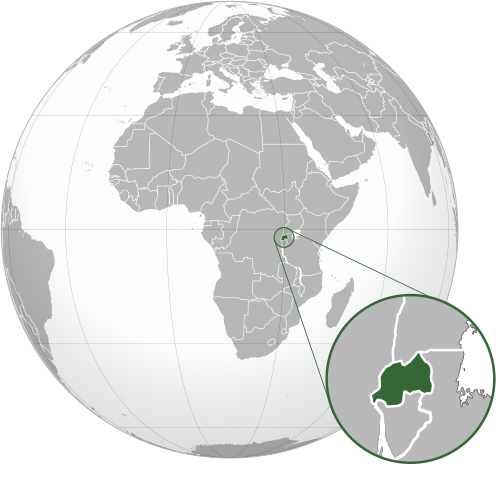
Rwanda is small, landlocked and mountainous, and coffee is grown across most of it. Sucafina groups production into the West Province along Lake Kivu, plus the South, North and East provinces.1 The Cup of Excellence results give a sharper picture of where the best lots come from — the 2018 top three were from Karongi, Gicumbi and Nyamasheke districts.8
The Lake Kivu corridor in the west is the name that appears most often on specialty bags: high ground, volcanic soil, and a lake that moderates the temperature swings.
To verify
Altitude figures. Roaster-facing guides put Rwandan quality arabica at roughly 1,500–2,000 m, with some Lake Kivu and volcanic north-west farms reaching ~2,200 m.7 Neither Sucafina nor NAEB published an altitude band in the sources consulted here, and no farm-level elevation data was verified. Treat the range as approximate trade knowledge.
The potato defect
To verify
Rwanda is the origin most often named in connection with the potato defect — a raw-potato or green-pea off-flavour that appears in an occasional individual bean, generally attributed to bacterial infection following damage from the antestia bug, producing methoxypyrazine compounds. It is described as affecting Rwanda and Burundi in particular, and as undetectable until the bean is ground.9
This is repeated everywhere and confirmed nowhere in the sources consulted here. The claim rests on a secondary coffee-geography compilation; no NAEB, university or peer-reviewed source was checked. The defect is almost certainly real — it is one of the best-known problems in African coffee — but the mechanism, the antestia link and the “Rwanda specifically” framing should not be stated as established fact from this note alone.
Cup of Excellence in Rwanda
Rwanda ran the Cup of Excellence in 2008 — the first African country to do so — then 2010, 2011, 2012, 2013, 2014, 2015 and 2018.4 It has not run since 2018, and Rwanda is not on the Alliance for Coffee Excellence’s current active list; see Cup of Excellence records by country for where that leaves the country’s records.
2018 — the last edition
The country’s best-documented auction. Twumba Coffee, in Karongi, producer Yandagiye Marthe, won at 90.53 points. The lot was split in two, as COE winners usually are:8
| Rank | Washing station | District | Score | Price | Buyers | |
|---|---|---|---|---|---|---|
| 1 | 1A | Twumba Coffee | Karongi, Twumba | 90.53 | $18.70/lb ($24,709.06) | Maruyama Coffee, Sarutahiko Coffee, Good Boy Bob Coffee, Difference Coffee |
| 2 | 1B | Twumba Coffee | Karongi, Twumba | 90.53 | $18.20/lb ($24,048.39) | Campos Coffee |
| 3 | 2A/2B | Cooperative Mayogi | Gicumbi, Muko | 90.06 | $9.00 / $9.10/lb | Ascension Coffee Roasters; Nippon Coffee Trading |
| 4 | 3A/3B | Murundo CWS | Nyamasheke, Gihombo | 90.03 | $8.00 / $8.10/lb | Intelligentsia, Puff Coffee, Carrboro Coffee, Willoughby’s, Single Origin; Dragonfly Coffee Roasters |
The whole auction: 28 COE winning lots plus 7 National Winner lots, 821 boxes of 30 kg, $359,217.70 total, weighted average $6.60/lb.8
Read that average carefully. $6.60/lb across the winning lots of a national competition is a fraction of what a Panamanian Geisha or an Ethiopian natural fetches at the same kind of event — the top Rwandan lot at $18.70/lb would not have made the top twenty at Best of Panama. Rwanda’s problem has never been the coffee in the cup; it is that the buyers who pay four-figure prices are chasing varieties and origins with more marketing gravity. See Premiumisation.
That gap also shows up in the commodity market: on the C-market differential table, Rwanda sits in the 100-point discount group alongside Burundi — the lowest tier of deliverable origins.
To verify
Why Rwanda stopped running COE after 2018 is not documented in any source consulted here. ACE’s archive simply ends. Do not assume the programme was cancelled, suspended, or replaced — it may be dormant, between editions, or organised differently.
What the country sells, and to whom
Rwandan coffee leaves the country almost entirely as green beans — less than 20% is consumed domestically, and the first exports of roasted beans happened only in April 2018.2 Between 2017 and 2023, coffee exports earned about US$452 million, with the United States, Switzerland, the UK, Belgium and Singapore as the main destinations.2
The sector is overseen by the National Agricultural Export Development Board (NAEB), a Rwandan government body that handles export quality assurance, warehousing and a sensory laboratory that cups samples before they ship.3 Note the name: several coffee sources call it the “National Agricultural Export Board,” dropping the Development — the official name includes it.
To verify
Older farm-count and ranking figures conflict with the current ones. A long-standing roaster reference describes Rwanda as having about 500,000 small farms averaging under 1 hectare, and as the 9th largest arabica producer in Africa.5 Both the farm count and the plot size disagree with the newer figures used above (400,000 farms, under a quarter hectare).21 The older numbers are not necessarily wrong — they may be a different vintage or a different definition of “farm” — but they should not be mixed with the newer ones in the same sentence.
Related
- Burundi — the neighbour with nearly the same coffee, and the same problems
- Bourbon — the variety Rwanda grows almost exclusively
- Washed process — the processing style the entire national profile is built on
- Producer cooperatives — how smallholder cherry gets pooled into a sellable lot
- Sucafina — the trader that owns washing stations in both Rwanda and Burundi
- Westrock Coffee — the Nasdaq-listed American company that dates its own founding to Rwanda in 2009
- Cup of Excellence · Alliance for Coffee Excellence · Cup of Excellence records by country — the competition that produced Rwanda’s only public price records
- C-market — where Rwanda sits when the coffee is not a competition lot
- Premiumisation — why a 90.53-point coffee sold for $18.70/lb
- Kenya · Ethiopia — the other African origin notes, for comparison
- Climate change and coffee — East Africa is projected to hold up better than most growing regions
- Coffee scoring · Cupping — how the 90.53 was arrived at
- Specialty coffee — the category the whole national strategy was aimed at
Official links
- Official site — National Agricultural Export Development Board (NAEB) — Rwanda’s government export authority for coffee
- Official — Alliance for Coffee Excellence: Rwanda 2018 results and auction
- Official site — ACE competition & auction results archive
Footnotes
-
Sucafina — Rwanda origin profile ↩ ↩2 ↩3 ↩4 ↩5 ↩6 ↩7 ↩8 ↩9 ↩10 ↩11 ↩12 ↩13
-
Coffee production in Rwanda — Wikipedia ↩ ↩2 ↩3 ↩4 ↩5 ↩6 ↩7 ↩8 ↩9 ↩10
-
National Agricultural Export Development Board (NAEB) — official site ↩ ↩2
-
Alliance for Coffee Excellence — competition & auction results archive ↩ ↩2
-
Africa Note — Rwanda coffee: hard beginnings to high value crop ↩
-
My Coffee Explorer — Rwandan coffee: Africa’s rising specialty star ↩ ↩2
-
Alliance for Coffee Excellence — Rwanda 2018 results and auction ↩ ↩2 ↩3