Burundi
Burundi is the origin that gets described as “like Rwanda, but.” The similarity is real and not lazy shorthand: the two countries share a border, a highland climate, a colonial history, a variety (Bourbon), a processing method (Washed process), a farm size (tiny), and a defect (the potato defect). A blind taster would struggle to reliably separate them.
What makes Burundi worth its own note is the scale of the dependence. Sucafina estimates that around 600,000 smallholder farmers grow coffee, and that nearly 5 million people — roughly 45% of the population — depend on smallholder coffee income.1 For a country of about 11 million people, that is not an industry. That is most of the country.
| Annual production | ~225,000 bags of 60 kg (about 13,500 tonnes)1 |
| Global production rank | roughly 24th1 |
| Growers | ~600,000 smallholders; ~5 million people dependent1 |
| Main varieties | Bourbon, French Mission Bourbon, Jackson, Mibirizi1 |
| Dominant processing | Washed process, at central washing stations |
| Key regions | Kayanza and Ngozi provinces1 |
| Harvest | March–July1 |
| Competition history | Cup of Excellence in 2012–2015 and 2017–20192 |
The Sogestal system
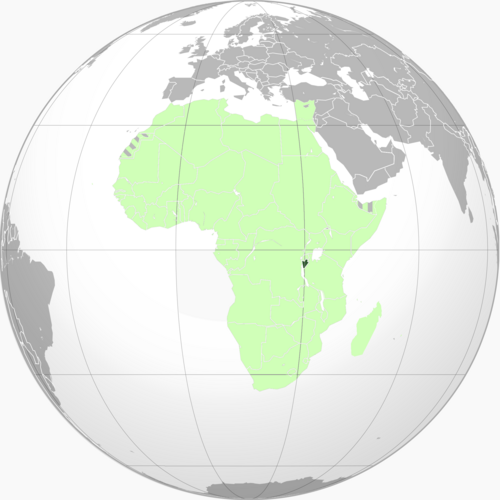
Photo: public domain. Source.

The one genuinely distinctive thing about Burundi’s coffee industry is its name for the middle layer.
Washing stations are grouped under management companies called Sogestals — Sociétés de Gestion des Stations de Lavage, literally “washing-station management companies.” Sucafina describes them as state-owned, operating alongside private washing-station operators.1 They are the reason Burundian lots are labelled the way they are: a specialty bag will name the station and then the Sogestal behind it, as with Gitwenge (Sogestal Kayanza) and Karinzi (Sogestal Kayanza) — the second- and third-place coffees at the 2019 Cup of Excellence.3
If you have read the Rwanda note, this is the same structure with a different label, and the same consequence: the “producer” on a Burundian bag is usually a building, not a farm. Several hundred families deliver cherry to one station, it is pulped and fermented and dried together, and the resulting lot carries the station’s name. See Producer cooperatives for what that does to traceability and to who gets paid.
Sucafina itself operates in Burundi through Bucafe (established 2007), with sister companies Bugestal managing stations and Budeca running dry mills1 — an example of the vertically integrated trader model described on that note.
To verify
Who regulates Burundian coffee is unresolved here. Burundi’s coffee authority has been reorganised more than once, and names including ODECA, ARFIC and InterCafé Burundi appear in trade writing. No official Burundian government coffee-authority website could be reached when this note was written (
odeca.bidoes not resolve), and none of the sources consulted names the current body. Do not state a regulator for Burundi from this note. Compare Rwanda, where NAEB is confirmed.
Cup of Excellence in Burundi
Burundi ran the Cup of Excellence in 2012, 2013, 2014, 2015, 2017, 2018 and 2019.2 Like Rwanda, it has not run since, and Burundi does not appear on the Alliance for Coffee Excellence’s current active-country list.
2019 — the last edition
| Rank | Washing station | Sogestal / operator | Score | Price | Buyers | |
|---|---|---|---|---|---|---|
| 1 | 1a / 1b | Gatukuza | Ets Nduwayezu | 90.13 | $21.10–$21.20/lb | Maruyama Coffee, Sarutahiko Coffee, lowkeycoffee, Anotherbeans, Songdo Coffee |
| 2 | 2 | Gitwenge | Sogestal Kayanza | 89.92 | $8.00/lb | Wataru, for Takamura Coffee Roaster |
| 3 | 3 | Karinzi | Sogestal Kayanza | 89.43 | $7.60/lb | Terarosa (Haksan Co. Ltd) |
The auction ran on 19 September 2019: 21 winning lots, 43,060.68 lb, $291,378.89 total, weighted average $6.76/lb. All winning coffees scored 87 or above and were cupped at least five separate times, judged by an international jury of 23 people from 15 countries.3
Two things are worth pulling out of that table.
The drop after first place is a cliff. Gatukuza at 90.13 fetched $21.10/lb; Gitwenge at 89.92 — two-tenths of a point behind — fetched $8.00. That is the shape of almost every COE auction: a handful of bidders decide there is exactly one trophy lot, and the rest of a very good field clears near the auction average. See Premiumisation.
The buyers are overwhelmingly East Asian. Japanese and Korean roasters — Maruyama, Sarutahiko, Takamura, Terarosa, Songdo — took the top of both the Burundian and the Rwandan auctions. See Japan coffee market.
Burundi’s numbers sit almost exactly on top of Rwanda’s: a 90.13 top lot at $21.20/lb against Rwanda’s 90.53 at $18.70/lb, with weighted averages of $6.76 and $6.60. The two countries are priced as one thing by the market. That also holds on the commodity side — on the C-market differential table, Burundi and Rwanda share the same 100-point discount tier.
What is not documented here
This is the honest limit of this note. Burundi is thinly covered by the sources available, and several things a reader would reasonably want are simply not established.
To verify
Colonial introduction. Burundi’s coffee history is usually described as parallel to Rwanda’s — German then Belgian colonial administration, compulsory planting, a commodity crop for most of the twentieth century. This is inference from shared regional history, not a documented fact, and the research feeding this note flagged it as such. No date, no named introducer, no Belgian administrative record was verified.
To verify
The potato defect. Burundi is named alongside Rwanda as an origin where the potato defect — a raw-potato off-flavour in the occasional bean — recurs.4 The claim rests on one secondary compilation and is not confirmed by any Burundian source consulted. See the fuller treatment, and the same caveat, on Rwanda.
To verify
Altitude, variety shares, and washing-station counts. No verified altitude band, no percentage breakdown of Bourbon versus Jackson versus Mibirizi, and no count of Burundian washing stations was located. Secondary write-ups assert all three; none was checkable here. The related claim on this wiki’s Bourbon note — that Rwanda and Burundi hold among the highest proportions of Bourbon in their national plantings — remains partly confirmed for Rwanda (95% per Sucafina) and unconfirmed for Burundi.
Related
- Rwanda — the near-identical neighbour, better documented
- Bourbon — the variety both countries are built on
- Washed process — how nearly all of it is processed
- Producer cooperatives — the station-and-pooled-cherry model the Sogestals implement
- Sucafina — the trader that owns washing stations in Burundi through Bucafe
- Cup of Excellence · Alliance for Coffee Excellence · Cup of Excellence records by country — the source of every price on this page
- C-market — where Burundi sits when it is not a competition lot
- Premiumisation — why 90.13 was worth two and a half times 89.92
- Japan coffee market — the buyers at the top of the 2019 auction
- Kenya · Ethiopia — the other African origin notes
- Coffee scoring · Cupping — how the scores above were produced
Official links
- Official — Alliance for Coffee Excellence: Burundi 2019 results and auction
- Official site — ACE competition & auction results archive
- (no official Burundian national coffee authority website confirmed — see the To-verify note above)