Kenya
Kenya is the origin that gets described by its paperwork. Ask about Ethiopian coffee and you get a region. Ask about Panamanian coffee and you get a farm. Ask about Kenyan coffee and you get a grade letter — “Kenya AA” — because for most of the last ninety years the only legal way to sell Kenyan coffee was through a national auction that catalogues lots by bean size, not by farm or variety.
Two things made the country’s reputation, and this note is mostly about how they fit together:
- The SL varieties. SL28 and SL34 — two individual trees picked out of a colonial research station in the 1930s, both rated “Exceptional” in the cup by World Coffee Research, both defenceless against every disease that matters.12
- The auction. A government-mandated open outcry market, running since the mid-1930s, built on the idea that if you make the bidding public, better coffee will fetch more money — and the farmer will find out.34
The third thing, which nobody puts on a bag, is that the crop is a third of what it was in the late 1980s.4
| Global production rank | roughly 19th3 |
| Recent annual crop | 34,500–51,900 tonnes4 — USDA forecast 750,000 60 kg bags for 2024/25, down ~6.3%3 |
| Species | Arabica, effectively all of it — see Arabica vs Robusta |
| Dominant processing | Washed process, usually double-washed |
| Signature varieties | SL28 · SL34 · Ruiru 11 · Batian |
| How it is sold | Nairobi Coffee Exchange auction, Tuesdays5 |
| Who grows it | ~70% from small farms, on ~75% of the coffee land4 |
| Regulator | Coffee Directorate, under Kenya’s Agriculture and Food Authority6 |
How coffee got there
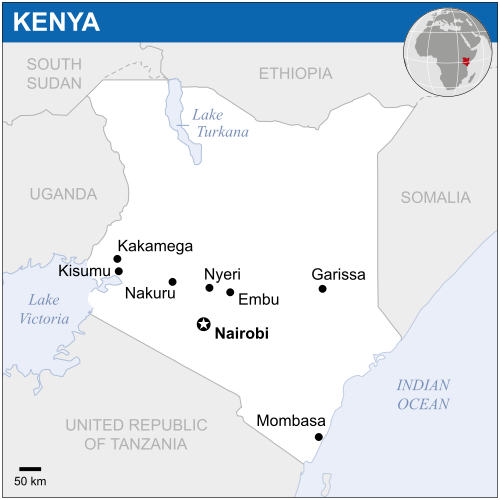
Photo by UN Office for the Coordination of Humanitarian Affairs (OCHA), CC BY. Source.
_-_KEN_-_UNOCHA.svg)
Coffee is not native to Kenya. It arrived from an island in the Indian Ocean, carried by missionaries.
French Holy Ghost Fathers introduced coffee trees from Réunion in 1893.4 The material was Bourbon — the variety that Réunion (then called Bourbon Island) gave its name to — and in Kenya it acquired a local trade name that still appears in variety paperwork today: “French Mission.” This wiki’s SL34 note records the same planting from the World Coffee Research side, placing the mission in Kenya’s Taita Hills.2
That single introduction is the root of nearly everything grown in Kenya since. The SL selections came out of it or out of material like it, and “French Mission” is the label that caused eighty years of confusion about what SL34 actually is.
To verify
A second, competing introduction story exists. The same encyclopedia entry that gives the 1893 French missionary account also notes a reference saying “the British introduced coffee growing about 1900.”4 The two are not necessarily contradictory — missionaries planting trees and a colonial administration commercialising a crop are different events — but no source consulted here reconciles them. The 1893 date is the one the variety literature is built on, so it is the one used above.
The SL varieties
The letters are not a word. SL stands for Scott Agricultural Laboratories, the research station where the selections were made; the numbers are serial codes for individual trees. This wiki has full notes on both:
| SL28 | SL34 | |
|---|---|---|
| Selected from | A single tree in the Tanganyika Drought Resistant population | A single tree on Loresho Estate, Kabete, labelled “French Mission” |
| Genetic group (WCR testing) | Bourbon-related | Typica-related — despite the Bourbon label2 |
| Quality potential at altitude | Exceptional | Exceptional |
| Drought | Tolerant, famously so | Not rated tolerant; wants good rainfall |
| Disease | Susceptible to rust, coffee berry disease, nematodes | Same |
| Spread beyond Kenya | Wide — Uganda, Malawi, Zimbabwe, Latin America | Limited12 |
The pair is why the phrase “Kenyan coffee” means something specific in a cup: blackcurrant, grapefruit sharpness, a savoury tomato-vine brightness, heavy wine-like body. How much of that is the plant and how much is Kenyan soil and Kenyan processing is genuinely unsettled — growers who have planted SL28 elsewhere generally report that the tree travels better than the flavour does.
The rest of the varietal detail, including the disputed selection dates, lives on the SL28 and SL34 notes rather than being repeated here; the unresolved question of when Scott Agricultural Laboratories was founded, who it was named after and what became of it has its own note.
To verify
“SL varieties are ~80% of Kenyan production, around 40,000 tonnes a year.” This figure comes from a single roaster-facing guide, MTPak Coffee,7 with no Kenyan government or research source behind it. The tonnage is in the right neighbourhood for the whole national crop,4 which makes the 80% share look like it was derived from a total rather than measured. No Coffee Directorate or Nairobi Coffee Exchange breakdown of planted area by variety was located. Treat “SL varieties dominate Kenyan production” as the safe statement and the 80% as unverified.
To verify
K7 and the Legetet Estate story. Trabocca states that the colonial government also selected the variety K7 from French Mission coffee at Legetet Estate in Muhoroni.8 That is a specific, checkable claim, but it appears in one secondary source here and was not confirmed against a WCR record or a Kenyan research document.
The varieties bred to replace them
Because both SL varieties catch everything, Kenya spent decades breeding tougher plants — and kept feeding SL genes back in to preserve the flavour. Both of the following are recorded on this wiki against their own World Coffee Research records:1
| Variety | Released | Bred by | Disease | Cup | |
|---|---|---|---|---|---|
| 1 | Ruiru 11 | 1985 | Coffee Research Foundation (now KALRO) | Highly rust-resistant, CBD-resistant | ”Good” |
| 2 | Batian | 2010 | Coffee Research Foundation (now KALRO) | Intermediate rust resistance, CBD-resistant | ”Very good” |
Neither matches SL28’s “Exceptional.” That gap is the whole tension in Kenyan coffee: the resistant plants are the sensible commercial choice, the susceptible ones are what buyers fly in for, and a lot of Kenyan farms are now a mixture of all four — which is part of why a lot bought at auction as “Kenya AA” may contain several varieties at once.
The research lineage matters institutionally too. The Coffee Research Foundation became the Coffee Research Institute, which now sits inside KALRO, the Kenya Agricultural and Livestock Research Organization — the body that releases new varieties and therefore shapes what turns up in the auction catalogue a decade later.
Ruiru 11’s trigger event is the 1968 coffee berry disease epidemic, which destroyed roughly half of Kenya’s coffee production and sent the Coffee Research Foundation into a decade of breeding work at its Ruiru station. That was flagged as unverified when this note was first written; it has since been confirmed against World Coffee Research’s own Ruiru 11 record as well as trade reporting.1 The detail lives on the Ruiru 11 note.
How Kenyan coffee is sold
This is the part that makes Kenya unusual, and it is old.
The 1933 Coffee Act established the Kenya Coffee Board and moved the sale of Kenyan coffee back to Kenya — before it, the crop was traded in London.4 From 1934, under that Act, green coffee could only be sold through a government-run open auction, a system explicitly designed so that higher quality would fetch higher prices in public.3
That auction is the Nairobi Coffee Exchange, and it still runs — weekly, on Tuesdays, from Wakulima House on Haile Selassie Avenue in Nairobi, now through a digital trading portal with a Direct Settlement System that pays growers, and under the oversight of Kenya’s Capital Markets Authority and Agriculture and Food Authority.5
The monopoly ended in 2006, when legislation allowed producers to sell directly to buyers alongside the auction.3 That “second window” is how most Kenyan single-farm and single-factory lots reach specialty roasters today — but the auction remains the price-setting reference for the whole country, which is why it matters even to coffee that never passes through it.
Why the transparency argument is not just PR. In most origins a smallholder learns the price after the fact, from whoever bought their cherry. Kenya’s design forces the price discovery into a public room with a published catalogue, so a farm that produces better coffee can see the premium land. Whether the money then reaches the farmer is a separate question — one that depends on cooperative governance, marketing agents and milling costs, and that the auction itself does not answer.
To verify
“The Kenyan auction inspired Cup of Excellence.” This claim appears in a 2024 origin report3 and is repeated in roaster write-ups,9 but it is not what the Cup of Excellence note on this wiki records from ACE’s own account: CoE began in 1999 in Lavras, Brazil, as “Best of Brazil,” and its innovation was the first online green-coffee auction. A Kenyan influence on the idea of auctioning graded quality is plausible and may well be true — but no Alliance for Coffee Excellence document stating it was located. Recorded as an industry claim, not as documented lineage.
The grades
Kenyan green coffee is catalogued primarily by screen size — how big the beans are, measured by the holes they fall through — not by farm, variety or cup score. Eight grades are used:35
| Grade | What it means |
|---|---|
| E | Elephant — the largest beans, often two beans fused together |
| PB | Peaberry — a single round bean instead of the usual pair |
| AA | Large, screen 17–18; the famous one — see Kenya AA |
| AB | The workhorse grade; the bulk of the crop |
| C | Smaller than AB |
| TT | Lighter beans separated out of AA and AB |
| T | The smallest, including broken beans |
| MH / ML | Mbuni Heavy / Mbuni Light — natural-processed and lower-grade coffee |
To verify
Only the grade letters themselves are sourced. Genuine Origin lists the eight grades and expands E as Elephant and PB as Peaberry;3 the Nairobi Coffee Exchange’s own site names “AA, AB, PB, and more.”5 The one-line descriptions of AA, AB, C, TT, T and MH/ML in the table above — including the screen-size numbers and the reading of MH/ML as Mbuni Heavy and Mbuni Light — are standard trade usage rather than quotations from a Kenyan grading manual. No government-issued grading standard was located. Treat the letters as certain and the definitions as conventional.
The trade logic is that larger beans carry more of the oils and sugars that show up in the cup,3 and AA and AB command premiums accordingly. Read the logic carefully, though: screen size is a proxy for quality, not a measurement of it. A small bean from a great farm and a large bean from an indifferent one land in different grades, which is why specialty buyers increasingly work through the direct window and cup lots themselves. See Cupping and Coffee scoring for what an actual quality assessment involves.
This grading habit is also why the SL28 and SL34 notes cannot give you variety-level auction records. The paperwork records a grade, not a plant.
Where it grows
Kenyan coffee sits on high, volcanic ground around Mount Kenya and the Aberdare Range, with a scattering of other zones. Genuine Origin groups the country into four clusters:3
- Central — Nyeri, Kiambu, Murang’a, Kirinyaga (the classic specialty names)
- Eastern — Meru, Embu
- Coastal — Taita Taveta, where the 1893 mission planting was
- Western — Eldoret, Bungoma, Kakamega
Wikipedia’s list adds Kisii, Nyanza, Nakuru, Kericho, Nandi, Mount Elgon and Machakos.4 The climate advantage is a stable two-season pattern, which gives Kenya two harvests: a main crop and a smaller fly crop.
To verify
Altitude figures differ between sources. Genuine Origin gives ideal Kenyan growing conditions as 1,400–2,000 m.3 This wiki’s SL34 note carries a 1,500–2,100 m working range from a roaster source, and the research behind this note used ~1,500–2,100 m for Nyeri and Kirinyaga. The ranges overlap heavily and nothing hangs on the difference, but no single authoritative Kenyan figure was found. Treat roughly 1,400–2,100 m as the honest span, and do not quote a precise altitude for any named cooperative or factory — no verified farm-level elevation data was located.
The industry today
The romantic version of Kenya is a country of blackcurrant coffee and clever institutions. The numbers are harder.
- Production fell from about 130,000 tonnes in 1987/88 to 40,000 tonnes in 2011/12, and has since run in a band of roughly 34,500–51,900 tonnes.4
- Coffee sold through the Nairobi Coffee Exchange was worth US$127.8 million in 2022–23, down sharply from US$227.3 million the year before.4
- Around 150,000 coffee farmers were counted as of 2012, most of them smallholders.4
Most of those smallholders do not process their own coffee. They deliver cherry to a cooperative society, which operates one or more “factories” — the Kenyan word for a wet mill, where cherry is pulped, fermented, washed and dried. This is why Kenyan lot names so often read as cooperative + factory rather than as a farm: the “producer” on the bag is usually several hundred families pooling cherry into one washing station.
To verify
The cooperative-and-factory structure is described here from general trade practice, not from a document. No Kenyan government, cooperative-registry or exporter source describing society structures, shareholding or factory ownership was located in this round of research. The claim that “6 million Kenyans are employed directly or indirectly in the coffee industry” appears in the encyclopedia entry as a quoted estimate rather than a sourced figure,4 and is not stated as fact above.
What Kenya does not have
One structural absence explains a lot about how Kenyan coffee is discussed.
There is no Cup of Excellence programme in Kenya. The Alliance for Coffee Excellence’s own competition list covers 17 countries and Kenya is not among them.10 So the country that arguably invented the idea of rewarding graded quality in public has no competition auction generating the thing this wiki is otherwise full of — named lots, cupping scores, record prices, winning buyers.
Combined with grade-based cataloguing, the effect is that Kenya produces some of the most sought-after coffee in the world and almost none of the citable records. Everything here is structure and history; the numbers that would let you rank a Kenyan lot against a Panamanian Geisha mostly do not exist in public form. That is a fact about the paperwork, not about the coffee.
Related
- SL28 · SL34 — the two research-station trees the country’s reputation rests on
- Nairobi Coffee Exchange — the auction, in detail
- Scott Agricultural Laboratories — the colonial station that made the SL selections
- Ruiru 11 · Batian — the disease-resistant Kenyan varieties bred to replace them
- KALRO — the state research body that now holds the breeding programme
- Bourbon · Typica — the two lineages the SL pair splits between
- Coffee leaf rust · Coffee berry disease — what the SL varieties have no defence against
- Washed process — the processing style the whole national profile is built on
- Cupping · Coffee scoring — how quality is judged when screen size is not enough
- Cup of Excellence · Alliance for Coffee Excellence — the competition circuit Kenya sits outside of
- Ethiopia · Colombia · Brazil — the other origin notes on this wiki, for comparison
- World Coffee Research — keeper of the variety records used throughout
- Specialty coffee — the category this all sits underneath
Official links
- Official site — Nairobi Coffee Exchange — Kenya’s national coffee auction
- Official site — Agriculture and Food Authority, Kenya — the state regulator; its Coffee Directorate oversees the sector
- Official — World Coffee Research variety record: SL28