Brazil
Brazil is the largest coffee producer in the world, and it is not close. It has held that position for roughly 150 years, and the encyclopedia record states it currently produces about one-third of global supply.1 No other origin comes near that, and no other origin has stayed on top that long.
That single fact reorganises everything else on this wiki. When Best of Panama sells a Geisha lot for hundreds of dollars a pound, it is selling a few hundred pounds of coffee. Brazil ships tens of millions of 60-kilogram bags a year. The two things are both called coffee and almost nothing else about them is the same — which is the argument the Premiumisation note makes at length.
| Global rank | First, for about 150 years1 |
| Share of world supply | ~one-third on the encyclopedia record1; trade sources say 35–40% — see below |
| Typical annual crop | 60–70 million 60 kg bags23 |
| Species grown | Arabica ~70%, Robusta/Conilon ~30%1 — see Arabica vs Robusta |
| Dominant processing | **[[Natural process |
| Leading state | Minas Gerais, roughly half the national crop1 |
| Planted area | ~27,000 km²14 |
| Specialty body | BSCA, since 19915 |
How coffee got there
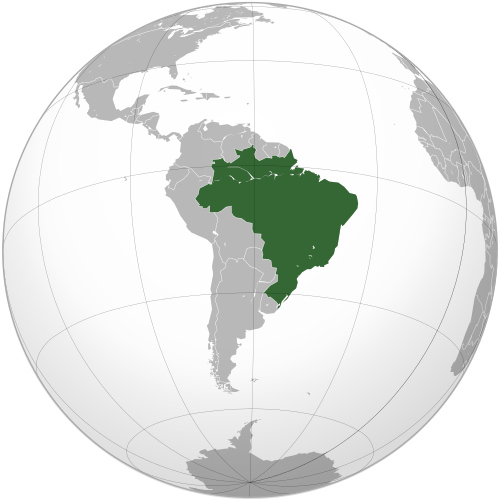
Photo by Ssolbergj, CC BY. Source.
.svg)
The story Brazilians tell is a good one. In 1727, an army officer named Francisco de Melo Palheta planted the country’s first coffee bush in the state of Pará. He had been sent to French Guiana ostensibly to settle a border dispute; the legend says he came home with seeds hidden in a bouquet given to him by the governor’s wife, whom he had seduced.1
Treat the seduction as folklore and the date as the record. What is not in doubt is what followed: coffee moved south down the coast into Rio de Janeiro and then onto the red soil of São Paulo and Minas Gerais, and within a little over a century it had made Brazil the centre of the world coffee trade.
- By the 1840s — Brazil is the world’s largest producer.1
- 1920s — the peak. Brazil holds a near-monopoly of the international market, supplying 80% of the world’s coffee.1
- 1950s onward — share falls as other origins scale up, but the top spot never changes hands.1
To verify — the exact year Brazil took the lead
Sources give “the 1830s,” “1840,” and “by the 1840s” for the moment Brazil overtook every other origin, and the research behind this note could not tie any of them to a customs or trade record.36 The encyclopedia record’s “by the 1840s” is used above because it is the vaguest and therefore the safest. Do not quote a single year.
The share nobody states the same way
To verify — one-third, or 35–40%?
The encyclopedia record says Brazil produces approximately one-third of global coffee supply.1 Trade and NGO sources consistently give a higher band: 35–40%,37 and one country profile puts Brazil at 40% of world production and 32% of world exports for 2021.2
The gap is real and it matters, because “a third” and “two-fifths” are different claims about how much leverage one country has over the price of coffee. Part of the spread is almost certainly that Brazil’s crop swings hard year to year — frost, drought and the natural on-off biennial cycle of a coffee tree can move the harvest by many millions of bags — so a share measured in a good year is not the same number as a share measured in a bad one. No source consulted here states which year its percentage describes. Say “roughly a third or more” and attach a year to any specific figure.
To verify — the production and export volumes are second-hand
The commonly cited figures are 60–70 million 60 kg bags in a typical year,23 a 2023/24 harvest of 66.4 million bags (44.7 million Arabica, 21.7 million Robusta),2 a USDA forecast of ~69.9 million bags for 2024/25,3 and exports of 47.3 million bags in 2023/24, up 32.7% year on year.8
A green-coffee importer’s origin page diverges further still, describing roughly 2 million hectares under coffee producing around 43 million bags a year — a figure well below every other estimate here, with no year attached.9
None of these was read from its primary source for this note. The USDA Foreign Agricultural Service pages and the Coffee: World Markets and Trade circular returned errors or unreadable PDFs when checked, and Conab — the Brazilian government agency that actually runs the national crop survey — could not be retrieved either. Every number above is a trade or NGO source quoting an official one. Check them against Conab or USDA FAS before repeating them as official.
The shape of the country
Coffee grows across six main states. Minas Gerais alone accounts for about half of national production, followed by Espírito Santo, São Paulo, Bahia, Rondônia and Paraná.1 Paraná is the outlier in that list: it led the country outright in the 1960s and now grows about 1% of the crop, after a black frost in July 1975 wiped out its plantations.
Inside Minas Gerais the named sub-regions are Sul de Minas, Cerrado Mineiro, Mogiana (which straddles into São Paulo) and Matas de Minas.10 Of these only Cerrado Mineiro has legal geographical protection for its name, which is why it has its own note here and the others do not yet.
The states also split by species. Espírito Santo and Rondônia are Conilon country — Conilon being the Brazilian name for Robusta — while Minas Gerais, São Paulo and Bahia are overwhelmingly Arabica. That is a climate division: Robusta tolerates the heat and lower ground that would ruin Arabica.
To verify — altitude
Brazilian coffee sits low by Latin American standards. The commonly quoted bands are ~800–1,200 m for Sul de Minas and Mogiana and ~800–1,300 m for Cerrado Mineiro, but the research behind this note describes these as an informed synthesis of specialty trade usage, not a single primary datum — plenty of farms fall outside them and figures vary by municipality. This wiki’s Cerrado Mineiro note records a separate unresolved dispute about whether that region’s certification has an altitude ceiling at all. Take elevation from the individual producer or competition record, never from a national band.
Flat ground, and what it does to coffee
This is the thing that actually makes Brazil different, and it has nothing to do with genetics or processing.
Most famous coffee is grown on slopes too steep for a machine, which means it is picked selectively by hand, cherry by cherry, over several passes. Much of Brazil’s coffee grows on flat or gently rolling ground. That single geographic fact produces the entire Brazilian model:
- Strip-picking. The whole branch is stripped at once — ripe, unripe and overripe together — by machine or by hand. This is why Brazilian mills sort by density in water after harvest rather than relying on the picker’s eye, as the Pulped natural note describes.
- Mechanised everything. Harvesters, centre-pivot irrigation, mechanical dryers. Labour is a line item rather than the constraint.
- A dry harvest season. Brazil’s coffee belt has a hard dry season when the cherries are ripe, so whole fruit can be dried in the open without rotting. In wetter origins that is a gamble; here it is the default.
Put those together and you get the Brazilian promise: not a spectacular cup, but a decent cup, in enormous quantity, at a predictable price, every year. That is the opposite of the auction model this wiki mostly documents, and it is why Brazil sets the floor for global Arabica pricing while Panama sets the ceiling.
Processing: naturals, and the method Brazil gave the world
Natural (dry) processing dominates, at roughly 60–70% of production, with Pulped natural the main alternative.3 Pulped natural — cereja descascada, “peeled cherry” — strips the skin off and dries the seed with its sticky mucilage still attached. It is Brazil’s own contribution to the processing vocabulary, and the direct ancestor of every honey coffee sold today.
To verify — when pulped natural was invented, and by whom
The research behind this note states that Brazil invented pulped natural in the 1990s, while conceding there is no patent, decree or primary document behind the claim — only consensus repetition in specialty literature.3 This directly conflicts with this wiki’s existing Pulped natural note, which records green-coffee importer Royal New York attributing the method to the 1950s, alongside a Perfect Daily Grind line about it being “pioneered around twenty years ago” (written in 2016) and a separate 1990s attribution from a café blog.
So there are at least three candidate decades in circulation, from sources of similar (low) authority. The Brazilian origin of the method is not seriously disputed; the date has no documented basis anywhere consulted. Do not put a decade on it.
What Brazil plants
The national roster is a production lineup, not a competition lineup — varieties chosen for yield, toughness and machine-harvestability rather than for a score sheet.
| Variety | What it is | Why Brazil grows it |
|---|---|---|
| Mundo Novo | Natural Typica × Bourbon cross, found 1943 | The plant that rebuilt Brazilian coffee after the war |
| Catuaí | Caturra × Mundo Novo, released 1972 | Short frame, heavy cropping — plants dense, picks easy |
| Timor Hybrid derivatives | Catimor / Icatu-type lines | Coffee leaf rust resistance borrowed from Robusta |
| Conilon | Brazilian Robusta | Heat and low ground where Arabica cannot go |
Also widely planted and largely absent from the international variety catalogue: Acaiá, Icatu, Catucaí, Arara, Topázio, Obatã and Paraíso. As the Mundo Novo note explains, World Coffee Research’s Arabica catalogue has no entry for most of these, because it is built around varieties that travelled internationally and Brazil’s public breeding programme — run by the Instituto Agronômico in Campinas — largely stayed home.
That is a genuinely important gap for anyone reading a Brazilian lot description: expect the variety name on the bag to have no reference-database entry behind it.
To verify — the rust-resistant share
A specialised technical source states that Timor Hybrid derivatives account for 51.72% of specialty coffee farms in Brazil.8 The research behind this note flags that figure as likely reflecting one particular survey sample rather than a national statistic, and the two-decimal precision on a number this soft is itself a warning sign. No survey methodology, sample size or year was published with it. Treat it as an indicator that rust-resistant lines are common, not as a measurement.
The specialty layer
Brazil is not only commodity coffee, but the specialty share is small relative to the crop.
The Brazil Specialty Coffee Association (BSCA) — Associação Brasileira de Cafés Especiais — has operated since 1991 and describes itself as the link connecting the whole Brazilian specialty chain. Its own site reports over 1.3 million bags of specialty coffee produced in the 2024 harvest, more than 425,000 bags certified by BSCA since 2019, and around 500 member organisations. It runs quality seals for both Arabica and Canephora, an education arm, and the Brazilian edition of Cup of Excellence.5
Set 1.3 million specialty bags against a 60–70 million bag crop and the proportion is clear: roughly two bags in a hundred. Brazil’s specialty story is real, growing, and a rounding error on its production story.
The two best-documented specialty examples on this wiki both sit in Minas Gerais: the demarcated Cerrado Mineiro region, which built an 80-point cupping floor into its protected designation, and Daterra, the estate in Patrocínio that subdivides itself into hundreds of separately-harvested mini-farms.
The exception to the flat-ground story is Camocim Estate, a biodynamic farm in the mountains of Espírito Santo — Conilon country — that hand-picks coffee grown inside Atlantic Forest and won the 2017 Cup of Excellence Brazil Naturals at 93.60 points and US$90.20 a pound.11
Exports are represented by CECAFÉ, the Conselho dos Exportadores de Café do Brasil — the Brazilian Coffee Exporters Council.12
The competition record
Unlike most origin notes on this wiki, Brazil’s is not empty — and it starts at the beginning, because Cup of Excellence was invented here. The competition began in 1999 in Lavras, Brazil, originally under the name “Best of Brazil,” and created the first online green-coffee auction.
The Alliance for Coffee Excellence’s own Brazil results page documents the 2019 edition:13
| 2019 Brazil Cup of Excellence | |
|---|---|
| Auction date | 26 November 2019 |
| Winning scores | 92.23 down to 87.16 across 27 placings |
| Top two lots | Fazenda Paie Filho (92.23) and Fazenda Primavera (92.15) |
| Total sold | 22,024.62 lb for $259,870.67 |
| Weighted average | $11.80/lb |
| Top lot price | $60.10/lb |
Two things are worth pulling out of that table. First, the $11.80/lb average — a Brazilian COE auction clears at a fraction of what Ethiopia or Panama fetch, because Brazil’s reputation is volume, not rarity. Second, the 92.23 top score is competitive with anywhere on earth. Brazil can produce a world-class cup; what it cannot do is get the market to pay Panamanian money for it. The all-time COE ledger bears this out — the standing Brazilian high of $126.10/lb for an experimental yellow Bourbon was tripled by Costa Rica in 2018 and is now roughly a quarter of Ethiopia’s record. See Cup of Excellence records by country.
Brazil also runs its competition in a format no other country uses: the ACE archive lists separate “Brazil Naturals” and “Brazil Pulped Naturals” competitions spanning 1999–2018, alongside the unified Brazil editions from 2019 onward.13 Splitting the competition by processing method is a direct acknowledgement that comparing a natural to a pulped natural on one table is comparing two different things — which is exactly the argument the Natural process and Pulped natural notes make.
The $60.10/lb top price belongs to Fazenda Paie Filho’s 1a lot — a natural Yellow Catuaí from ten leased hectares at Ibiraci, bought jointly by Maruyama Coffee, Goodboybob Coffee and Harrods.14
Trade, price, and leverage
Brazil is described as the producing country with both the largest production and the lowest Arabica prices, which is precisely why it moves the global benchmark: when Brazil’s harvest is good, the world price falls, and when Brazil frosts, the world price spikes.28 Coffee buyers everywhere watch Brazilian weather forecasts for this reason, whether or not they buy a single Brazilian bag.
It is also the backbone of European Arabica supply: in 2021, 40% of Germany’s green coffee imports came from Brazil.2
To verify — nobody agrees how many coffee farmers there are
- ~220,000 coffee farms, employing about 3.5 million people — the encyclopedia record.1
- 287,000 coffee producers — a green-coffee importer’s origin profile.15
These are close enough to be the same population counted differently — farms and producers are not the same unit, and a family partnership can be several producers on one farm — but no source consulted here reconciles them, and neither traces to IBGE (Brazil’s statistics agency) or MAPA (its agriculture ministry). The same problem appears on the Colombia note, where three grower counts differ by nearly a factor of two. Quote a range, not a number.
Why it matters
Brazil is the origin that most coffee writing quietly ignores, because it does not fit the story specialty coffee tells about itself. There is no romance of the smallholder on the mountainside, no rare cultivar, no hammer price.
What there is instead:
- The price floor. Brazil’s harvest is the single biggest input into what everyone else’s coffee is worth. A grower in Honduras who has never heard of Patrocínio is affected by whether it rained there.
- The genetics. Mundo Novo and Catuaí were bred in São Paulo and are now planted across Central America. Much of the coffee sold as “Costa Rican” or “Honduran” is Brazilian plant material.
- A processing method the whole world adopted. Pulped natural became honey processing, which became the mucilage experiments that now win competitions.
- The proof that quality can scale. Cerrado Mineiro’s 80-point certification floor and BSCA’s seals are attempts to raise a whole national crop rather than isolate one lot from it. That is a harder and less glamorous problem than winning an auction, and it affects far more people.
The honest summary: Brazil is where coffee stops being a craft product and becomes an agricultural commodity — and understanding that transition is the only way the rest of the industry’s economics make sense.
Related
- Cerrado Mineiro — the demarcated Minas Gerais region, Brazil’s first protected coffee origin
- Paraná — the state that grew 64% of Brazil’s coffee in 1962 and about 1% today
- Daterra — the Patrocínio estate that is Brazil’s best-known specialty farm
- Camocim Estate — the biodynamic Espírito Santo farm that won COE Brazil Naturals 2017, and sells Jacu Bird coffee
- Fazenda Paie Filho — the ten leased hectares in Sul de Minas that won COE Brazil 2019 at 92.23 and $60.10/lb
- Mundo Novo · Catuaí · Caturra · Bourbon · Typica — the varieties that fill the country
- Timor Hybrid · Catimor · Coffee leaf rust — the rust-resistance lines and the disease behind them
- Robusta · Arabica vs Robusta — Conilon is Brazilian Robusta, and about a third of the crop
- Natural process · Pulped natural · Honey process — the processing Brazil defaults to, and the one it exported
- Dry milling — where every Brazilian lot finishes
- Instituto Agronômico · World Coffee Research — the institute that bred the varieties and the body that mostly doesn’t catalogue them
- Instituto Brasileiro do Café — the federal agency that set national coffee policy from 1952 until it was abolished in 1990
- Cup of Excellence · Alliance for Coffee Excellence · Cup of Excellence records by country — the competition that was invented here in 1999
- Colombia · Ethiopia — the other two origin notes on this wiki, and two completely different models
- Premiumisation · Specialty coffee · Coffee scoring · Cupping — why 1.3 million specialty bags and 66 million total bags are different worlds
- Emi Fukahori · Laurina — the 2018 World Brewers Cup win on a Brazilian lot
Official links
- Official site — BSCA, Brazil Specialty Coffee Association (Associação Brasileira de Cafés Especiais) — the national specialty body since 1991, which also runs Cup of Excellence Brazil
- Official site — CECAFÉ, Conselho dos Exportadores de Café do Brasil (Brazilian Coffee Exporters Council) — the export council
- Official results — Alliance for Coffee Excellence, Brazil Cup of Excellence — scores, auction totals and the 1999–2018 Naturals / Pulped Naturals archives
Footnotes
-
Coffee production in Brazil — Wikipedia — confirmed via WebFetch; source of 1727 and Francisco de Melo Palheta, the 1840s rise, “largest producer for the last 150 years,” ~one-third of global supply, the 1920s 80% peak, ~220,000 farms, 3.5 million workers, ~27,000 km², the state ranking, Minas Gerais at half the crop, and the ~70/30 Arabica–Robusta split ↩ ↩2 ↩3 ↩4 ↩5 ↩6 ↩7 ↩8 ↩9 ↩10 ↩11 ↩12 ↩13
-
Solidaridad — Coffee producer country profile: Brazil (PDF) — NGO country profile; source of the 2023/24 harvest split, the 40% of world production / 32% of world exports figure for 2021, the German import share and the lowest-Arabica-prices framing ↩ ↩2 ↩3 ↩4 ↩5 ↩6
-
All About Coffee — Brazil — educational reference; source of the 35–40% share, 60–70 million bag range, the USDA 2024/25 forecast figure, the 60–70% natural processing share and the 1990s pulped-natural invention claim ↩ ↩2 ↩3 ↩4 ↩5 ↩6 ↩7
-
Coffee Consulate — Brazil — source of the plantation area and the 1920s peak framing ↩
-
BSCA — Brazil Specialty Coffee Association, official site — confirmed via WebFetch; source of the 1991 founding, 1.3 million specialty bags in the 2024 harvest, 425,000 bags certified since 2019, ~500 members, the Arabica and Canephora seals and the Cup of Excellence Brazil role ↩ ↩2
-
Caféiculture au Brésil — Wikipédia (French) — French-language encyclopedia record; one of the sources giving a differing date for Brazil’s rise to first place ↩
-
Agrisapien — How much of the world’s coffee is produced in Brazil? — SEO write-up; one of the sources repeating the 35–40% share ↩
-
Morning Wines — Brazil: cultivars and processing — source of the 2023/24 export figure, the 51.72% Timor Hybrid derivative share, and the Minas Gerais and pricing framing ↩ ↩2 ↩3
-
Melbourne Coffee Merchants — Brazil — green coffee importer; source of the ~2 million hectare and ~43 million bag commercial estimate not used as fact here ↩
-
Sucafina — Brazil origin page — green coffee trader; source of the Sul de Minas, Cerrado Mineiro, Mogiana and Matas de Minas sub-region list ↩
-
Alliance for Coffee Excellence — farm directory: Fazenda Camocim 2017, 93.60 — confirmed via WebFetch; the 93.60 score, natural processing and Domingos Martins, Espírito Santo location ↩
-
CECAFÉ — Conselho dos Exportadores de Café do Brasil, official site — fetched; the organisation’s name and identity as the Brazilian Coffee Exporters Council were confirmed, but the page returned no extractable export statistics ↩
-
Alliance for Coffee Excellence — Cup of Excellence Brazil results — confirmed via WebFetch; source of the 2019 auction date, the 92.23–87.16 score range, Fazenda Paie Filho and Fazenda Primavera, the 22,024.62 lb / $259,870.67 / $11.80 per lb auction totals, and the separate Naturals and Pulped Naturals competition archives 1999–2018 ↩ ↩2
-
Alliance for Coffee Excellence — Cup of Excellence Brazil 2019 results — confirmed via WebFetch; the $60.10/lb price attributed to Fazenda Paie Filho’s 1a lot, and the Maruyama Coffee / Goodboybob Coffee / Harrods buyer list ↩
-
Royal New York — Origin Profile: Brazil — green coffee importer; source of the 287,000 producers figure and the Palheta introduction account ↩