Honduras
Honduras is the largest coffee producer in Central America and the sixth largest in the world — about 384,000 tonnes in 2023, or roughly 6.4 million sixty-kilogram bags, on United Nations agricultural data.1 It sits directly below Ethiopia on that list and above Uganda and Peru, which puts it in a very different weight class from its famous neighbours: Honduras grows several times more coffee than Panama and comfortably more than Guatemala.
It also has the least glamorous reputation of any origin at that scale, and the story of Honduran specialty coffee is essentially the story of that gap closing.
| Position | 6th largest coffee producer worldwide (2023)1 |
| Volume | ~384,000 t / ~6.4 million 60 kg bags (2023)1 |
| National body | IHCAFE (Instituto Hondureño del Café) |
| Producers | ~120,000, overwhelmingly smallholders2 |
| Spread | Coffee in 15 of 18 departments, 210 of 298 municipalities2 |
| Formal regions | Copán, Opalaca, Montecillos, Comayagua, El Paraíso, Agalta345 |
| Harvest | roughly October/November – March63 |
| Competition | Cup of Excellence Honduras, running since 20047 |
| Record auction price | US$136.50/lb — La Salsa, 20247 |
From bulk coffee to auction coffee
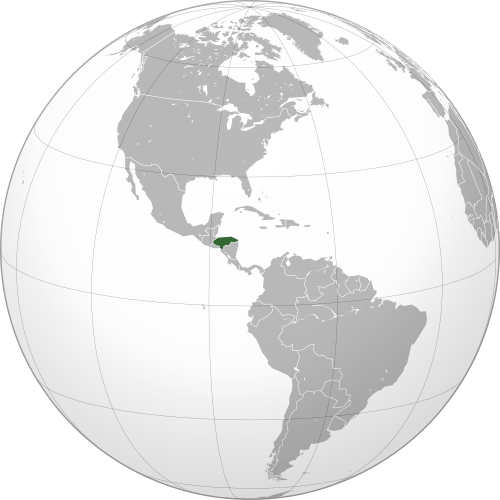
Photo by Mexico_(orthographic_projection).svg: Ssolbergj derivative work: Addicted04 (talk), CC BY. Source.
.svg)
For most of the twentieth century Honduran coffee was a commodity, not a name. It was sold in bulk, blended into other people’s coffee, and traded on price rather than flavour — bananas and sugarcane were the country’s export headlines.6 Two things changed that.
The first was volume. In 2011 Honduras passed Guatemala to become Central America’s top producer,86 and production has roughly doubled over the last decade.5 Scale on its own does not buy respect, but it does buy attention from buyers.
The second was competition results. Honduras has run its own national Cup of Excellence since 2004 — the 2024 edition was billed by the Alliance for Coffee Excellence as the country’s twentieth.7 That is a two-decade paper trail of scores, prices and named farms, which is exactly what an origin needs to stop being anonymous. A Cup of Excellence is a blind national cupping competition ending in an online auction: judges score every entered lot, the top lots are published with the farmer’s name, and roasters worldwide bid on them.
What the auctions actually show
Three consecutive years of the Honduran auction, straight from ACE’s own published results tables:
| Year | Top lot | Producer | Variety / process | Score | Price | |
|---|---|---|---|---|---|---|
| 1 | 2024 | La Salsa | Benjamín Paz Muñoz | Washed Geisha | 91.21 | $132.00/lb (1A) and $136.50/lb (1B)7 |
| 2 | 2023 | Pino De Oro | Oscar Edgardo Tinoco Madrid | Natural Pacamara | 91.78 | $62.00/lb (both lots)9 |
| 3 | 2025 | La Salvaje | not published in the table read here | Washed Geisha | 91.59 | $81.20–$88.40/lb10 |
A few things in that table are worth pulling out.
$136.50/lb is Honduras’s record, and on the Cup of Excellence records by country ledger it lands fourth — behind only the two Ethiopian records and Costa Rica’s 2018 Geisha, and ahead of El Salvador and Brazil. That is not the position most people would guess for Honduras.
The buyers are the same names that chase the world’s most expensive coffees. La Salsa’s two 2024 lots went to Angelino’s Coffee — the California roaster that bought the all-time COE record lot in Ethiopia the same year — and to a consortium of Proud Mary Coffee, Black & White, Verve and Onyx.7 The 2023 winner went to Coffee Libre in South Korea and again a Proud Mary–led group;9 second place that year went to Glitch Coffee & Roasters and Kyokuto Fadie in Japan.7
Score does not set price here either. The 2023 winner scored higher than the 2024 winner (91.78 against 91.21) and sold for less than half as much. What changed between the two years was not the cup — it was who turned up to bid. The same lesson runs through Cup of Excellence records by country and Premiumisation.
Honduras enters coffees that other origins don’t. The 2024 runner-up, El Mango, was a washed SL-28 — a Kenyan variety, in Central America, at 90.86 points.7 And the 2025 competition judged in three groups: exotic varieties, traditional varieties, and a category of its own for Parainema, the rust-resistant hybrid IHCAFE itself released.10 Parainema’s Honduran competition record is the single best piece of cup evidence anyone has for a Timor Hybrid-descended variety, and it is documented on the Sarchimor page.
Who grows it
Honduras is a smallholder country. A 2022 value-chain mapping by the International Labour Organization, built on IHCAFE data, counts roughly 120,000 coffee producers, most of them farming small plots, with production concentrated in the departments of El Paraíso, Santa Bárbara, Comayagua and Lempira and coffee present in 15 of the country’s 18 departments and 210 of its 298 municipalities.2 Many of those farmers sell through cooperatives rather than directly.4
Above them sits IHCAFE, the Instituto Hondureño del Café — the national coffee institute, Honduras’s counterpart to Costa Rica’s ICAFE, Guatemala’s ANACAFÉ and El Salvador’s ISIC. IHCAFE does research, extension work and quality promotion, and it is one of the six institutions in the Central American breeding consortium documented on the CATIE and ICAFE notes. It bred Parainema, Lempira and IHCAFE 90, and it is the body that introduced Pacas and Villa Sarchi to Honduras in 1974.
Who buys it from them
Between 120,000 farmers and the world’s roasters sit two layers the origin guides rarely name: the cooperatives and mills that buy, process and dry the cherry, and a short list of export companies that ship it. This is where most of the country’s coffee actually changes hands, and it is the part of Honduras with no auction table attached.
The growers have their own national association, separate from the government institute. AHPROCAFE — Asociación Hondureña de Productores de Café — is a producers’ body, and by its own account it has been at this for more than 58 years, which puts its founding in the mid-1960s.11 Its structure is worth reading slowly: 15 departmental boards, 210 local boards, 3,247 village-level boards, and 42 affiliated cooperatives.11 The first two numbers are the same as the coffee footprint in the ILO/IHCAFE mapping — coffee in 15 departments and 210 municipalities2 — which is what you would expect from an association built municipality by municipality rather than region by region. An ILO value-chain mapping names AHPROCAFE as one of four key national producer organisations; the other three are not identified in the material read here.2
One cooperative on that map is confirmable at source. COMSA — Café Orgánico Marcala S.A. de C.V. — is based in Marcala, La Paz, has been trading since 2001, and has been certified organic since 2004, alongside Fair Trade, USDA Organic, UTZ and Bird Friendly marks.12 COMSA is the useful case to hold onto, because it is two things at once — a producer cooperative that farmers belong to, and, on the export ranking below, one of the ten largest shippers in the country. That combination is the exception in Honduras, not the rule.
To verify — who exports Honduran coffee, and how concentrated it is
The USDA Foreign Agricultural Service’s Coffee Annual for Honduras (2025) is reported to rank the country’s leading exporters by share of total exports in marketing year 2023/24 as follows.13 The USDA is about as authoritative as this data gets, but the published PDF could not be read directly here — the figures below come from a secondary reading of it, so treat the exact percentages as unconfirmed:
Exporter Share of exports 2023/24 1 Compañía Hondureña del Café (COHONDUCAFE) 31.05% 2 BECAMO 15.49% 3 Molinos de Honduras 10.37% 4 OLAM Honduras 9.24% 5 Louis Dreyfus 8.94% 6 Beneficio de Café INLOHER 7.15% 7 Exportadora de Café OG 5.43% 8 HAWIT-CAFEX 4.36% 9 COMSA (Café Orgánico Marcala) 4.16% 10 SOGIMEX 3.79% If those numbers hold, the shape of the trade is the striking part: ten companies account for essentially the whole export book, one of them takes nearly a third of it, and two of the ten are arms of the global trading houses that also appear on the Green coffee trading page. A country of 120,000 independent smallholders ships through a bottleneck ten names wide — which is a large part of why an individual Honduran farmer has so little pricing power against the C-market par differential recorded further down this page.
To verify — the specialty mills and cooperatives
A green-coffee importer’s origin page names four Honduran operations it works with as “progressive mills” and “innovative cooperatives”: Beneficio San Vicente (Santa Bárbara), Beneficio San Marcos, COMSA (Marcala), and COCAFCAL – Las Capucas (Copán).14 Only COMSA is independently confirmed here, via its own site.12 Web addresses for Beneficio San Vicente and Las Capucas could not be resolved on the guesses tried, so ownership, size and founding dates for all three of the others are unverified — do not repeat them as fact. The same importer page lists Honduras’s main specialty regions as Copán, Santa Bárbara, Marcala, Ocotepeque, El Paraíso, Comayagua, Opalaca and Montecillos.14 That is worth comparing with IHCAFE’s six official regions listed below: the trade list keeps five of them, drops Agalta entirely, and adds three names that are not official coffee regions at all — the departments of Santa Bárbara and Ocotepeque and the town of Marcala. Buyers use the geography they can taste differences in, not the geography the institute publishes.
To verify — one cooperative in numbers
A US roaster’s origin page describes CAFESCOR (Cafés Especiales Corquín) in Corquín, Copán as a cooperative of 131 producer partners — 37 women and 94 men — farming roughly 400 hectares between them, selling SHG EP, fully washed and sun-dried coffee from 1,200–1,800 m, grown from Caturra, Catuaí and Pacas, certified organic.15 This is a single seller’s page and none of it is corroborated, so it stands as an illustration rather than a record. It is a useful one, though: 131 farmers across 400 hectares works out at about 3 hectares each, which independently lands on the ~3.2 ha average farm size flagged as uncertain further down this page.4 The roaster’s cup description — medium acidity and body, citrus, dark chocolate, roasted almonds — is marketing copy, not a scored cupping sheet, and carries no number.15
To verify — what Honduran specialty actually retails for
A specialty-coffee price aggregator’s Honduras catalogue puts named-producer retail lots in a band of roughly US$1.48 to US$2.83 per ounce of roasted coffee — around $24 to $45 a pound — with washed Santa Bárbara and La Paz lots clustered near $2.00–2.30.16 The same catalogue counts more in-stock lots from Santa Bárbara (35) than from any other Honduran region, followed by La Paz (13) and Marcala (12), and names COMSA, Benjamín Paz, Marysabel Caballero & Moisés Herrera (Finca El Puente), Meladis Reyes, Fincas Mierisch, Katia Duke, David López, Evin Herrera and Alexia Mejía & Marcio Paz among the producers with several lots on shelves at once.16 This is an aggregator, not a primary source, retail prices move constantly, and one numeric value on the page (“9.09”) is not labelled clearly enough to be read as a cupping score. Take the band and the ranking as a snapshot of shelf presence, not as fact.
Put the numbers on this page in one line and you get the ladder Honduran coffee sits on. As bulk green coffee it trades at par with the New York C price — no origin premium at all. As a named retail bag it sells for roughly $24–45 a pound roasted. As an auction lot it has reached $136.50 a pound green. Those are three different units and three different products, so the figures do not divide neatly into each other; the point is the gap between the top and bottom of the same country’s coffee, and how few farmers ever see the top of it.
The six regions
IHCAFE divides the country into six formal coffee regions, and the names show up on specialty bags:345
| Region | Where | Note |
|---|---|---|
| Copán | North-west, near the Guatemalan and Salvadoran borders | Typically 1,000–1,500 m; sweet, chocolate and stone-fruit descriptions34 |
| Opalaca | Western highlands | |
| Montecillos | West/central highlands | The highest-elevation region; much of the top-grade production34 |
| Comayagua | Central | |
| El Paraíso | South-east, on the Nicaraguan border | One of the largest by volume and area217 |
| Agalta | East |
Note where El Paraíso is: it borders Nueva Segovia in Nicaragua, the department that has been supplying that country’s Cup of Excellence winners. This is one continuous mountain range with a political line through it.
The flavour notes above come from importer and roaster origin guides rather than from IHCAFE laboratory data, so read them as a tendency rather than a promise. Santa Bárbara, meanwhile, is the department behind much of the country’s competition record — La Salsa’s producer Benjamín Paz is a Santa Bárbara name — even though it is not one of the six official region labels.
Varieties and processing
The planted stock is the Central American standard: the heirlooms Bourbon and Typica, the compact Caturra and Catuaí, the Salvadoran dwarf Pacas, the big-beaned Pacamara — and, unusually, three home-bred rust-resistant lines of its own in Parainema, Lempira and IHCAFE 90.345 Honduras is also one of the few countries where original Bourbon survives at commercial scale, per World Coffee Research, as recorded on the Bourbon page.
That last group matters more here than in most origins. Coffee leaf rust pushed a large share of the national crop onto Catimor- and Sarchimor-family hybrids bred for survival and yield rather than flavour, and the Catimor note is blunt about the price: Lempira and IHCAFE 90 both rate at the bottom of World Coffee Research’s quality scale. The Yunnan coffee note describes the same bargain being struck later in China with the same varieties and the same outcome. Honduras’s answer was Parainema — a rust-resistant hybrid that does cup — and a competition category built around it.
Processing is overwhelmingly washed: the fruit is stripped off, the beans fermented to loosen the sticky layer, rinsed, and dried. Naturals and honeys have grown over the last decade as a way to differentiate lots,65 and both appear at the top of the auction tables — 2023’s winner was a natural Pacamara, 2025’s Traditional category winner a natural Typica.109
Grading by altitude
Honduran coffee is graded by how high it grew, not by bean size or defect count, which is the Central American convention:5
- SHG — Strictly High Grown, at or above about 1,350 m
- HG — High Grown, roughly 1,200–1,350 m
- Central Standard — below about 1,200 m
The logic is that slower ripening at altitude concentrates sugars, so elevation is used as a rough proxy for cup quality in export contracts.
To verify — the exact grade cut-offs
The 1,350 m and 1,200 m thresholds above come from a single green-coffee importer’s origin overview, not from an IHCAFE or export-authority document.5 The existence of an altitude-based SHG/HG system is well attested across trade sources; the precise metre figures should be checked against IHCAFE before being quoted as regulation.
To verify — "100% Arabica, Robusta banned by law"
Two secondary sources state that Honduras grows only Arabica and that Robusta cultivation is prohibited by law.617 The all-Arabica part is consistent with everything else on this page. The legal prohibition is not verified — no statute, decree or IHCAFE regulation was read here. Do not state it as law.
To verify — how much land, and how many departments
The figures in circulation disagree with each other:
- The Spanish-language encyclopedia entry gives about 280,000 hectares under coffee across 14 departments, with El Paraíso the largest by area.17 The ILO/IHCAFE mapping says 15 of 18 departments.2 Fourteen versus fifteen is unresolved; the ILO figure has the better provenance.
- A second reading of that same ILO document produces a coffee-department list of all eighteen, including Gracias a Dios and the Bay Islands — a lowland Caribbean department and an island group, neither of them plausible coffee country.2 The likeliest explanation is that the ILO table enumerates every department and records zero or negligible area for some, and that a list of headings got read as a list of producers. Either way, do not treat eighteen as the number of coffee-growing departments; fourteen or fifteen is the live question.
- “Up to 60% of agricultural land” and “about 30% of agricultural GDP” are each single-sourced to trade or importer summaries of USDA data, not to the USDA tables themselves.65
- Average farm size is given as 3.2 hectares by one importer and as a 1–10 hectare range by others.46
- Production for 2023/24 is reported at about 6.5 million bags via USDA data summarised by a green importer.5 That is close to the ~6.4 million bags implied by the UN figure for 2023,1 so the order of magnitude is safe; the exact seasonal number is not.
To verify — the free regional cupping labs
One importer profile states that IHCAFE runs a cupping lab in each of the six regions offering free cupping to farmers.3 This is a specific and checkable institutional claim, and if true it is a significant piece of national quality infrastructure — but it appears in only that one source here, and IHCAFE’s own site could not be read (see Official links). A published Q&A with IHCAFE describes six research and development centres plus one accredited quality-control laboratory — possibly the same six sites described differently, possibly not.18 See IHCAFE.
How coffee got there
The early history is thinner and shakier than the production numbers, and the wiki should be honest about that.
The first documented mention of coffee in Honduras is an import record, not a planting record: the Gazeta de Guatemala of 12 September 1799 notes coffee arriving at the Caribbean port of Trujillo aboard a vessel named Reina Luisa.1920 Domestic production is placed by one historical study at around 1835, and local research dates coffee’s arrival in Llama, Santa Bárbara — the western department that now supplies much of the competition record — to 1850.2021
Then, in 1998, Hurricane Mitch tore through the sector; the replanting and quality programmes that followed are part of how the modern industry took shape.5
To verify — the 1799 record and the dates around it
The two sources describing the 1799 Gazeta entry do not agree on what was imported: one says “3 barrels of coffee from Havana, Cuba”, the other “six quintals” on the schooner “La Reyna Luisa”.1920 The date, port and vessel match; the quantity does not. Also single-sourced and unverified: the ~1835 start of domestic production,20 the 1850 introduction to Llama (based on a 1940 narrative),21 and the description of Hurricane Mitch’s specific effect on coffee.5 One source additionally calls Honduras a principal regional coffee exporter “by the early 19th century”,17 which contradicts the 1835 production date on the same page — a century of Honduran coffee history is genuinely unsettled in the material behind this note.
Where Honduras sits in the wider wiki
Two entries elsewhere on the wiki frame the country’s economics. The C-market note lists Honduras at par with the New York C price — no origin differential at all, the same tier as Mexico, Nicaragua and Peru, and a full 500 points below Guatemala. That is the bulk market’s verdict on Honduran coffee as a group, and it sits alongside auction lots clearing $136 a pound. Both numbers are true; they describe different coffees.
The Climate change and coffee note records Honduras losing about 27% of its suitable coffee land in the modelling it summarises — among the worst-hit countries in Mesoamerica. For an economy where coffee involves 120,000 farming families, that is the most consequential number on this page.
Related
- IHCAFE — the national coffee institute behind the regions, the grading and three of the varieties
- AHPROCAFE — the growers’ own national association, organised into 15 departmental and 210 local boards
- COMSA — the Marcala cooperative that is both a specialty mill and one of the country’s ten largest exporters
- ICAFE · ANACAFÉ · Instituto Salvadoreño de Investigaciones del Café · CATIE — IHCAFE’s counterparts and co-breeders in Central America
- Producer cooperatives · Dry milling · Green coffee trading · Coffee supply chain — the layers between a Honduran smallholder and a roaster
- Fair trade coffee · UTZ — the certifications Honduran cooperatives sell under
- Cup of Excellence · Cup of Excellence records by country · Alliance for Coffee Excellence — the competition Honduras has run since 2004, and where its $136.50/lb record ranks
- Parainema · Sarchimor · Lempira · IHCAFE 90 · Catimor · Coffee leaf rust — the rust story, and the one rust-resistant variety with real cup evidence
- Bourbon · Typica · Caturra · Catuaí · Pacas · Pacamara · Geisha · SL28 · Villa Sarchi — what is planted here
- Washed process · Natural process · Honey process — the processing mix
- Guatemala · Nicaragua · Panama · Brazil · Colombia — the neighbours and the comparison points
- C-market — where Honduras’s zero origin differential is recorded
- Climate change and coffee — the 27% suitable-land loss projected for Honduras
- Finca El Puente — the La Paz farm that won the 2016 national Cup of Excellence at $120.50/lb
- Benjamín Paz — the Santa Bárbara producer behind La Salsa and the national record price
- Fincas Mierisch — the Nicaraguan family whose Comayagua farm Santa Lucía won the national Cup of Excellence in 2019 and 2021
- Angelino’s Coffee · Proud Mary Coffee · Stumptown Coffee Roasters — roasters with Honduran coffee on the shelf or on the auction table
- Premiumisation — why the same score fetches wildly different prices year to year
- Yunnan coffee — an origin making the same rust-resistance bargain a generation later
Official links
- Official site — IHCAFE (Instituto Hondureño del Café) — unconfirmed: the site returned HTTP 403 to an automated check here, so nothing on this page rests on IHCAFE’s own text
- Official results — Alliance for Coffee Excellence, Cup of Excellence Honduras 2024
- Official results — Alliance for Coffee Excellence, Cup of Excellence Honduras 2025
- Official results — Alliance for Coffee Excellence, Cup of Excellence Honduras 2023
- Official site — AHPROCAFE (Asociación Hondureña de Productores de Café) — confirmed
- Official site — COMSA, Café Orgánico Marcala — confirmed
Footnotes
-
List of countries by coffee production (FAOSTAT 2024 data for 2023) — Wikipedia — confirmed via WebFetch ↩ ↩2 ↩3 ↩4
-
International Labour Organization / IHCAFE — Mapping the coffee value chain in Honduras (2022) ↩ ↩2 ↩3 ↩4 ↩5 ↩6 ↩7 ↩8
-
Origin Profile: Honduras Coffee — Royal New York ↩ ↩2 ↩3 ↩4 ↩5 ↩6 ↩7 ↩8
-
Honduras Coffee: A Deep Dive into History, Cultivation, and Flavor — Genuine Origin ↩ ↩2 ↩3 ↩4 ↩5 ↩6 ↩7 ↩8 ↩9 ↩10 ↩11
-
Honduras coffee culture — Charles Liégeois ↩ ↩2 ↩3 ↩4 ↩5 ↩6 ↩7
-
Alliance for Coffee Excellence — Cup of Excellence Honduras 2024 results and auction — confirmed via WebFetch ↩ ↩2 ↩3 ↩4 ↩5 ↩6 ↩7
-
Coffee production in Honduras — Wikipedia — confirmed via WebFetch ↩
-
Alliance for Coffee Excellence — Cup of Excellence Honduras 2023 results and auction — confirmed via WebFetch ↩ ↩2 ↩3
-
Alliance for Coffee Excellence — Cup of Excellence Honduras 2025 results and auction — confirmed via WebFetch ↩ ↩2 ↩3
-
AHPROCAFE — official site — confirmed via WebFetch ↩ ↩2
-
COMSA (Café Orgánico Marcala) — official site — confirmed via WebFetch ↩ ↩2
-
USDA Foreign Agricultural Service — Coffee Annual, Honduras (HO2025-0002) — the PDF could not be parsed by an automated read here; exporter shares are taken from a secondary reading of it ↩
-
Honduras — Temecula Coffee Roasters (CAFESCOR origin page) ↩ ↩2
-
Producer Roaster Forum — Q&A with IHCAFE — confirmed via WebFetch ↩
-
Histoire du café au Honduras (historical study, via Scribd) ↩ ↩2 ↩3 ↩4
-
Paradigma — Revista de Investigación Educativa, año 20 no. 32 (coffee in Llama, Santa Bárbara) ↩ ↩2