Bourbon
Bourbon is one of the two varieties nearly all cultivated Arabica coffee traces back to — the other being Typica. It is a tall plant, easy to get sick, not especially productive, and it makes an unusually sweet, round cup. That trade-off is the whole story of Bourbon: farmers keep planting a fragile tree because of how good the coffee tastes.
The name is a place name, not a whisky reference. Bourbon comes from Île Bourbon, the French colonial name for the island of Réunion in the Indian Ocean, which was renamed after 1789.12
Where it came from
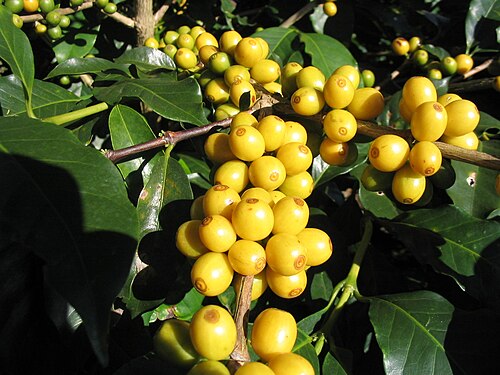
Photo by unknown, CC BY-SA. Source.

- Early 1700s — French missionaries carry coffee from Yemen to Bourbon Island. World Coffee Research’s history of Arabica records three separate introduction attempts, in 1708, 1715 and 1718.3 Isolated there, the plants become the lineage we now call Bourbon.
- Around 1860 — Bourbon reaches Brazil, and from there spreads across South and Central America over the following decades.
- Along the way it also travels into East Africa, where Bourbon-descended selections became the backbone of Kenyan and Rwandan coffee — see SL28.
Both Bourbon and Typica ultimately came out of Yemen, and they are conventionally described as the two parents of the modern Arabica world. The genetics literature treats them as two separate dispersals from the same Yemeni stock rather than one descending from the other — see Bourbon-Typica group for what the shared family label means and how narrow the resulting gene pool is.4
To verify
Many popular coffee sites state flatly that Bourbon is a natural mutation of Typica that happened on the island. The two authoritative sources checked here do not say that: World Coffee Research describes Bourbon only as having a “Bourbon-like genetic background” within the “Bourbon-Typica group” and says it was introduced from Yemen; Wikipedia calls Bourbon and Typica two varieties that both “originated in Yemen,” without making one the parent of the other. Treat “mutation of Typica” as an unconfirmed popular claim rather than established fact.
To verify
The “early 1700s” dating is often narrowed in popular writing to a single founding year. World Coffee Research’s variety record says only “the early 1700s,” while its history-of-Arabica page lists three attempts — 1708, 1715 and 1718 — without saying which one took.13 Treat any single year as an approximation.
What the plant is like
Everything below is from the World Coffee Research variety catalogue entry — the specialty industry’s reference database for coffee varieties, maintained by World Coffee Research.
- Stature: tall.
- Yield potential: medium. WCR’s own summary calls Bourbon “characterized by relatively low production, susceptibility to the major diseases, and excellent cup quality.”
- Coffee leaf rust: low resistance / susceptible. Rust is the fungal disease Hemileia vastatrix, the single biggest threat to Arabica farms — see Coffee leaf rust.
- Nematodes: susceptible. (Nematodes are microscopic soil worms that attack roots.)
- Coffee berry disease: susceptible.
- Quality potential: “High,” rated “Very Good” at higher elevations. The altitude that counts as “high” shifts with latitude — near the equator (5°N–5°S) WCR puts it above 1,600 m.
There is an apparent contradiction worth untangling. Bourbon is often described as yielding 20–30% more than Typica while WCR simultaneously calls its production “relatively low.” Both are true: Typica is a famously unproductive plant, so beating it by a quarter still leaves Bourbon far behind modern high-yield hybrids.
The family tree
Bourbon is less a single variety than the root of a large family. Confirmed descendants and relatives, each verified against its own World Coffee Research entry:
| Variety | Relationship to Bourbon | Where / when |
|---|---|---|
| Caturra | ”Natural mutation of the Bourbon variety” — a dwarf form | Minas Gerais, Brazil, between 1915 and 19185 |
| Mundo Novo | ”Typica x Bourbon” natural cross | Mineiros do Tietê, São Paulo; found 1943, distributed from 19526 |
| SL28 | ”Bourbon-like genetic background”; selected from a population called Tanganyika Drought Resistant | Scott Agricultural Laboratories, Kenya, 19357 |
| Pacas | ”A natural mutation of Bourbon” — a dwarf form | Santa Ana, El Salvador, 1949; formal selection by ISIC from 19608 |
| Villa Sarchi | ”A natural mutation of a Bourbon population” — a dwarf form | Alajuela, Costa Rica, 1950s or 1960s9 |
| Catuaí | ”Mundo Novo x Caturra” — Bourbon-derived on both sides | Instituto Agronômico, São Paulo, Brazil; created 1949, released 197210 |
| Pacamara | ”Pacas x Maragogipe” — Bourbon-derived through its Pacas parent | Instituto Salvadoreño de Investigaciones del Café, El Salvador11 |
The single most repeated event in that table is the dwarfing mutation. Bourbon spontaneously threw a short-growing version of itself at least three separate times in three different countries — Caturra in Brazil, Pacas in El Salvador, Villa Sarchi in Costa Rica — and each time farmers pounced on it, because a short plant can be packed closer together and picked without ladders. World Coffee Research describes all three the same way: a single-gene mutation in a Bourbon population that makes the plant grow smaller.
Caturra in turn is the parent of much of what came next, including the Catimor family, which was bred by crossing Caturra with rust-resistant stock precisely because Caturra inherited Bourbon’s vulnerability to rust. Every one of the Bourbon descendants above is still rated susceptible to leaf rust — the family passed its cup quality and its fragility down together.
Laurina — “Bourbon Pointu,” the naturally low-caffeine variety — is a mutation of Bourbon found on the same island Bourbon itself came from.12
SL34 is not a Bourbon descendant, despite being widely listed as one. Its historical record says it was selected from a “French Mission” (Bourbon) population in Kenya in the late 1930s, but World Coffee Research reports that genetic testing places it in the Typica-related group with a “Typica-like genetic background,” and says outright that the original French Mission story “could be incorrect”.13 Its Kenyan stablemate SL28 does still test as Bourbon-related — the two are usually named in one breath, but only one of them belongs to this family.
To verify
Secondary sources describe Red, Yellow, Orange and Pink Bourbon as stable colour variants of the same family. World Coffee Research’s catalogue returns no entry for either Yellow Bourbon or Pink Bourbon (both, HTTP 404), so their standing as catalogued Bourbon variants rests on secondary sources only — this matters, since a Brazilian yellow Bourbon holds a place in the Cup of Excellence record books. For Pink Bourbon the picture is now stronger than “uncatalogued”: DNA testing commissioned by Cafe Imports found it is not a Bourbon at all, but an Ethiopian landrace — see its own note.
What it tastes like
The authoritative agronomic verdict is short: excellent cup quality, rated “Very Good” at altitude by World Coffee Research. Wikipedia frames the traditional trade view more conservatively — Bourbon quality is “generally accepted to be standard to good” — which reflects how it was judged as a commodity rather than how specialty buyers rate the best lots.
Specialty roasters and variety guides consistently describe Bourbon as sweet and balanced with a medium-to-full body, leaning chocolate and caramel, with a clean brightness on top. Those descriptors come from roaster and blog write-ups rather than a controlled sensory study, so read them as the trade’s shared impression, not a measurement.141516
To verify
One encyclopedia-style compilation puts carefully processed washed Bourbon lots at roughly 83–91+ points on the Specialty Coffee Association 100-point scale. That range is a synthesis of scattered cupping and competition data, not a published dataset, and no primary source for it was found. Don’t quote it as a standard.
Where it’s still grown
World Coffee Research notes that Bourbon “has largely been replaced by varieties that descend from it,” but that the original is still cultivated in El Salvador, Guatemala, Honduras, and Peru.
That replacement accelerated after the coffee leaf rust epidemics that swept Central America from roughly 2008 onward, when many farms pulled susceptible Bourbon and Caturra blocks in favour of resistant hybrids. Quality-focused estates at high altitude often kept theirs.
To verify
Secondary sources claim Rwanda and Burundi hold some of the highest proportions of Bourbon in their national Arabica plantings, and that the Central American replanting was driven specifically by the 2008–2013 rust epidemic. The exact epidemic years are still unconfirmed. The country claim is now partly supported for Rwanda: the exporter Sucafina states that Bourbon accounts for 95% of all coffee trees cultivated in Rwanda,17 and an encyclopedia entry independently gives Bourbon as the dominant variety within the country’s 97%-Arabica crop.18 For Burundi it remains unconfirmed — Bourbon, French Mission Bourbon, Jackson and Mibirizi are all listed as Burundian cultivars, with no percentage split published.19
Related
- Typica — the other founding Arabica variety
- Bourbon-Typica group — the genetic family the two founders define, and the bottleneck behind it
- Laurina — the low-caffeine Bourbon mutation from the same island
- Caturra · Mundo Novo · SL28 · Pacas · Villa Sarchi · Catuaí · Pacamara — verified Bourbon descendants
- SL34 — the famous “Bourbon” that genetic testing says is actually Typica-related
- Coffee leaf rust — the disease that keeps pushing Bourbon off farms
- World Coffee Research — keeper of the variety catalogue
- Geisha — the variety that displaced Bourbon at the top of the price charts
- Coffee scoring · Cupping — how its cup quality gets judged
- Cup of Excellence records by country — where a Brazilian yellow Bourbon once held the record
- Rwanda · Burundi — the two origins built almost entirely on Bourbon