Mundo Novo
Mundo Novo is the variety that nobody bred. Somewhere in a São Paulo coffee field, a Bourbon plant and a Typica plant crossed on their own, and the seedlings that came out grew bigger and carried more fruit than anything around them. Farmers noticed. Brazil’s agricultural institute noticed. Within a decade it was being handed out to growers across the country, and within thirty years it had become the plant Brazilian coffee was built on.123
The formal record is short and unusually clean. World Coffee Research states that Mundo Novo “is the result of a natural cross between the Bourbon and Typica varieties found in Mineiros do Tietê, São Paulo, Brazil,” that the variety was discovered in 1943, and that it was bred out by the Instituto Agronômico de Campinas (IAC).4
The name means “New World” in Portuguese, and it is a place name rather than a boast: seed from the original plants was taken to a municipality then called Mundo Novo — renamed Urupês in 1944 — and it was the growing-out done there that produced the variety.567
Its most lasting contribution is genetic. Cross Mundo Novo with a dwarf Caturra and you get Catuaí, which is now one of the most planted Arabicas in the Americas — so a great deal of Brazilian and Central American coffee carries Mundo Novo genetics without ever saying so on the bag.8
One wrinkle in how the parentage gets written down. Trade sources often specify the cross as “Red Bourbon × Typica from Sumatra”,9 which reads like a third parent has been smuggled in. It hasn’t. “Sumatra” is one of World Coffee Research’s listed trade names for Typica itself — along with Criollo, Indio, Arábigo and Blue Mountain — as recorded on this wiki’s Typica note. The Trabocca phrasing and the WCR phrasing describe the same two parents; one just uses the regional name for the Typica line that reached Brazil by way of Java and the Guianas.
Resolved: World Coffee Research and Diário da Região used to disagree here, WCR calling the municipality “Novo Mundo” and the newspaper calling it “Mundo Novo.” The Portuguese Wikipedia record and the town’s own government page settle it: the municipality was founded as Mundo Novo on 24 September 1928 and renamed Urupês in 1944, after the Tupi word urupê.67 WCR has the word order inverted. The municipal page also quotes the IAC breeder Alcides Carvalho directly — the Coffee Commission named the variety Mundo Novo “in tribute to the municipality that diffused it.”6
Where it came from
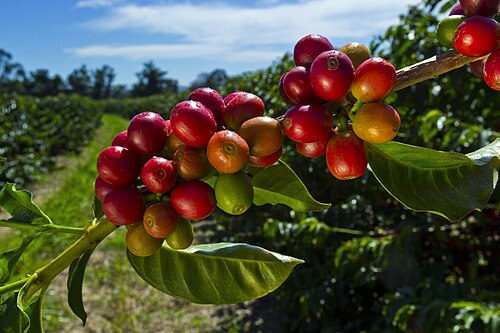
Photo by Jonathan Wilkins, CC BY-SA. Source.

- 1943 — the natural cross is spotted at Mineiros do Tietê, São Paulo, and the IAC begins working on it.
- 1940s — seed is grown out and selected at Novo Mundo / Urupês, where the variety is stabilised and named.
- 1952 — Mundo Novo is released to Brazilian farmers, and reaches Costa Rica the same year.
- 1950s onward — it spreads through Brazil’s coffee regions, above all Minas Gerais, São Paulo and Paraná.
That timeline matters for a reason that is easy to miss. Brazil’s post-war replanting happened almost entirely with material coming out of a public institute, not out of a seed company — the same institute that later produced Caturra’s selection programme and Catuaí itself.
Corroborated: the farm-level origin story used to rest on one regional newspaper. It now has a second, independent and more authoritative source — the Urupês municipal government’s own history page, which names Fazenda Aparecida (owner Luís Crivellaro) and Sítio Bacuri (owner Pedro Mázaro) as the properties whose exceptionally vigorous, well-branched and productive coffee brought the IAC to town in 1943, and credits Mázaro’s smallholding as the place farmers queued for seed.610 Still missing: an IAC or agronomic document naming the farms. Two independent local records now agree, which is enough to state the farms as fact, but not the finer details of who did what.
What the plant is like
All figures from the World Coffee Research variety catalogue entry, the specialty industry’s reference database, maintained by World Coffee Research.
| Trait | Mundo Novo |
|---|---|
| Genetic group | Bourbon-Typica group |
| Parentage | Typica × Bourbon (natural cross) |
| Breeder | Instituto Agronômico de Campinas, Brazil |
| Stature | Tall |
| Leaf tip colour | Green or bronze |
| Yield potential | Medium |
| First production | Year 3 |
| Planting density | 3,000–4,000 plants/ha (single-stem pruning) |
| Nutrition requirement | High |
| Ripening period | Average |
| Bean size | Average |
| Optimal altitude | High (varies by latitude) |
| Quality potential at altitude | Good |
| Coffee leaf rust | Low resistance / susceptible |
| Nematodes | Susceptible |
| Coffee berry disease | Susceptible |
Read that table next to Caturra and the trade-off is obvious. Mundo Novo is tall, so it plants at 3,000–4,000 trees per hectare against Caturra’s 5,000–6,000 — fewer trees in the same ground, and pickers need ladders. What it offered instead was raw toughness: a big, hard-to-kill plant that took pruning well and kept cropping year after year without the violent on-off cycle Brazilian growers dreaded.
The disease rows are the family curse. Mundo Novo is susceptible to leaf rust, nematodes and coffee berry disease — exactly like both of its parents, and exactly like Catuaí, the child it went on to produce. Nothing in this lineage is resistant to anything.
To verify
Mundo Novo’s yield rating is the biggest unresolved conflict in this note. World Coffee Research rates its yield potential at “medium” — the same as Caturra, and below Catuaí’s “medium to very high.” Nearly every other source calls it high-yielding: Green Coffee Collective describes it as “vigorous, tall, and productive” and “high-yielding”;11 Ozone Coffee calls its yield potential “impressively high”; Bean Brew Digest cites a 2018 Embrapa study reporting 38 bags/ha of parchment under optimal conditions.12 This wiki’s own Catuaí note explains that variety’s yield jump as inherited “Mundo Novo’s productivity,” which the WCR ratings do not support on their face. The likely reconciliation is that WCR’s “medium” is a global rating against modern hybrids, while the Brazilian reputation is relative to the Bourbon and Typica plantings Mundo Novo replaced in the 1950s. That is an interpretation, not a sourced fact.
To verify
Altitude is also contested. World Coffee Research puts Mundo Novo’s optimal altitude at “high (varies by latitude)” — its standard formula, which it deliberately refuses to reduce to one number. Secondary sources say the opposite: Green Coffee Collective describes it as suited to “Brazil’s lower-altitude commercial growing conditions,” and Bean Brew Digest gives a specific band of 800–1,100 masl with best expression at 950–1,050 masl. Both readings can be partly true — Brazil’s coffee belt is lower than Central America’s, so “high for Brazil” is not high globally — but no source reconciles them. Don’t quote the 800–1,100 m band as the variety’s specification.
To verify
Bean Brew Digest states that Mundo Novo was selected in part for “disease resistance (particularly to coffee leaf rust)”. The importer Trabocca repeats the same idea in trade form, saying Mundo Novo is “often chosen by Brazilian farmers because of its high yield and resistance against common coffee tree diseases”. Both directly contradict the World Coffee Research record, which rates rust resistance as low / susceptible and marks the variety susceptible to nematodes and coffee berry disease as well. Prefer WCR — it is the only one of the three publishing a structured agronomic rating. Note that two sources repeating a claim is not two sources confirming it; this looks like a piece of trade folklore, not an independent finding. Any “rust-tolerant Mundo Novo” claim should be treated as wrong until a primary agronomic source says otherwise.
How much of Brazil it actually was
This is the part of the Mundo Novo story everyone repeats and nobody sources properly.
To verify
Two circulating statistics, neither traced to a primary dataset. Bean Brew Digest, citing Embrapa Café, says Mundo Novo accounted for over 40% of Brazil’s Arabica plantings by the 1970s — the Embrapa publication itself was not located, so this is a citation of a citation. Diário da Região goes much further: “cerca de 80% das plantas existentes no País eram originárias de Urupês” — roughly 80% of the plants in the country originated from Urupês. The 80% figure is a regional newspaper’s framing with no period attached and no census behind it, and “originating from Urupês” may be counting descendants such as Catuaí rather than Mundo Novo plantings. Use neither number as a statistic.
What is safe to say, because independent sources agree on it, is directional: Mundo Novo became one of the most widely planted varieties in Brazil, and Brazilian coffee today carries its genetics broadly even where the variety is not named on the lot.
The descendants nobody catalogued
Catuaí is the famous child, but it is not the only one, and this is where the paper trail runs out in an interesting way.
Brazil kept breeding from Mundo Novo for decades — Acaiá, Icatu, Catucaí and Arara are all Brazilian selections commonly described in the trade as Mundo Novo derivatives or Mundo Novo backcrosses. Every one of those names appears in Brazilian Cup of Excellence results. None of them has an entry in the World Coffee Research variety catalogue.
That was checked directly: WCR’s Arabica catalogue lists 70-odd varieties including Mundo Novo, Catuai, Caturra, Bourbon, Typica, Pacamara, Obata (Red) and Geisha (Panama) — and contains no page for Acaiá, Icatu, Catucaí or Arara.13
The gap is not evidence that those varieties are unimportant. It is evidence that the industry’s main reference database is built around varieties that moved internationally, and Brazil’s domestic breeding programme largely stayed home. If you are trying to identify a Brazilian lot by variety, expect WCR to come up empty more often than it does for Central America.
To verify
The specific lineage of each Brazilian descendant is not established here. Acaiá is widely described as an IAC selection out of Mundo Novo, and Icatu as a Robusta × Bourbon hybrid backcrossed to Mundo Novo, but neither claim could be checked against WCR (no entry exists) or against an IAC or Embrapa primary document —
iac.sp.gov.brdid not respond when checked for the Catuaí note. Treat “Mundo Novo is the parent of Acaiá and Icatu” as trade consensus awaiting a primary source. The only descendant confirmed against a structured record is Catuaí.
Where it spread
World Coffee Research records the introductions:
| Country | Introduced / released |
|---|---|
| Brazil | bred there; released from 1952 |
| Costa Rica | 1952 |
| Guatemala | 1963–64 |
| Honduras | 1974 |
| Peru | recorded, no date given |
| Malawi | recorded, no date given |
Note that Costa Rica had it in the same year Brazil released it. Material moved between Latin American research stations fast — the same pattern visible in the Catuaí note, where Guatemala was planting Catuaí two years before Brazil’s official release.
What it tastes like
The only formal rating is World Coffee Research’s: quality potential at altitude, “Good.” That is the same word it gives Caturra and Catuaí, and one notch below Bourbon’s and Typica’s “Very Good.”
That single word carries the whole commercial logic of the variety. Mundo Novo was never planted to win anything. It was planted because it was reliable — a clean, sweet, unsurprising cup produced in volume, which is exactly what a blend needs.
To verify
The flavour descriptors in circulation all come from roaster and educational write-ups, not from a controlled sensory study or a cupping dataset. Green Coffee Collective: “cup quality is reliable rather than distinctive — clean, moderate acidity, full body,” suited to commercial blending. Ozone Coffee: “mild to medium” acidity, “full and creamy” body, with hazelnut/almond, chocolate and caramel-to-brown-sugar sweetness. Bean Brew Digest goes furthest, listing roasted hazelnut, dried fig, milk chocolate, cedar or toasted grain, soft malic acidity, and a cocoa-and-baked-apple finish. They converge on the same shape — nutty, chocolatey, soft-acid, full-bodied — so the direction is trustworthy even though the specific notes are not measurements.
As always, processing is not part of the variety. Whether a Mundo Novo lot arrives as a natural, washed, honey or anaerobic coffee is a farm decision, and Brazil’s default is natural — dried whole in the fruit. One documented example: a Brazil Cerrado Mineiro DO – Fazenda Líder – Mundo Novo lot sold as a natural.14 That is an importer’s product listing, not a score sheet — no cupping score or verified altitude for that lot is available here.
The competition record — and its absence
There isn’t one, and that is the most informative fact in this section.
At the 2019 Cup of Excellence Brazil, checked directly against the Alliance for Coffee Excellence results page,15 no winning lot was a Mundo Novo. The varieties that placed were Yellow and Red Catuaí, Catuaí 144, Gesha, Yellow Bourbon, several Catucaí selections, Acaiá, Obatã and Arara — including Mundo Novo’s own child, which took the top two positions.
Read that winners list again, though, and the absence is narrower than it looks. Catuaí, Catucaí, Acaiá and Arara are all Mundo Novo descendants or reputed descendants — so on the trade’s own account of the lineages, most of the 2019 Brazilian podium was Mundo Novo genetics under other names. What is missing from the results is the name, not the DNA. (The lineage caveat in the section above applies: only Catuaí’s parentage is confirmed against a structured record.)
No primary auction record from the Alliance for Coffee Excellence, Cup of Excellence, Best of Panama, the SCA or the CQI documenting a named Mundo Novo lot with a score, price or buyer was found. Anyone quoting a Mundo Novo competition score is synthesising.
The honest reading: Mundo Novo is a production variety, and it was superseded at the top of the quality table by the descendants it made possible. Its legacy is measured in hectares and in genetics, not in hammer prices.
Related
- Fazenda Aparecida (Urupês) — the farm in Urupês whose trees brought the IAC to town in 1943
- Bourbon · Typica — the two parents that crossed on their own to make it
- Catuaí — its child with Caturra, and the variety that now wins the competitions it never did
- Caturra — the dwarf it was crossed with, and the shape Brazilian farming moved toward
- Acaiá · Icatu — the other Brazilian selections bred from it, absent from the international variety catalogue
- Robusta — the species crossed into the Icatu line that was then backcrossed to Mundo Novo
- Instituto Agronômico · World Coffee Research — the institute that selected it and the body that catalogues it
- Coffee leaf rust — the disease it, its parents and its child are all susceptible to
- Natural process · Honey process · Anaerobic fermentation — the processing choices applied to it on the farm
- Cup of Excellence · Alliance for Coffee Excellence · Cup of Excellence records by country — the competition record it is absent from
- Cerrado Mineiro — the demarcated Brazilian region where it is one of the two dominant varieties
- Daterra — Brazilian estate coffee at the quality end of the same country’s production
- Coffee scoring · Cupping — how “Good” quality potential gets turned into a number
Official links
-
Official site — World Coffee Research variety record: Mundo Novo
-
Official site — World Coffee Research Arabica variety catalogue
-
Official site — Instituto Agronômico (IAC), the breeding institute
(iac.sp.gov.br did not respond when first, but answered normally later the same day while the Instituto Agronômico note was being written — the domain appears to be intermittent.)
Footnotes
-
Morning Wines — Mundo Novo: Brazil’s workhorse and the father of Catuaí ↩
-
XLIII Coffee — Giống cà phê Mundo Novo: tiềm năng specialty coffee từ Brazil ↩
-
Prefeitura Municipal de Urupês — Café Mundo Novo — confirmed via WebFetch; the municipality’s own history page, source of the 1928 seed arrival from Mineiros do Tietê, the 1943 IAC investigation, Fazenda Aparecida / Luís Crivellaro and Sítio Bacuri / Pedro Mázaro, and the Alcides Carvalho quotation on the naming of the variety ↩ ↩2 ↩3 ↩4
-
Urupês — Wikipédia (Portuguese) — confirmed via WebFetch; source of the municipality’s founding as Mundo Novo on 24 September 1928 and its 1944 renaming to Urupês ↩ ↩2
-
Diário da Região — Supervalorizado no mercado, café Mundo Novo surgiu na região de Rio Preto ↩
-
Green Coffee Collective — Mundo Novo: Brazilian natural Typica-Bourbon cross ↩
-
Burman Coffee — Brazil Cerrado Mineiro DO, Fazenda Líder, Mundo Novo ↩
-
Alliance for Coffee Excellence — Brazil 2019 results and auction ↩