Coffee berry disease
Coffee berry disease attacks the fruit, not the leaf. A fungus lands on a green cherry that is still weeks away from ripening, sinks a dark sunken patch into its skin, and rots it on the branch. The fruit either drops or dries into a hard black mummy. Nothing is harvested from it, because the bean inside never finished forming.
That is the difference between this and Coffee leaf rust, the other great coffee fungus. Rust starves the tree slowly by taking its leaves. Berry disease takes the crop directly, in the same season, off a tree that otherwise looks healthy. The trade shortens it to CBD.
The fungus is Colletotrichum kahawae — kahawa is Swahili for coffee. It was long filed under the name Colletotrichum coffeanum, and only formally separated as its own species by Waller and Bridge in 1993.1 Older papers still call it C. coffeanum var. virulans, which is why the literature looks confusing before you know the name changed.2
Where it came from, and where it is
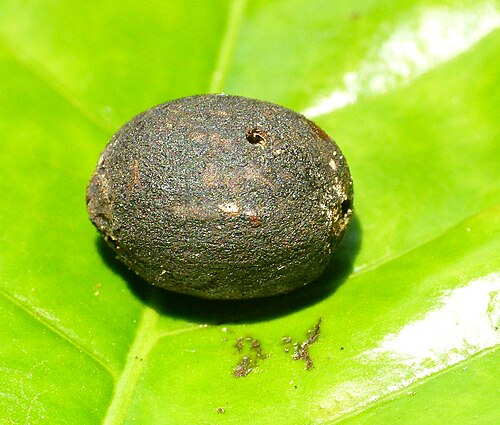
Photo by L. Shyamal, CC BY-SA. Source.

CBD was first recorded in western Kenya in 1922, on Coffea arabica plantations.123 It then worked its way through Africa’s arabica belt over the next sixty years:1
| Year | Country | |
|---|---|---|
| 1 | 1922 | Kenya (first record) |
| 2 | 1930 | Angola |
| 3 | 1938 | Democratic Republic of Congo |
| 4 | 1955 | Cameroon |
| 5 | 1964 | Tanzania |
| 6 | 1971 | Ethiopia |
| 7 | 1985 | Malawi and Zimbabwe |
The standard line in coffee literature is that CBD exists only in Africa — that no other continent has it, and that quarantine rules are the reason.243 That is very close to true, but not quite, and the exception matters (see the callout below).
To verify
“Africa only” is the textbook claim, and it has cracks. Wikipedia’s pathogen page states that “until 2018, the disease remained constrained to the African continent, but reported occurrence now includes Colombia and Cuba in the Americas with Hainan island in Asia.”1 The EPPO Global Database, the European plant-health authority’s official register, does not support that reading: it lists Cuba as “Absent, unreliable record”, carries no present record for Colombia, and records only China — present, restricted distribution, with “few occurrences” in Yunnan province as a confirmed non-African presence.5 Treat “restricted to Africa” as the working truth, with a confirmed foothold in Yunnan and the American reports unconfirmed. This has a direct bearing on this wiki’s Yunnan coffee note, which does not currently mention the disease.
What it does to a crop
The damage figure most often quoted, and the one confirmed here: up to 80% yield loss, with losses around 50% of the potential crop still occurring under unfavourable weather even where the disease is being managed.1 Farm-level reports of 70–100% loss where nothing is sprayed appear across the agronomic literature.46
Kenya’s own history is the clearest illustration. An outbreak in 1968 destroyed roughly half the country’s coffee production — the event that caused the breeding programme behind Ruiru 11, as that note records in detail.
It is worst where arabica is best: high altitude, high humidity, high rainfall.14 The conditions that give East African coffee its acidity are the same conditions the fungus wants.
On the tree
- Green berries are the target. Wikipedia’s pathogen record puts peak susceptibility at 4–14 weeks after flowering;1 the agronomic sources behind this note give a wider window of roughly 5–20 weeks, and add that flowers and ripe cherries can also be hit.24 Either way: the fruit is attacked long before harvest.
- Infection shows as dark brown, slightly sunken spots that spread until the berry blackens. A second, milder form appears as corky, pale tan “scab” lesions.1
- The fungus pushes straight in through the berry skin — it does not need a wound or a pore. For a short while it lives alongside living plant cells, then switches, releases enzymes that kill the tissue, and feeds on what it has killed.4
- Spores are produced in acervuli — small cushions of fungal tissue that burst through the skin — and rain-splash moves them to the next fruit.2
Not every Colletotrichum on a coffee cherry is this. A much less damaging brown blight turns up on ripening fruit worldwide, caused by other strains of the same genus. Only the green-berry killer is CBD.27
Fighting it: spray, or plant something else
Copper fungicides are the cheap standby, and the cost is not in the chemical but in how often you have to apply it. Disease pressure can demand 7–8 applications a year, which can reach 45% of a farm’s annual production cost.1 That single number explains why African breeding programmes chased resistance so hard: spraying works, and it eats the farm.
Other chemistry has been used — captafol, chlorothalonil, benomyl, thiophanate-methyl, thiabendazole, dithianon — and tolerance has already been observed with carbendazim, cypendazol and, less so, benomyl, so mixtures and rotations with non-systemic protectants are the standing advice.7 Cultural work helps the spray reach its target: hedgerow planting and opening the canopy by pruning let fungicide actually land on the fruit.73
The other answer is genetic. Major resistance genes sit at three separate loci in arabica, and two sources of resistance are cited over and over: Rume Sudan, a wild-origin Sudanese arabica, and the Timor Hybrid (Híbrido de Timor), the natural arabica × robusta cross that also carries rust resistance.18 Both names run straight through this wiki’s variety pages — Rume Sudan is a parent of Ruiru 11, Batian and CATIE’s Centroamericano; the Timor Hybrid is the backbone of Catimor and Sarchimor.
No arabica has been shown to be completely resistant.4
Which varieties catch it
The resistance ratings recorded across this wiki’s variety notes, which follow World Coffee Research’s catalogue:
| Resistant | Susceptible |
|---|---|
| Ruiru 11 · Batian · Starmaya · JARC 74158 · Castillo · Cenicafé 1 | SL28 · SL34 · SL14 · Bourbon · Typica · Geisha · Caturra · Mundo Novo · Pacamara · Villa Sarchi · Lempira |
Read that table next to the Best of Panama and Cup of Excellence score sheets and the tension is obvious: the varieties specialty buyers pay most for are, almost without exception, in the right-hand column. Kenya lives this trade-off every season — SL28 and SL34 built the country’s reputation and catch everything, while Ruiru 11 and Batian keep farms solvent and get stepped around by buyers. The Kenya note covers that argument.
CBD is normally listed with Coffee leaf rust and coffee wilt disease as the three major fungal diseases of arabica in Africa.89
To verify
Is robusta immune, or a host? The breeding literature treats Coffea canephora — Robusta — as totally resistant to CBD, which is precisely why the Timor Hybrid is useful.48 But Wikipedia’s pathogen page lists robusta among the fungus’s hosts, alongside liberica, apple, mandarin and tree tomato.1 These may be reconcilable — a pathogen can infect a plant in a lab without causing field disease — but no source consulted here reconciles them. Do not state robusta immunity as settled fact.
To verify
The Brazil import claim. An educational coffee course states that in Brazil, roasters are prohibited from importing green coffee from Africa specifically to keep CBD out.4 No official Brazilian government or phytosanitary text was consulted, and the scope, date and current status of any such rule are unverified. That CBD drives phytosanitary restrictions on green coffee movement out of Africa is well attested in general terms;43 this specific rule is not.
Related
- Coffee leaf rust — the other great coffee fungus; takes the leaves instead of the fruit
- Ruiru 11 · Batian — the two Kenyan varieties bred as the answer to it
- KALRO — the Kenyan research body (formerly the Coffee Research Foundation at Ruiru) that bred them
- Timor Hybrid · Catimor · Sarchimor — the resistance-breeding line CBD shares with rust
- SL28 · SL34 · SL14 — the susceptible Kenyan classics kept for their cup
- Kenya · Ethiopia — the origins that live with it
- Coffee cherry — the fruit the disease destroys
- World Coffee Research — publisher of the per-variety CBD resistance ratings
- Climate change and coffee — the warming and rainfall shifts that move disease pressure
- Arabica vs Robusta — why the species difference matters here
Official links
- Official site — EPPO Global Database, Colletotrichum kahawae datasheet
- Official site — World Coffee Research variety catalogue (CBD rating per variety)
Footnotes
-
Wikipedia — Colletotrichum kahawae — confirmed via WebFetch; source of the 1922 Kenya first record, the country-by-country spread dates, the 80% and 50% loss figures, the 4–14 week susceptibility window, the 7–8 copper applications and 45%-of-production-cost figure, the three resistance loci, and the Waller & Bridge 1993 description ↩ ↩2 ↩3 ↩4 ↩5 ↩6 ↩7 ↩8 ↩9 ↩10 ↩11
-
CABI — Coffee Pests, Diseases and Nutritional Disorders (chapter PDF) ↩ ↩2 ↩3 ↩4 ↩5 ↩6
-
Coffee berry disease: a century-old anthracnose of green berries of Arabica coffee (Coffea arabica L.) in Africa, Journal of Plant Diseases and Protection (2023) — publisher blocked automated access; cited via the research report only ↩ ↩2 ↩3 ↩4
-
Barista Hustle — T 4.03 Coffee Berry Disease — page returned HTTP 402 to automated access; cited via the research report only ↩ ↩2 ↩3 ↩4 ↩5 ↩6 ↩7 ↩8 ↩9
-
EPPO Global Database — Colletotrichum kahawae distribution — confirmed via WebFetch; source of the Yunnan/China record and the “absent, unreliable record” status for Cuba ↩
-
Review on coffee berry disease, Journal of Biology, Agriculture and Healthcare 10(20), 2020 (PDF) ↩
-
University of Hawaii Extension — Colletotrichum coffeanum crop knowledge master ↩ ↩2 ↩3
-
Coffee resistance to the main diseases: leaf rust and coffee berry disease (PDF) ↩ ↩2 ↩3
-
A review of three major fungal diseases of Coffea arabica L. in the rainforests of Ethiopia and progress in breeding for resistance in Kenya, Journal of Advanced Research — returned HTTP 403 to automated access; cited via the research report only ↩