Coffee berry borer
The coffee berry borer is a beetle about the size of a sesame seed that flies to a coffee cherry, drills a hole in the end of it, and lays its eggs inside the seed. The grubs eat the seed from the inside out. What comes off the tree looks like a normal cherry; what comes out of the mill is a bean with holes in it, lighter than it should be, and often mouldy.
It is the single most damaging insect pest of coffee anywhere in the world.12 Growers in Latin America call it la broca — “the drill”. English-language trade writing also calls it the coffee borer beetle, and science shortens it to CBB.
The insect is Hypothenemus hampei, described by Ferrari in 1867. It sits in the weevil family Curculionidae, in the bark-beetle subfamily Scolytinae.3
This is the fruit-side counterpart to the two great coffee fungi already on this wiki: Coffee leaf rust takes the leaves, Coffee berry disease rots the green cherry, and the borer eats the seed itself.
What it actually is
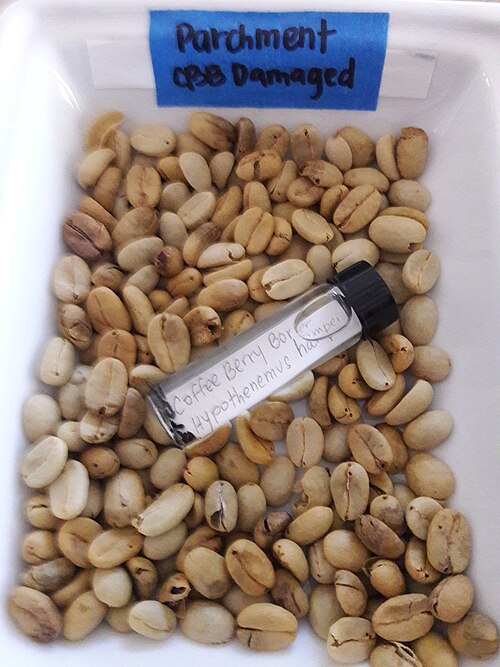
Photo by Forest and Kim Starr, CC BY. Source.
.jpg)
- Size: females 1.4–1.8 mm, males 1.2–1.6 mm — smaller than a grain of rice.3
- Colour: shiny black.3
- Only females matter for spread. Males cannot fly; their wings are underdeveloped. Broods run about 13 females to every male, and mating happens between siblings inside the fruit before the females leave.3 A single infested cherry therefore exports a squad of already-pregnant females and keeps the males at home.
- It lives on caffeine. Microbes in the beetle’s gut make an enzyme, caffeine demethylase, that breaks caffeine down.3 Caffeine is a plant’s insecticide; this insect has outsourced the antidote to its bacteria.
- A draft genome of the species — 163 million base pairs — was published in 2025.3
Why it is so hard to kill
The beetle spends nearly its whole life inside the fruit. A female bores in through the tip of the cherry, cuts a gallery into the seed, and lays eggs there; larvae and adults feed on the seed tissue. By the time anything is visible from outside, the insect is behind a wall of coffee.
That is the whole problem with chemicals: a spray lands on the outside of a cherry the beetle has already left behind. Control therefore leans on three things that do not require reaching inside the fruit:
- Sanitation — stripping every remaining cherry off the tree and off the ground at the end of harvest, so there is nowhere for the population to overwinter. Peer-reviewed review work calls this the most critical part of managing the pest.1
- The fungus Beauveria bassiana, which infects the female during the short window when she is walking on the outside of the fruit. Reported field mortality ranges from under 1% to 70% — a spread wide enough that it is a tool, not a solution.1
- Parasitoid wasps brought over from the beetle’s African home range: Prorops nasuta, Cephalonomia stephanoderis and Phymastichus coffea, plus nematodes.12
Nobody uses one of these alone. The standard framing is integrated pest management — traps and monitoring to know when the flight starts, sanitation to cut the population’s carryover, biology to trim what is left.
Where it came from and where it is
The beetle is native to Africa — the humid evergreen forest belt that is also Coffea’s home ground.123 Early reports date to Liberia in 1897, and over roughly a century it followed coffee around the planet.1
Today it is present in nearly every coffee-producing country.1 The best-attested figure for its human reach: it hurts the income of about 20 million coffee-growing families — roughly 100 million people — in around 80 countries.23
In Hawai’i, one of the last major regions it reached, it was found in South Kona on Hawai’i Island in August 2010, already spread across a stretch of coast from north of Kainaliu to south of ʻŌpihihale — meaning it had been there a while before anyone noticed.4 The Kona note records what it has cost that district since. In Panama, Graciano Cruz — a biological-pest-control specialist before he was a farmer — wrote the country’s borer action plan when the beetle arrived.
To verify — which countries are still free of it
Three sources give three different lists, and this note cannot reconcile them.
- The peer-reviewed global review says the pest is present everywhere except Australia, China and Nepal, assessed as of 2017.1
- A USDA-hosted review lists the exceptions as Nepal and Papua New Guinea.5
- A Hawai’i state plant-protection document also gives Nepal and Papua New Guinea.6
The two PDF sources could not be read directly here (both returned unparseable binary to automated retrieval), so only the first list is confirmed at the source. Treat “present in nearly every coffee-producing country” as the safe statement and check current national plant-protection data before naming any country as free of it.
To verify — the 1926 arrival in Brazil
The date 1926 for the beetle reaching the Americas via Brazil is repeated in commercial coffee writing7 but is not stated in either peer-reviewed source read for this note. What the bibliographic review does show is a run of Brazilian publications on the pest from the 1920s–1930s, which is consistent with the date without confirming it.2 No phytosanitary record was consulted. Do not quote 1926 as established.
What it costs
Losses attributed to the beetle run to more than US$500 million a year worldwide — a figure that appears independently in both the global review and the bibliographic survey.12 For Brazil alone, the review puts annual losses at US$215–358 million.1
To verify — the yield-loss percentages
Three numbers circulate and they measure different things, which is why they look contradictory:
- 50–100% of berries attacked where no control is applied — CABI’s compendium entry, which returned HTTP 403 to automated retrieval and could not be confirmed at source.8
- Crop losses up to 35%, from an agronomy blog.7
- Yields reduced by up to 90% in some regions — the figure the Kona note already carries, sourced there to an encyclopedia article.6
“Share of berries hit” and “share of the crop lost” are not the same measurement, and none of the three was verified against a primary field study here. Quote them as claims, not as facts.
Why specialty coffee cares
Every hole in a bean is a defect, and defects are counted before a coffee is ever scored. Insect-damaged beans lose weight, and the entry and exit holes let in moisture and fungus, which is where the mould and off-flavours come from.7 In Green coffee grading terms the damage shows up in the defect count; in Cupping terms it shows up as a lower score and a downgraded lot.
The practical consequences on a farm are all upstream of the cupping table:
- Selective picking and floater removal at intake — bored cherries are light and float, so they can be pulled out before processing.
- Density and colour sorting in dry milling, which is where most insect-damaged beans are actually caught.
- Drying and storage discipline, because a bean with a hole in it takes on moisture faster than an intact one — see Water activity.
Climate change and coffee adds the forward-looking part: a peer-reviewed systematic review expects the beetle’s distribution to increase as the growing belt warms, at the same time as rust severity rises. Warmer nights at altitude mean more generations per season in places that used to be too cool for it.
To verify — no published score penalty
There is no public dataset tying borer damage to a specific number of cupping points. Labs, mills and buyers measure it lot by lot and do not publish. Any claim that borer damage costs “X points” on the SCA cupping protocol scale should be treated as unsupported. Likewise, no Cup of Excellence or Best of Panama lot in the sources checked here is publicly linked to borer infestation — the pest sits in defect counts and farm narratives, not in auction results.
The scale of the research
A single bibliographic review compiled 1,865 peer-reviewed and non-peer-reviewed papers on this one insect.2 For comparison, that is the literature of a major crop disease attached to a beetle under two millimetres long — a fair measure of how much of world coffee’s agronomy budget it consumes. Cenicafé in Colombia and IHCAFE in Honduras both run standing borer programmes.
Related
- Coffee leaf rust — the leaf fungus; the other permanent cost line on a coffee farm
- Coffee berry disease — the fungus that rots the green cherry, where the borer eats the seed
- Coffee cherry — the fruit the beetle drills into
- Climate change and coffee — the warming that is projected to widen the beetle’s range
- Green coffee grading · Cupping — where insect damage turns into lost points
- Selective picking · Dry milling — the two stages that pull damaged beans out of a lot
- Kona — the origin whose economics changed when the beetle arrived in 2010
- Graciano Cruz — the Panamanian producer who wrote his country’s borer action plan
- Cenicafé · IHCAFE — national research bodies running borer programmes
- Arabica vs Robusta · Robusta — both species are hosts; neither escapes it
- World Coffee Research — the breeding network that tracks pest and disease ratings by variety
Official links
- Official site — CABI Compendium datasheet, Hypothenemus hampei
- Official site — University of Hawai’i CTAHR coffee berry borer programme
Footnotes
-
Coffee Berry Borer (Hypothenemus hampei), a Global Pest of Coffee, PMC — confirmed via WebFetch; source of the US$500m and Brazil US$215–358m figures, the Liberia 1897 record, the Australia/China/Nepal exception list, the Beauveria bassiana <1–70% mortality range, and the sanitation-first management line ↩ ↩2 ↩3 ↩4 ↩5 ↩6 ↩7 ↩8 ↩9 ↩10
-
A Coffee Berry Borer (Coleoptera: Curculionidae) Bibliography, PMC — confirmed via WebFetch; source of the 1,865 papers, the 20 million families / 100 million people / ~80 countries figures, and the named parasitoids ↩ ↩2 ↩3 ↩4 ↩5 ↩6 ↩7
-
Wikipedia — Hypothenemus hampei — confirmed via WebFetch; source of the Ferrari 1867 authority, the adult size range, the flightless males and 13:1 sex ratio, the caffeine demethylase gut microbes, and the 2025 draft genome ↩ ↩2 ↩3 ↩4 ↩5 ↩6 ↩7 ↩8
-
University of Hawai’i CTAHR — coffee berry borer — confirmed via WebFetch; source of the August 2010 South Kona detection and its extent ↩
-
The coffee berry borer, Hypothenemus hampei (Ferrari), Terrestrial Arthropod Reviews (USDA-ARS PDF) — PDF returned unparseable binary to automated retrieval; cited via the research report only ↩
-
Hawai’i Department of Agriculture — Hypothenemus hampei new pest advisory (PDF) — PDF returned unparseable binary to automated retrieval; cited via the research report only ↩ ↩2
-
Coffee & Tea Culture — Coffee Borer Beetle: Coffee’s Worst Insect Pest — commercial guide; not independently verified ↩ ↩2 ↩3
-
CABI Compendium — Hypothenemus hampei (coffee berry borer) — returned HTTP 403 to automated access; cited via the research report only ↩