Baoshan
Baoshan is a prefecture-level city in western Yunnan, China — a mountain administrative region roughly the size of Wales, sitting against the Myanmar border. It is the place where coffee in China stopped being an experiment and started being farmed, and it is the prefecture Chinese specialty buyers name first when they want to argue that Yunnan coffee can be more than blend filler.
Two things make it worth its own note rather than a line in the province’s:
- It has the oldest surviving commercial coffee planting tradition in China, including old Typica trees still standing from the 1950s.
- It is a protected origin in its own right — “Baoshan Arabica Coffee” carries a Chinese geographical indication and, since 2020, recognition in the European Union too.1
Where it is
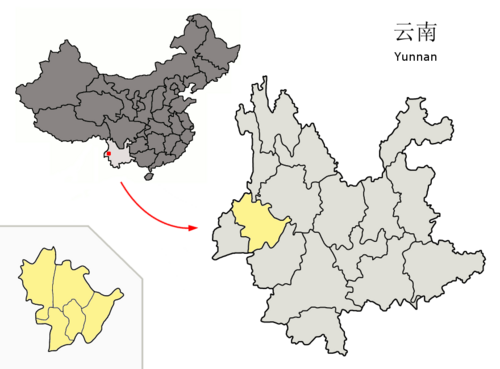
Photo by Croquant, CC BY. Source.
.png)
Baoshan covers about 19,065 km² and is divided into five parts: Longyang District, Tengchong City, and the counties of Shidian, Longling and Changning.2 It borders Myanmar’s Kachin State to the northwest and Shan State to the south, and the Nujiang — the river the rest of the world calls the Salween — runs the length of the prefecture from north to south.2
The coffee sits in the hot, dry valley floors and lower slopes rather than up on the plateau. The two names that matter are the Nujiang dry-hot valley (怒江干热河谷) and Lujiangba (潞江坝), a valley basin in Longyang District that is effectively the birthplace of Chinese arabica.34 The growing area lies on the southern flank of the Gaoligong mountains, a range protected as a biosphere reserve.56
A “dry-hot valley” is the useful bit of geography here: Baoshan is reported to get less rain at harvest than Pu’er or Lincang,4 which is exactly the condition natural processing needs — you can dry whole cherries outdoors without them rotting.
To verify — altitude, and the smaller geographic numbers
Sources disagree badly about how high Baoshan’s coffee grows, and the disagreement is not trivial — it is the difference between a commodity band and a specialty one.
- A coffee-geography site hosted on a personal GitHub page gives 1,100–1,800 m, with a “specialty core” at 1,400–1,800 m.4
- A Yunnan travel site gives 800–1,200 m, extending to about 1,400 m, and says the formal GI standard specifies 1,000–1,500 m.3
- The Alliance for Coffee Excellence table for Gems of Yunnan 2025 — the only figures here that come with a jury attached — puts the Baoshan lots between 1,100 m and 1,500 m.7
The ACE numbers are the ones to trust, because they describe actual scored lots. Do not repeat “1,400–1,800 m” as Baoshan’s specialty band.
Separately, a research report gives Baoshan a 170 km border with Myanmar, an area of 19,600 km² and 92% mountainous or semi-mountainous terrain, sourced to an agricultural-drone company’s blog that could not be reached (the host no longer resolves). The area figure is close to but not the same as the 19,064.6 km² confirmed above.2 Treat the border length and the 92% as unverified.
How coffee got here
The provincial government’s own account dates large-scale Chinese coffee planting to 1952, when experts from the Yunnan Academy of Agricultural Sciences handed 80 kg of coffee seed to farmers at Lujiangba in Baoshan.8 That single hand-out is why Baoshan’s heritage Typica and Bourbon trees exist at all, and why the prefecture is described — including by China’s own intellectual-property office — as a pioneer of Chinese coffee cultivation and processing.13 The surviving trees from that era are marketed locally as “Baoshan old-tree coffee.”4
Baoshan’s own slogan puts the claim more bluntly: “Looking at Chinese coffee, Yunnan’s specialty coffee is in Baoshan.”6
To verify — "China's oldest commercial coffee region," and the mid-century awards
The research report behind this note calls Baoshan flatly China’s oldest commercial arabica region, sourced to a personal coffee-geography site.4 That sits awkwardly with the same provincial portal cited above, which dates commercial cultivation to 1951 at the Luxi Cotton Experiment Station in Dehong — a different prefecture — a year before the Lujiangba planting.8 See Yunnan coffee for both. Baoshan is safely the site of the first large-scale planting and the oldest surviving stands; “oldest region” full stop is contested.
A Yunnan travel site also reports that Baoshan coffee was rated a first-class product on the London market in 1958 under the name “Lujiang No. 1,” and won the title “Crown of National Coffee” at the 1980 National Coffee Conference.3 Both are repeated widely in Chinese promotional material; neither could be traced to a contemporaneous record, an exchange document or a conference proceeding.
The geographical indication
A geographical indication, or GI, is a legal name-protection: only coffee grown inside a defined area and made to a defined standard may be sold under the name. It is the same instrument behind Champagne and Parma ham.
Baoshan Arabica Coffee was granted GI product protection in 2010 by China’s then General Administration of Quality Supervision, Inspection and Quarantine (AQSIQ), on 24 December of that year.13 In 2020 it was included in the first batch of products mutually recognised and protected under the China–EU bilateral GI agreement — meaning the name is defended in European markets as well as Chinese ones.1
The protected area covers Longyang District and the counties of Longling, Shidian, Changning and Tengchong3 — which is to say the whole prefecture, since those five are all of it.2
The GI standard also fixes the process. The registered washed method runs: fresh cherry → skin removal → fermentation → washing → drying → hulling → grading and packaging → storage, with fermentation of 20–24 hours at around 20 °C and drying down to 12% moisture.3 That is an ordinary washed recipe written into law rather than left to the producer.
Scale today
China’s National Intellectual Property Administration published the current figures in 2024:
| Baoshan coffee, 2024 | |
|---|---|
| Planting area | over 130,000 mu (≈ 8,700 ha) |
| Annual output | over 20,000 tons |
| Direction of travel | value-added products — freeze-dried and cold brew |
Both rows from CNIPA — Coffee Industry Brings Prosperity to China’s Baoshan.1 Mu is the Chinese land unit, fifteen to a hectare; the hectare conversion is arithmetic, not a published figure.
Set against the province — 1.267 million mu and 146,000 tons at end-2024, per Yunnan coffee — Baoshan is about 10% of Yunnan’s planted area and 14% of its output. It is a mid-sized prefecture producing above its acreage, not the volume leader. Pu’er is much bigger.
The push into freeze-dried and cold brew is the interesting line in that table. Freeze-drying is instant coffee’s premium end; cold brew is a bottled drink. Both are ways of capturing margin at home rather than shipping green beans out at commodity prices — which, as China coffee market describes, is where the money in Chinese coffee actually is.
To verify — the "300,000 hectares" figure
A Malaysian state news agency feature on Baoshan reports approximately 300,000 hectares of coffee plantations and over 10,000 farmers.6 The hectare figure is not credible: it is roughly 35 times the CNIPA area above, and more than three times the entire planted area of Yunnan province.1 It is almost certainly a mu-to-hectare conversion error somewhere in the chain. Do not quote it. The same article names a Beaton Coffee brand and industrial park, Baoshan Zhongka Food, and a Baoshan Coffee Industry College teaching around 700 students — none of which appear in any other source consulted.
What is planted, and how it cups
Baoshan carries the same inheritance as the rest of the province: heritage Typica and Bourbon from the 1950s, largely replaced by rust-resistant Catimor for yield and disease resistance, and now overplanted at the top end with Geisha.4 The green trader Sucafina lists Baoshan as one of three sourcing regions for its commodity “Yunnan Standard” grade — Catimor, washed, 80–81 points — which is the floor of the specialty scale and a fair description of the prefecture’s average lot.
The ceiling is a different story, and for once there is a scoreboard. Of the nineteen lots the Alliance for Coffee Excellence published from its Gems of Yunnan 2025 selection, eight came from Baoshan — more than any other prefecture:7
| Rank | Score | Producer / entity | Variety | Process | Altitude (m) | |
|---|---|---|---|---|---|---|
| 1 | 4 | 88.88 | Yuanyuan Duan — Baoshan Vitalian Coffee Co., Ltd. | Geisha | Anaerobic washed | 1,400–1,500 |
| 2 | 5 | 88.83 | Yanwei Qu — producer in Baoshan | Yunka No.1 | Natural | 1,300 |
| 3 | 7 | 88.63 | Yanhua Yang — producer in Baoshan | Yunka No.2 | Honey | 1,100 |
| 4 | 12 | 87.63 | Lei Wang — producer in Baoshan | Geisha | Anaerobic natural | 1,300 |
| 5 | 13 | 87.54 | Chongzhen Yang — producer in Baoshan | Yunka No.1 | Washed | 1,100 |
| 6 | 14 | 87.54 | Lei Wang — producer in Baoshan | Geisha | Natural | 1,400 |
| 7 | 18 | 87.04 | Yan Li — producer in Baoshan | Yunka No.2 | Natural | 1,100 |
| 8 | 19 | 87.00 | Xie Zhang — Baoshan Longyang District Xiexing Trading Co., Ltd | Sarchimor 402 | Washed | 1,300 |
All rows from the ACE Gems of Yunnan 2025 results.7 The full nineteen-lot table is on Yunnan coffee.
Read that table carefully and it says something the marketing does not. Baoshan’s scoring lots are at 1,100–1,500 m — low ground by Best of Panama standards — and they scored 87 to 89 anyway. Half of them are the province’s own Yunka varieties rather than imported Geisha. And not one of the eight is a heritage Typica or Bourbon lot, despite the old trees being the prefecture’s headline story.
To verify — the "85–88 point" quality ceiling for old-tree lots
The claim that Baoshan’s best Typica and Bourbon naturals reach 85–88 on the SCA scale comes from a single coffee-geography site hosted on a personal GitHub page, with no lot IDs, no cupping forms and no competition attached.4 No CQI, SCA or ACE record naming a Baoshan old-tree lot was found. Treat it as a regional estimate, not a score.
Estates
Three Baoshan estates recur in the available reporting. All the detail below comes from a single Yunnan travel-industry publisher, so it is described here as claims rather than facts — but the estates themselves are real and each probably deserves its own researched note.
To verify — Zuoyuan Coffee Manor's Geisha record
Zuoyuan Coffee Manor (佐园咖啡庄园), in Xinzai Village, Lujiangba, on the southern slope of Gaoligong at 1,100–1,800 m, is reported as founded by the Fan Qi Zuo (番啟佐) family, in coffee since 1988. The same source says the family brought Geisha from Panama in 2013, making Zuoyuan the first plantation in Yunnan to grow the variety at scale, with commercial planting from 2016 (200 acres), reaching 800 acres of Geisha by 2023 and 1,100 acres total by 2024, at an average 2 tons of coffee a year. On price and quality it claims a 2024 cupping score of 89.175, auction prices of 3,800 RMB per kilogram, wholesale green at 800–1,200 RMB/kg, and a domestic auction price record for coffee beans.5
None of that is corroborated. No auction is named, no organiser, no date, no buyer, and no scoring body. Zuoyuan does not appear in the ACE Gems of Yunnan table above.7 The “acres” figures are also suspect — Chinese sources almost always state area in mu, and 1,100 mu is about 73 ha where 1,100 acres is 445 ha. Do not quote the 89.175, the 3,800 RMB/kg, or the “first in Yunnan” claim as fact.
To verify — Yijiayuan and Gaosheng
Yijiayuan Coffee Manor (益嘉园咖啡庄园), in Mangkuan Township, Longyang District, inside the Gaoligong Mountain national ecological protection area, is reported as recognised among the first batch of “Yunnan Province Boutique Coffee Plantations” at a Tasting Yunnan’s Premium Coffee seminar on 23 November 2022, with 1,393 acres planted (800 of them premium), over 20 tons of annual production and over 10 million RMB in annual sales.9 The same publisher reports Zuoyuan receiving the same first-batch recognition in 2022.5 No provincial announcement listing the recipients was located, and the acre/mu problem above applies again — 20 tons from a single estate would be one thousandth of the entire prefecture’s output, which is plausible; 1,393 acres would not be.
Gaosheng Coffee Manor (高晟咖啡庄园), at Bayi Team, Lujiang Farm, Lujiang Town, Longyang District, near the Nujiang gorge and about 50 km from the Myanmar border, is described as a combined estate and tourism site charging 40 RMB admission including a tasting.10 Its owner, varieties, volumes and scores are not stated anywhere consulted.
Why it matters
Baoshan is the test case inside the test case. Yunnan coffee is the story of an origin planted for survival trying to replant for quality; Baoshan is the part of that origin with the longest memory, the driest harvest weather, and the most lots in the province’s first internationally judged selection.
It also shows how thin the public record still is. The prefecture’s own government, China’s IP office and an international competition body between them establish the area, the output, the legal protection and eight scored lots. Everything else — the record auction, the 89-point old-tree naturals, the London medal in 1958 — currently rests on travel-industry pages and promotional copy. That gap is the single most useful thing to know about researching Chinese coffee.
Related
- Yunnan coffee — the province Baoshan belongs to, and the full Gems of Yunnan results table
- China coffee market — the domestic demand that makes freeze-dried and cold brew worth building
- Alliance for Coffee Excellence — the body that ran the 2025 Yunnan selection
- Typica · Bourbon — the 1950s heirlooms still standing at Lujiangba
- Catimor · Coffee leaf rust — the rust-resistant replacement that reset the prefecture’s cup quality
- Geisha — the imported variety carrying Baoshan’s top scores
- Washed process · Natural process · Honey process · Anaerobic fermentation — the processes in the results table and the GI standard
- Coffee scoring — where 80, 87 and 89 points sit
- Sucafina — the trader listing Baoshan in its commodity Yunnan grade
- Starbucks China — the largest international buyer active in the province
- Pu’er tea — the older cash crop grown by the same prefectures
- Panama · Best of Panama — where Baoshan’s Geisha is said to have come from, and the benchmark it is measured against
Official links
Footnotes
-
China National Intellectual Property Administration — Coffee Industry Brings Prosperity to China’s Baoshan ↩ ↩2 ↩3 ↩4 ↩5 ↩6
-
Yunnan Exploration — Baoshan Arabica Coffee ↩ ↩2 ↩3 ↩4 ↩5 ↩6 ↩7
-
All About Coffee — Baoshan Coffee Region ↩ ↩2 ↩3 ↩4 ↩5 ↩6 ↩7
-
Yunnan Exploration — Zuoyuan Coffee Manor in Baoshan ↩ ↩2 ↩3
-
Bernama — Discovering Baoshan, China’s Emerging ‘Coffee City’ ↩ ↩2 ↩3
-
Alliance for Coffee Excellence — Gems of Yunnan 2025 ↩ ↩2 ↩3 ↩4
-
Yunnan Gateway (provincial government English portal) — Yunnan coffee: Why does it represent China? ↩ ↩2