Liberica
Liberica is not a variety of coffee the way Geisha or Bourbon are. It is a separate species — a third kind of coffee plant altogether, alongside Arabica and Robusta. Botanically it is Coffea liberica, and it comes from the forests of western and central Africa, “from Liberia to Uganda and Angola”.1
Everything about the plant is oversized. The trees run up to 20 metres tall, and the leaves, cherries and beans are all noticeably bigger than Arabica’s. It grows happily where Arabica sulks: hot, wet lowlands with tired, acidic soil. For about twenty years at the end of the 19th century that made it one of the most important coffees on earth. Then it collapsed, and today it is a rounding error in world trade — except in the Philippines, where it is not exotic at all but the everyday national coffee, known as kapeng barako.
Two kinds of Liberica, one of them famous under another name
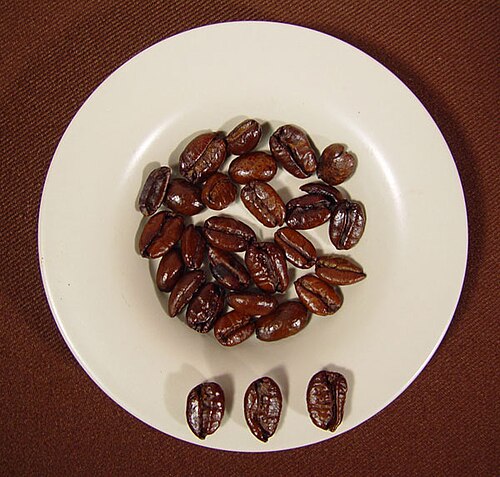
Photo by HaztechGuy, CC BY. Source.

For about two decades the species split into two recognised varieties: C. liberica var. liberica and C. liberica var. dewevrei. The second one matters because it is the plant the trade calls Excelsa — long sold as if it were a fourth coffee species. Coffea excelsa, C. dewevrei and C. dybowskii were all folded into C. liberica var. dewevrei in a 2006 reclassification, so for that period a bag marked “Excelsa” was botanically Liberica.
That has since been reversed. Genomic work led by the Royal Botanic Gardens, Kew (Aaron Davis and colleagues, August 2025) divides C. liberica into three species — C. liberica, C. dewevrei (Excelsa) and C. klainei.12 Under the current reading, Excelsa is again a species in its own right rather than a variety of this one. The Excelsa note covers the other side of the split, including how settled the change is.
Where it actually grows
- In the Philippines, Liberica accounts for more than 70% of all coffee grown, and it is “the main species of the Coffea genus grown in Malaysia and the Philippines”.3 Philippine production centres on Batangas and Cavite.
- Beyond that it is “mostly grown and consumed in Southeast Asia — namely the Philippines, Indonesia and Malaysia”, with Indonesian plantings on Java and in West Kalimantan.
- The wider historical footprint is much longer. PROSEA lists it as fairly widely cultivated in Guyana, Surinam, Bioko, São Tomé, Liberia, Malaysia and the Philippines, and more thinly in Sierra Leone, Ivory Coast, Nigeria, Congo (Brazzaville), Mauritius, Sri Lanka, India, Thailand, Vietnam, Taiwan and Timor.4
The rust boom, and the bust
Liberica’s rise is a direct consequence of Coffee leaf rust. When the fungus destroyed Ceylon’s Arabica in the 1870s and 1880s, planters everywhere went looking for a coffee that could take it, and Liberica was the answer of the moment.
| Year | What happened | |
|---|---|---|
| 1 | 1792 | Earliest mentions of Liberica cultivation |
| 2 | 1864 | First Liberica plantation established in Liberia |
| 3 | 1872 | Reaches India |
| 4 | 1875 | Reaches Indonesia |
| 5 | 1880s | Planted across the coffee belt as a rust escape; the Philippines briefly becomes a major world producer |
| 6 | ~1900 | Falls out of favour almost everywhere as Brazilian Arabica floods the market |
Dates for the first plantation, the 1792 mentions, and the arrivals in India and Indonesia come from PROSEA.
The bust had two causes. The first is that the rust story was oversold. PROSEA is blunt about it: Liberica is susceptible to coffee leaf rust, “though much less than the other coffees.” It buys time; it is not immune. In Indonesia, that is precisely why Liberica was itself replaced — by Robusta, which handled the disease better. The second cause was price: Brazil’s Arabica expansion drove the market down far enough that nobody wanted the awkward, slow, oversized tree any more.
To verify
How much of world coffee Liberica was, and is. Wikipedia says the species “accounts for less than 1.5% of commercial coffee grown.” The research report cites Global Coffee Report saying the widely repeated “1%” figure is a misquote, and that production is simply “minuscule” with no definitive percentage — but that article returned an access error and could not be read directly here.5 The historical claim that Liberica once made up half the world’s coffee, or that it “stood alongside Arabica” as a main species of global commerce in 1880–1900, is repeated in popular media and in a Nature Plants paper summary, but no primary 19th-century export dataset was consulted to confirm any share.6 Treat all Liberica share figures — past and present — as unconfirmed.
To verify
When Liberica reached the Philippines. Wikipedia dates its arrival to the 1740s, which sits oddly against PROSEA’s “first plantation, Liberia, 1864” and against the standard story of a rust-driven global rollout from the 1870s. Both can be true (an early ornamental or missionary introduction, then a commercial boom a century later), but no source consulted reconciles them. Do not state a single Philippine introduction date as fact.
To verify
Whose name is on the species. Wikipedia gives the author citation as Coffea liberica W.Bull; the research report gives C. liberica Hiern. Kew’s Plants of the World Online — the authority that would settle it — blocked automated access.7 The full form is most likely “W.Bull ex Hiern,” but that was not verified here.
How it grows
Liberica is a lowland plant, and that is its whole agronomic identity. PROSEA places it in “lowland to lower montane rain forest” up to roughly 1,300 m, with practical ceilings of about 1,200 m in Malaysia and 900 m in the Philippines — well below the 1,500–2,000 m band where prized Arabica lives. It wants warm, humid conditions and light shade, does well on well-drained clay to sandy soils, and — the trait that made 19th-century officials excited — tolerates acid and poor soils, growing without liming at pH 4.0. It is drought tolerant but will not take waterlogging.
That combination is why Liberica keeps being floated as a climate-resilience play: it already produces where it is too hot and too low for Arabica. The proposition is plausible, not proven — no primary agronomic bulletin with temperature maxima or drought metrics for the species turned up in this research.
Caffeine and composition
Green Liberica beans carry 0.5–1.8% caffeine by dry weight, averaging about 1.6%. That puts the species between Arabica (~1.2–1.5%) and Robusta (~2.2–2.7%) as recorded on this wiki’s Laurina note, and roughly three times the naturally low-caffeine Laurina.
The rest of a 100 g green bean, per PROSEA: 11 g water, 14 g protein, 8 g sucrose and reducing sugars, 42 g cellulose and polysaccharides, 12 g lipids, 7 g chlorogenic acids, 4 g ash.
What it tastes like
The reputation Liberica carries — harsh, woody, second-rate — comes from a century of it being grown as a bulk crop and roasted hard. Handled as specialty, the descriptions change completely:
- Big body, low acidity, high sweetness, often with a savoury or umami edge.
- Naturally processed lots show “delicate jackfruit notes” and read as fruity.
- Washed lots turn toward “more citrus and floral flavours, or even more ‘traditional’ flavour notes, like chocolate”.
- It is “often described as being sweeter than arabica.” One proposed mechanism: Liberica seeds are more porous, so the bean absorbs more sugar from the surrounding mucilage during processing.
No SCA cupping scores, competition placings or auction results for specific Liberica lots were found in primary records — not at Best of Panama, not at Cup of Excellence, not in SCA or CQI documents. That absence is itself informative: the major competitions are built around Arabica, with a separate Fine Robusta track, and Liberica has nowhere to enter.
To verify
A Food & Wine explainer is the source for several colour claims: that wild Liberica now survives in only five Upper West African nations (Sierra Leone, Liberia, Ivory Coast, Ghana, Nigeria); and Filipino roaster Michael Harris Conlin’s descriptions of a “strikingly fruity” aroma with jackfruit, ripe pineapple and rose. The page could not be fetched to confirm, and no second source was found for the five-nation figure.8 Attribute, don’t assert.
Kapeng barako
In the Philippines Liberica has a name and a personality. Kapeng barako — Spanish café verraco, roughly “stud coffee” — is drunk for its strength, and the term carries a deliberate machismo. It is typically brewed coarse in a pot on the stove, strained, and sweetened with raw cane sugar, which is a very different proposition from a pour-over and produces a smoky, heavy, sweet cup.910
Interest from the specialty side is recent and still small. Turkish barista champion Serkan Sağsöz is among the more visible advocates, arguing publicly that the species deserves a seat at the specialty table.
Related
- Excelsa — treated as var. dewevrei of this species from 2006, split back out as C. dewevrei in 2025
- Robusta — the other non-Arabica commercial species, and the one that displaced Liberica in Indonesia
- Coffee leaf rust — the disease that made Liberica’s fortune and then unmade it
- Laurina — the caffeine comparison point at the opposite extreme
- Geisha · Bourbon · Typica — Arabica varieties, for contrast
- Natural process — the processing route that brings out its jackfruit character
- Serkan Sağsöz — specialty advocate for the species
- Michael Harris Conlin — Filipino roaster who has documented its flavour
- Philippines coffee market — where Liberica is the mainstream, not the curiosity
- Coffee scoring · Cupping · Fine Robusta — the grading systems it falls outside of
Official links
- Official site — Kew Plants of the World Online, Coffea liberica — the taxonomic authority for the species; note the site blocked automated access, so the species page URL is unverified
- Official site — PROSEA (Plant Resources of South-East Asia), Coffea liberica monograph
A species has no owner and no homepage; the two above are the authoritative bodies that describe it.
Footnotes
-
Christopher Feran — Empires, fungus, and wars: an intimate history of Liberica & Excelsa ↩
-
Global Coffee Report — Researchers reveal new insights into the history of Liberica coffee ↩
-
Reviving Liberica coffee’s legacy (Nature Plants paper, copy on Scribd) ↩
-
Food & Wine — Liberica coffee may be the answer to climate stress in coffee-growing regions ↩
-
Corner Coffee Store — Liberian coffee: history, flavors and brewing tips ↩