Excelsa
Excelsa is a coffee plant from the dry edge of Central Africa that has spent a century being reclassified. It has been sold as a fourth coffee species, demoted to a variety of Liberica, and — as of a 2025 genomic study — restored to species rank again.12 Whatever the label, the plant is the same: a large, deep-rooted tree that fruits in heat and drought that would kill Arabica and stress Robusta, producing a cup of dark dried fruit, chocolate and spice.
It is genuinely rare. Nobody counts it: the International Coffee Organization publishes no official statistics on Excelsa production or trade, because demand is not considered commercially significant.3 It moves in such small volumes that most of what a drinker meets is a component in a blend rather than a bag of its own.
The name problem, in order
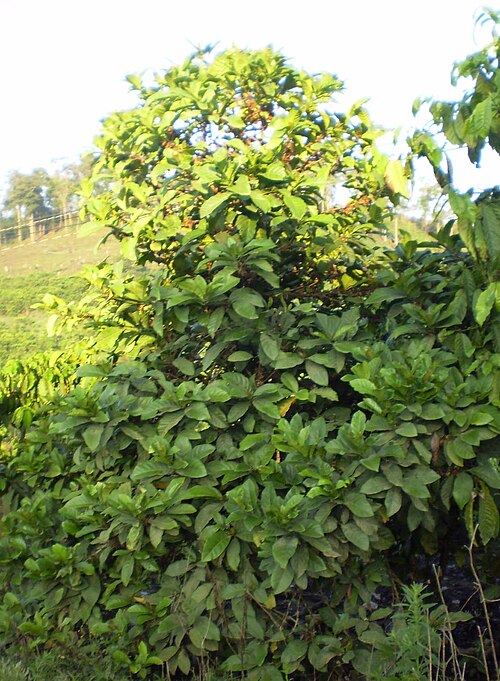
Photo by DXLINH, CC BY-SA. Source.

This is the single most confusing thing about Excelsa, so here it is as a sequence rather than an argument.
| Year | What happened to the name | |
|---|---|---|
| 1 | 1899 | Dutch botanists find and name Coffea dewevrei4 |
| 2 | 1903 | Auguste Chevalier finds coffee in the Lake Chari region of Chad and announces Coffea excelsa; because of where it came from, the plant is also widely called Chari34 |
| 3 | Mid-20th c. | Agronomic literature lumps it in with Liberica as C. liberica var. dewevrei |
| 4 | 2006 | C. excelsa, C. dewevrei and C. dybowskii are formally reclassified as synonyms of C. liberica var. dewevrei32 |
| 5 | 2025 | Genomic work led by the Royal Botanic Gardens, Kew (Aaron Davis and colleagues, August 2025) splits C. liberica into three species — C. liberica, C. dewevrei (Excelsa) and C. klainei124 |
So a bag labelled “Excelsa” was, for roughly two decades, botanically Liberica. Under the current reading it is its own species again. Both statements have been true; neither was wrong at the time. The Liberica note on this wiki covers the other side of the same split.
To verify
How settled the 2025 split is. The Specialty Coffee Institute of Canada states plainly that Kew genomic work “has confirmed it as a species in its own right, separate from Liberica,”1 and Wikipedia and coffee historian Christopher Feran both attribute the three-way division to a Davis et al. study.24 The original paper was not read for this note, and Kew’s own Plants of the World Online — the database that would settle the accepted name — blocks automated access, so its current entry could not be checked. Separately, Coffeeness reports the opposite direction of travel, describing a 2020 reclassification from species to Liberica variety.5 Treat the species status as current best reading, not a closed question.
Where it comes from and where it grows
Excelsa is native to tropical Central Africa — riverine and gallery forest across the Republic of Congo, Cameroon, the Democratic Republic of Congo, the Central African Republic, South Sudan and Uganda.1
Today it is farmed in India, Uganda, South Sudan, Vietnam and Indonesia according to SICC,1 and Perfect Daily Grind adds the Philippines to the Southeast Asian list.3 India is the one origin with an established note here; the rest are effectively undocumented on the specialty side.
On altitude the two best sources describe different things and do not really conflict. SICC gives the typical farmed band as roughly 500–1,500 m;1 PDG gives the optimum as 1,000–1,300 m.3 Read together: it will grow much lower than Arabica needs to, and the lots most likely to be sold as specialty sit at the top of its range.
The plant
Excelsa is arboreal — a tree, not the shrub that Arabica and Robusta are pruned into. PDG puts mature trees at more than 15 m tall with a canopy 6–7 m across,3 which means an Excelsa plot needs vertical room and a different picking approach entirely.
The agronomic case for it is climate. SICC describes strong vigour and marked drought tolerance, and says it copes with higher temperatures and longer dry seasons than Robusta1 — which is already the heat-tolerant option. Excelsa Coffee Company attributes this to a deep taproot and thick, low-transpiration leaves, and claims two to four times the drought tolerance of Arabica.67 The first half of that is a plant-anatomy description; the “2–4×” figure is a company marketing claim with no published trial behind it in anything consulted here. See Climate change and coffee for why this keeps coming up.
Caffeine
Excelsa is the lowest-caffeine of the commercially grown coffees. Measurements from the germplasm bank at Brazil’s Instituto Agronômico de Campinas, reported by Dr Oliveiro Guerreiro Filho, give:3
| Species | Caffeine per 100 g green | |
|---|---|---|
| 1 | Excelsa | 0.86–1.13 g |
| 2 | Arabica | 1.2–1.5 g |
| 3 | Canephora (Robusta) | 2.2–2.7 g |
That puts Excelsa below Arabica and at roughly a third to a half of Robusta — though still far above the naturally decaffeinated Laurina.
What it tastes like
Descriptions split by roast level and by who is doing the describing.
- SICC, tasting it as a species profile, reports dark dried fruit — currant, prune, plum, fig — with chocolate and spice, low to medium acidity, low bitterness, and a rounded sweetness closer to Demerara sugar or maple syrup.1
- Perfect Daily Grind separates by roast: medium-light gives berry-like and fruity notes alongside woody and popcorn-like flavours; darker roasts give fuller body with chocolate and cream.3
The common thread is dried fruit and sweetness rather than the bright acidity that drives Arabica scores, which is part of why Excelsa reads as a blending component — it adds depth under a blend rather than leading one.
No numeric SCA cupping scores for single-species Excelsa lots were found in any primary record, and no Excelsa lot appears in Cup of Excellence, Best of Panama or any green-coffee auction result consulted. As with Liberica, that absence is structural rather than a verdict: the major competitions are Arabica-only, with Fine Robusta as the one separate track, and Excelsa has no door to enter through. Any “86 points” on a roaster’s page is self-reported unless it is tied to a documented SCA or CQI event.
To verify
How much Excelsa exists. Coffeeness, summarising industry estimates, puts global production at 50,000–80,000 60 kg bags a year, about 0.1% of world coffee.5 This is an estimate, not an official statistic — the ICO publishes nothing on Excelsa at all,3 so there is no primary figure to check it against. Useful for scale, not quotable as fact.
History: a colonial bet that did not pay off
Excelsa’s commercial story is short and mostly a failure. Coffee historian Christopher Feran traces it from Chevalier’s 1903 find to French Indochina: seeds reached Vietnam in 1905–06, the Borel brothers made the first plantings, and a first harvest of about 30 kg came in 1910. Planters filed positive reports on its disease resistance through the 1910s and 1920s, and then largely abandoned it in the 1930s as Robusta took over.4
That arc — planted as a rust-and-disease escape, then dropped when a hardier commodity crop won on economics — is almost exactly the Liberica story, and both trace back to Coffee leaf rust reshaping the coffee world. See History of coffee for the wider frame.
To verify
The Vietnam timeline above (1905–06 seeds, Borel brothers, 30 kg in 1910, abandonment in the 1930s) comes from a single source — Feran’s historical essay, a well-researched personal site rather than an archive or journal.4 No colonial agricultural record was consulted to confirm the dates or the tonnage. Attribute it; do not treat the numbers as established.
Processing
Nothing distinctive is documented. Excelsa is handled by the same routes as any other coffee — natural or washed, sun-dried after harvest — and no source consulted ties a named mill, farm or exporter to a specific Excelsa processing protocol. Excelsa Coffee Company advertises a “Reserve” line of hand-selected micro-lots with experimental processing, which is the closest thing to a documented specialty processing programme for the species.6
Who is working with it
Excelsa Coffee Company (San Diego, USA) is the one company built entirely around the species. It was founded in 2014 by Michael Mazzotta and Olin Patterson, sources exclusively Excelsa, and sells across three lines — Origins (standard green coffee), Reserve (micro-lots) and House (its own roasts and blends).67 Its pitch is explicitly a climate one: that half the world’s Arabica land could be unsuitable by 2050, and Excelsa is a way through.6 It ships in recyclable stock bags with stickers rather than custom-printed packaging, a deliberate waste-and-cost decision.7
Beyond that, the species has no producer association, no varietal register entry with World Coffee Research, and no auction presence.
Related
- Liberica — the species Excelsa was folded into in 2006 and split back out of in 2025
- Robusta — the heat-tolerant benchmark Excelsa is measured against
- Arabica vs Robusta — the two-species framing Excelsa sits outside of
- Laurina — the other low-caffeine outlier, at a further extreme
- Coffee leaf rust — the disease that drove the colonial-era planting of both Liberica and Excelsa
- Climate change and coffee — why a drought-tolerant tree species is being revisited now
- Excelsa Coffee Company — the only company built solely on the species
- Instituto Agronômico — the Brazilian institute whose germplasm bank produced the caffeine figures
- India — the one Excelsa-growing origin with a note here
- Coffee scoring · Cupping · Fine Robusta — the grading systems that have no slot for it
- Cup of Excellence · Best of Panama · Green coffee auctions — where it does not appear
- Natural process · Washed process — how it is processed
- History of coffee — the wider colonial-expansion context
Official links
- Official site — Kew Plants of the World Online — the taxonomic authority for the species; the site blocks automated access, so the specific taxon page could not be confirmed here
- Official site — Specialty Coffee Institute of Canada, Excelsa species profile
A coffee species has no owner and no homepage of its own; the two above are the authoritative bodies that describe it.
Footnotes
-
Specialty Coffee Institute of Canada — Excelsa coffee, species profile ↩ ↩2 ↩3 ↩4 ↩5 ↩6 ↩7 ↩8
-
Perfect Daily Grind — What is excelsa coffee? ↩ ↩2 ↩3 ↩4 ↩5 ↩6 ↩7 ↩8 ↩9
-
Christopher Feran — Empires, fungus, and wars: an intimate history of Liberica & Excelsa ↩ ↩2 ↩3 ↩4 ↩5 ↩6
-
MTPak Coffee — Excelsa Coffee Company: introducing a climate-resistant species ↩ ↩2 ↩3