India
India is a large coffee producer that most specialty drinkers have never knowingly tasted. It sits in the world’s top ten by volume, exports the overwhelming majority of what it grows, and much of that disappears into European espresso blends where the bag never says “India” on it.
It is also the origin behind one of coffee’s strangest and most famous products, Monsooned Malabar — green coffee deliberately exposed to the monsoon for months until it swells, turns gold and loses its acidity.
Where it grows
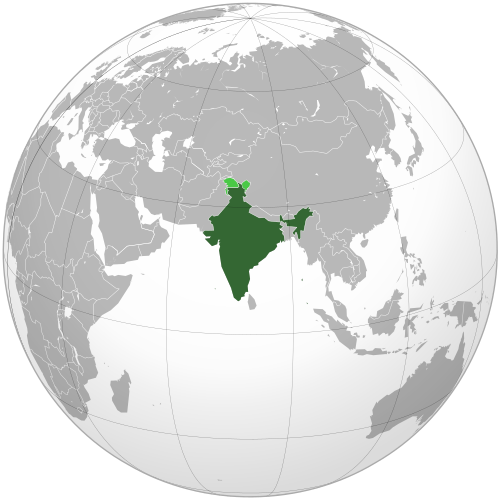
Photo by Ssolbergj (talk), CC BY-SA. Source.
.svg)
Indian coffee is concentrated in three southern states, all along the Western Ghats — the mountain range running down India’s southwestern flank:12
| State | Share of Indian production |
|---|---|
| Karnataka | 71% (Kodagu district alone: 33%) |
| Kerala | 21% |
| Tamil Nadu | 5% (about 8,200 tonnes) |
Coffee also grows in the Eastern Ghats — the Araku Valley, spanning Andhra Pradesh and Odisha, holds its own geographical indication.3 But the centre of gravity is unmistakably Karnataka, and within it Kodagu (Coorg) and Chikmagalur.
The Coffee Board of India describes the growing zones as “ecologically sensitive regions of the Western and Eastern Ghats,” identified as one of the world’s 25 biodiversity hotspots.4
The thing that makes Indian coffee unusual: shade
All coffee grown in India is grown in shade, and typically under two tiers of it — a lower and an upper canopy of trees over the coffee bushes.14 Elsewhere shade-growing is a choice a farm makes; in India it is simply how coffee is done.
The farms are also routinely intercropped with spices — cardamom, cinnamon, clove and nutmeg growing among the coffee.1 That has two consequences worth knowing. Agronomically, it makes Indian coffee estates function more like managed forest than plantation, which is why they feature in climate and biodiversity discussions far out of proportion to their volume. Commercially, it means an Indian coffee farmer’s income does not rest on the coffee price alone.
Robusta, not Arabica
This is the fact that most surprises people who know India by reputation.
India was traditionally an Arabica origin. Over roughly the last decade that has flipped: Robusta now accounts for over 60% of Indian coffee, driven by its higher yields.1 Perfect Daily Grind confirms both species are grown at scale.2
So the modern Indian crop is majority Robusta, shade-grown, and largely destined for blending — which is exactly the profile that the Fine Robusta movement is trying to reframe as a quality category rather than a cheap one.
The main cultivars are S.795, Kent, Cauvery and Selection 9.12 S.795 is described as probably the most widely planted Arabica in India and Southeast Asia — a Bourbon–Typica-descended selection bred for leaf rust resistance.1
An export crop
Roughly 70–80% of Indian coffee is exported.12 Very little of the crop stays home relative to what leaves, which is why India’s reputation abroad is shaped almost entirely by what blenders want.
To verify
The destination breakdown is disputed. Perfect Daily Grind says Italy alone takes almost 30% of Indian coffee exports.2 Wikipedia’s account instead lists the main destinations as Germany, Russia, Spain, Belgium, Libya, Poland, Jordan, Malaysia, the USA, Slovenia and Austria, without naming Italy in the leading position.1 These are not compatible pictures, and neither is sourced to a customs dataset or a Coffee Board of India export table. The ~70–80% export share is agreed on by both; the country ranking is not.
To verify
India’s world ranking rests on a 2009 figure. Wikipedia states that “as of 2009, Indian coffee made up just 4.5% of the global production, being the 7th largest producer of coffee.”1 That is the only ranking figure found in the sources behind this note, and it is over fifteen years old — a period in which Vietnam, Indonesia and others moved substantially. India remains a top-ten producer, but the exact rank and share should be taken from a current Coffee Board of India or ICO statistical release, not from this note.
India also sits at a 100-point discount to the benchmark in the C-market differentials table this wiki records — grouped with Burundi, Rwanda and Venezuela — which is the market’s blunt statement of where it prices Indian Arabica relative to the standard.
How coffee got to India
The traditional story is one of the most-told in coffee, and India tells it about a single person.
Baba Budan, an Indian Muslim saint, is said to have returned from pilgrimage to Mecca carrying seven coffee seeds taken from Mokha in Yemen — hidden, in the popular telling, in his beard — and to have planted them near his home at Chikmagalur, Karnataka.1 The Coffee Board of India tells the same story on its own site: “the saga of Indian coffee began on a humble note, with planting of ‘Seven seeds’ of ‘Mocha’ during 1600 AD,” followed by commercial expansion in the 18th century.4
The hills where he is said to have planted them are now called the Bababudangiri range — and carry their own coffee GI today.3
To verify
The Baba Budan date does not line up with this wiki’s variety record. The Coffee Board dates the first planting to 1600 AD,4 and Wikipedia to the early 17th century.1 But this wiki’s Typica note, sourced to World Coffee Research, has seed reaching India in the 1690s — the Mysore region on the Malabar coast — from which the Dutch carried it to Java in 1696 and 1699. The History of coffee note likewise puts Dutch cultivation in Ceylon at 1658 and southern India later. These need not be contradictory (a devotional planting and a documented commercial seed transfer are different events, a century apart), but they are frequently conflated into a single origin date. The Baba Budan account is traditional history, told by the national coffee body about itself; the 1690s transfer is genetic and archival record. This note does not merge them.
The other Indian coffee GIs
Beyond Monsooned Malabar — India’s earliest coffee geographical indications, registered in 2007–08 — a second wave of regional coffee GIs was registered in 2018–19:3
| GI name | State(s) |
|---|---|
| Coorg Arabica Coffee | Karnataka |
| Chikmagalur Arabica Coffee | Karnataka |
| Bababudangiri Arabica Coffee | Karnataka |
| Wayanaad Robusta Coffee | Kerala |
| Araku Valley Arabica Coffee | Andhra Pradesh, Odisha |
This is India doing deliberately what Ethiopia and Colombia did earlier: converting a commodity origin into a set of named places that can be sold on identity rather than on the C-price.
The specialty turn
India’s specialty movement is recent and small but real. Perfect Daily Grind’s 2021 survey of the origin names Ratnagiri Estates (managing partner Ashok Patre) and Sangameshwar Coffee Estates, both in the Western Ghats, as producers pushing micro-lots, and reports growing buyer interest from Japan, South Korea and Australia.2 The obstacles it names are the familiar ones: unpredictable climate and a shortage of skilled labour for consistent quality.2
To verify
The “85 to 86 points” claim. The same article quotes a buyer describing Indian coffee that “consistently scored 85 to 86 points, which for a blend is absolutely amazing quality.”2 This is a single practitioner’s recollection reported in a trade publication, not a scoresheet, a Q Grader report or a competition result. No cupping protocol, sample set or scoring body is identified. Recorded here as a claim about Indian coffee’s ceiling, not a verified score.
Beyond that, the record is thin in a specific way: no auction results, hammer prices or named lot buyers for Indian coffee were found in any source behind this note. India trades as volume with a protected name or two, not as lot-by-lot auction coffee — the same structural position Yemen occupies for different reasons.
Related
- Monsooned Malabar — the process India is famous for, and the deep-dive companion to this note
- Coffee Board of India — the government body that runs Indian coffee
- Subko Coffee — the Mumbai roaster buying Indian Arabica for the Indian specialty market
- Robusta · Arabica vs Robusta · Fine Robusta — the species majority of the modern Indian crop, and the movement trying to revalue it
- Typica · Bourbon-Typica group — the lineage that passed through India on its way from Yemen to Java
- Yemen — where the Baba Budan seeds are said to have come from
- History of coffee — the wider chronology this origin sits inside
- Wet hulling — the Indonesian neighbour with a comparably unorthodox processing signature
- C-market — where Indian coffee is priced, and at what discount
- Climate change and coffee · Coffee leaf rust — the pressures on a shade-grown, rust-bred crop
- Coffee Belt — India’s place on the global growing map
Official links
- Official site — Coffee Board of India — Government of India, Ministry of Commerce & Industry; statistics, export data and the national account of Indian coffee’s history
Footnotes
-
Coffee production in India — Wikipedia — confirmed via WebFetch: state production shares (Karnataka 71%, Kodagu 33%, Kerala 21%, Tamil Nadu 5% / 8,200 t), the 2009 world-ranking figure, the Robusta majority, the two-tier shade and spice intercropping, the S.795 / Kent / Cauvery / Selection 9 cultivars, the export share and destination list, and the Baba Budan account ↩ ↩2 ↩3 ↩4 ↩5 ↩6 ↩7 ↩8 ↩9 ↩10 ↩11
-
Micro lots & Monsoon Malabar: India’s future as a coffee origin — Perfect Daily Grind — confirmed via WebFetch: the three growing regions, the 70–80% export share and Italy figure, the S795 / Kent / Cauvery cultivars, Ratnagiri and Sangameshwar estates, the 85–86 point quote, and the climate and labour challenges ↩ ↩2 ↩3 ↩4 ↩5 ↩6 ↩7 ↩8
-
List of Geographical Indications in India — Wikipedia — confirmed via WebFetch: the 2007–08 Monsooned Malabar Arabica and Robusta registrations and the 2018–19 Coorg / Chikmagalur / Bababudangiri / Wayanaad / Araku Valley coffee GIs with their states ↩ ↩2 ↩3
-
Coffee Board of India — official site — confirmed via WebFetch: the Western and Eastern Ghats biodiversity-hotspot framing, shade cultivation, and the “seven seeds of Mocha, 1600 AD” founding account ↩ ↩2 ↩3 ↩4