Wet hulling
Wet hulling — known in Indonesia as giling basah, which literally means “wet grinding” — is a coffee processing method in which the seed’s papery parchment shell is stripped off while the bean is still soft and far wetter than normal.1 Everywhere else in the coffee world, that shell stays on until the seed is fully dry and about to be exported (see Dry milling). In Sumatra it comes off in the middle of drying, at roughly a third moisture — and that single change of timing is what gives Indonesian coffee its unmistakable cup.
The method is indigenous to northern Sumatra and is now used by most small-scale farmers in Sumatra, Sulawesi, Flores and Papua, for both Arabica and Robusta.1 It is the reason a bag marked “Sumatra” or “Mandheling” tastes the way it does before you know anything else about the farm.
Why it exists: humidity, not flavour
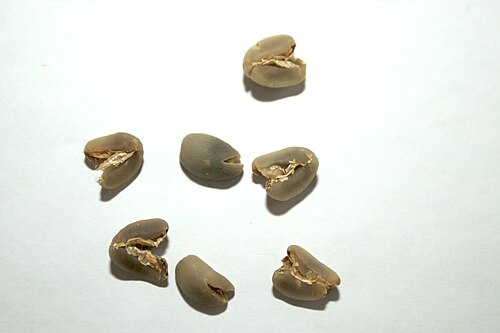
Photo by Michael.C.Wright, CC BY-SA. Source.

Wet hulling was not invented to make coffee taste earthy. It was invented to get coffee dry at all.
Sumatra’s coffee highlands are extremely wet — humidity often sitting around 90% — and the conventional route of drying a bare seed in its parchment for two to three weeks (the washed path) is slow and risky there. Rain comes, the parchment stays damp, and the crop moulds or ferments past the point of use.23 Cracking the parchment off early, while the bean is still semi-wet, exposes the green seed directly to the air and lets it dry in a few days instead of a few weeks.42 It also gets the farmer paid sooner, which for a smallholder living on the crop matters as much as the weather.
So the whole method is a bargain struck with the climate: give up the clean, protected drying of parchment coffee, and in exchange get a crop that actually dries. The flavour is a side effect of that bargain — a large and now-prized one.
How it actually happens
The sequence is the same broad shape as washed processing up to a point, and then it forks:
- Hand-pick and pulp. Ripe cherries are picked by hand and run through a simple hand-cranked drum pulper that scrapes the skin off.45
- Short ferment. The pulped seeds sit in tanks or bins overnight — roughly 12 to 18 hours — long enough to loosen the sticky mucilage but far shorter than many washed ferments.4
- Rinse. The next day the partly broken-down mucilage is washed off.42
- Brief first dry. The parchment-covered seed is dried only briefly, down to about 30–35% moisture — still “semi-wet” and nowhere near storage-dry.12
- Hull it wet. At this point the soft parchment is cracked off while the bean is still damp — the “wet hull.” This is the step that names the method and the step no other origin does.12
- Dry again, bare. The naked green seed goes back out to dry to a final, safe 10–12% moisture.42
The finish line — 10–12% moisture before storage and export — is the same target every processing method aims for. What is radically different is the path: the parchment protects the seed for barely a day here, versus the roughly three weeks of a washed coffee, and the bean spends the back half of drying naked and exposed rather than shielded.
Across both drying stages together, Sumatran conditions typically take 5 to 10 days in total.6
Gabah, Labu, Asalan: the coffee changes its name three times
Indonesian coffee is bought and sold at half-finished stages, and the trade has a separate word for each one. Nowhere else does a single crop pass through three named commercial forms before it is even green coffee. Knowing the words is the fastest way to understand how the supply chain is cut up:7
| Stage | Indonesian name | Moisture | What it physically is | |
|---|---|---|---|---|
| 1 | After the rinse and a first patio dry | Gabah | ~40–50% | Wet parchment coffee — plump, moist, shell still on |
| 2 | Straight out of the wet huller | Labu | ~40–50% | Naked green bean, still swollen and soft |
| 3 | After roughly two more days on the patio | Asalan | ~15% | Nearly dry bare green coffee, ready for the dry mill |
After the Asalan stage the coffee goes to a dry mill or warehouse for the last of the drying down to 12%, plus sorting and grading, before export.7
This is why wet-hulled coffee has such a dispersed supply chain. A washed coffee usually leaves one washing station as parchment and arrives at one dry mill; a wet-hulled coffee can change hands at Gabah, again at Labu and again at Asalan, with a different farmer, collector, huller or mill responsible for each leg. Around 99% of Indonesian coffee comes from smallholders, so there is rarely one party who owns the whole chain.7 For the farmer, selling at Gabah means being paid in days rather than holding a crop for months — which is a large part of why the practice survives even where the weather would now allow slower drying.
The costs: split beans and mould
The speed is bought with risk, and the trade is candid about it.
- Split and chipped beans. Because the huller bites into a bean that is still soft and swollen, it can crack the ends off instead of just cracking the shell. Indonesian millers call the resulting defect “kuku kambing” — goat’s nail.8 Wet-hulled lots consequently carry a higher rate of physical defects than parchment-hulled coffee.68
- Mould. A bare green bean has no shell to shield it. If the final drying stage is rushed or the coffee is rained on while naked, mould and related defects follow.6
- Under-dried, sour cups. Coffee that does not get enough dehydration at the right moments ends up tasting inconsistent, astringent, unbalanced and sour.8
None of this is a footnote to the method — it is the method’s other half. The earthy, heavy Sumatran cup and the higher defect count come from exactly the same decision to hull early.
Why it tastes the way it does
Wet-hulled Indonesian coffee — Sumatra above all — has one of the most recognisable profiles in the trade:
- Low acidity and a heavy, syrupy body.192
- Flavours of wood, earth, spice, tobacco, leather and mustiness, sometimes stretching to cedar, forest floor or wild mushroom.1910
- Importer descriptions land in the same place from a different direction: earthy, cedar, dark chocolate and herbal-savoury, over a heavy, syrupy body with muted acidity.6
Wikipedia’s summary matches the trade’s: the process “is thought to reduce the acidity and increase the body, resulting in the classic Indonesian cup profile,” and “introduces additional flavours that can be vegetal or herbal, woody or musty, sometimes earthy.”1
Green wet-hulled beans also look different — a distinctive deep blue-green to emerald colour, attributed to the truncated parchment drying and the altered chemistry that follows from it.2
To verify
The chemistry is a professional hypothesis, not lab-proven. Roasters explain the earthy profile by pointing to the short ferment, the rapid drying, and the high oxygen exposure on a bean left unprotected by parchment while still wet.10 These are well-informed trade interpretations of a real and consistent result — but no lab-validated mechanistic study was consulted here tying a specific reaction to a specific note. Treat the profile as established and the cause as a strong working explanation.
Mandheling, Gayo and the trade names
Two words a reader meets constantly are trade names, not varieties or processes:
- Mandheling (also Mandailing) refers to coffee from the Tapanuli region of northern Sumatra, around Lake Toba and the Batak highlands. It is a marketing name derived from an ethnic group, not a coffee cultivar.2
- Gayo refers to the Gayo Highlands of Aceh province, at the northern tip of Sumatra — the other major Sumatran Arabica zone.52
Both are wet-hulled almost by default, which is why the trade name and the process are so tangled together in the way Sumatran coffee is sold.
Who does it: smallholders and cooperatives
Wet hulling is overwhelmingly a smallholder method. Production is dominated by small farms with hand-crank pulpers delivering to local hulling stations, rather than the vertically integrated estates behind competition coffees elsewhere.45 A concrete example is the Gayo Arabika Indonesia cooperative in Aceh, whose members process their own coffee by wet hulling.5
This structure is itself part of the story: the Dry milling note’s rule that “in origins built on small farms, the shared facility rather than the farm is the real unit of quality” applies here too, except the chokepoint arrives unusually early — the hulling station handles a still-wet bean that in any other origin would not reach a huller for weeks.
Where it sits among the processes
| Method | When the parchment comes off | Cup signature |
|---|---|---|
| Washed | After ~2–3 weeks drying, at the dry mill | Clean, bright, higher acidity, lighter body |
| Natural | After the whole cherry dries, at the dry mill | Heaviest fruit, jammy, low acidity |
| Wet hulling (giling basah) | Mid-drying, at ~30–35% moisture | Earthy, spicy, very low acidity, heavy body, blue-green beans |
Read against this wiki’s Dry milling note, wet hulling is the exception that proves its central rule. There, hulling is a neutral cleaning step that every process shares at the very end. Here it is moved forward into the middle of drying and becomes a flavour decision — the one place in coffee where cracking the shell off changes the cup rather than just tidying it.
What the record does not show
Unlike Best of Panama Geisha lots or Cup of Excellence winners, wet-hulled Sumatra has no readily documented trail of auction prices, record scores or named buyers in the sources behind this note.
To verify
No primary competition, cupping or price data was found. The research behind this note surfaced no official auction catalogue, CQI Q-grading report, SCA scoresheet or price sheet tied to a specific wet-hulled Sumatra lot. Any specific score, price or “winning lot” claim for Sumatra would rest on unsourced memory and is therefore not stated here as fact. A reader wanting those numbers should go to producer/exporter records in Aceh or Tapanuli, or to a Q-grade report, directly.
To verify
The history is trade narrative, not archive. Two historical claims recur in roaster and cooperative writing: that wet hulling originated in Aceh before spreading across the archipelago,9 and that Sumatra pivoted to it after the 1970s partly under the influence of Japanese buyer demand for the profile.5 These are well-supported industry accounts, not government or academic archives, so they are flagged rather than stated flat.
To verify
Altitude bands are unconfirmed here. Typical figures of 1,200–1,600 m for Gayo and Mandheling Arabica are widely quoted, but the sources behind this note publish no primary altitude dataset tied to named farms or lots.5 Treat the range as trade convention pending producer or CQI farm data.
To verify
Moisture-at-hulling varies by farmer. Wikipedia and Sweet Maria’s give 30–35%;1 a Nespresso description of Aceh practice puts hulling nearer 40%, after only 2–3 hours of drying following the overnight ferment.3 The importer Dr Wakefield puts both the pre-hull (Gabah) and just-hulled (Labu) stages at 40–50%, after 2–3 days of first drying.7 Reports across the trade span a wider 25–50%, and the length of that first patio dry ranges from a few hours to three days. Read these as a range that shifts farm to farm and day to day, not a single universal number — the stage names above are stable, the numbers attached to them are not.
To verify
“One month instead of three” is a single-source figure. One roaster account states that washed coffee takes 2–3 months from picking to export-ready while wet-hulled coffee is ready in about one month.11 That page could not be re-fetched to confirm, and no primary exporter or customs documentation was found for it. Perfect Daily Grind supports only the weaker, directional version — that wet hulling “takes several less days to dry” and lets farmers “see returns quicker, and for less labour.”8 Treat the speed advantage as real and the specific month figures as unconfirmed.
To verify
“Semi-washed” is not a synonym you can trust. Wet-hulled coffee is often sold as semi-washed, and this note carries that alias because readers arrive searching for it. But the trade also uses “semi-washed” loosely for other partial-mucilage-removal methods outside Indonesia, so a non-Indonesian coffee labelled semi-washed is not necessarily giling basah — it may be closer to Pulped natural or Honey process. The sources behind this caution are roaster and blog commentary rather than an SCA terminology standard, so it is flagged rather than stated as a definition. If the label matters to you, ask the importer what was actually done.
Related
- The other processes it contrasts with: Washed process · Natural process · Honey process · Pulped natural · Anaerobic fermentation
- What it is a variant of: Dry milling — hulling, moved forward into the middle of drying
- The species it is used on: Arabica vs Robusta · Robusta · Fine Robusta
- Where it happens: Indonesia · Coffee Belt · Timor Hybrid (the Timor Hybrid emerged from this same island world)
- How coffee like this is judged: Cupping · Coffee Value Assessment · Q Grader · Green coffee grading (where the split-bean defects get counted)
- The chain it travels through: Coffee supply chain · Producer cooperatives · Green coffee trading
Official links
- Reference — Giling Basah (Wikipedia)
- Reference — Sumatran Coffee Processing: Why You Should Know Giling Basah (Sweet Maria’s Coffee Library)
Footnotes
-
Giling Basah — Wikipedia — the “wet grinding” meaning, the Sumatra/Sulawesi/Flores/Papua spread, the 30–35% hulling moisture, and the reduced-acidity/increased-body flavour summary all confirmed via WebFetch ↩ ↩2 ↩3 ↩4 ↩5 ↩6 ↩7 ↩8
-
Sumatran Coffee Guide — Mandheling, Gayo & Wet Hulling Explained — Baristalog — trade guide; Mandheling/Gayo trade-name definitions, humidity rationale, moisture stages and bean colour, cited in the research report ↩ ↩2 ↩3 ↩4 ↩5 ↩6 ↩7 ↩8 ↩9 ↩10
-
A guide to Indonesian coffee — Nespresso — the ~40% Aceh hulling-moisture and 2–3 hour drying detail, cited in the research report ↩ ↩2
-
Sumatran Coffee Processing: Why You Should Know Giling Basah — Sweet Maria’s Coffee Library — green-coffee retailer/library; process steps, overnight ferment, brief drying, and the days-vs-weeks contrast, cited in the research report ↩ ↩2 ↩3 ↩4 ↩5 ↩6
-
Sumatra Coffee: the captivating effects of the wet-hulled process — Need More Roasters — roaster; the Gayo Arabika Indonesia cooperative, the 1970s/Japanese-buyer narrative, and smallholder structure, cited in the research report ↩ ↩2 ↩3 ↩4 ↩5 ↩6
-
Wet Hulling Coffee: How It Works, Flavor Impact & Risks — Volcana Coffee — trade guide; the 5–10 day total drying time, the higher physical-defect and mould risk on naked-bean drying, and the earthy/cedar/dark-chocolate flavour set, confirmed via WebFetch ↩ ↩2 ↩3 ↩4
-
What is Wet Hulled? — Dr Wakefield — green coffee importer; the Gabah / Labu / Asalan stage names and their moisture bands, the two-extra-days patio dry, the hand-off to dry mills at 12%, and the 99%-smallholder figure, all confirmed via WebFetch ↩ ↩2 ↩3 ↩4
-
Indonesian Wet Hulled Coffee: Your One-Stop Guide — Perfect Daily Grind — trade publication; the “kuku kambing” / goat’s nail split-bean defect, the astringent-and-sour under-drying outcome, and the faster-returns-for-less-labour framing, confirmed via WebFetch ↩ ↩2 ↩3 ↩4
-
More Than a Process: Sumatran Wet-Hulled Coffee — Five Senses — roaster; the Aceh-origin claim and profile description, cited in the research report ↩ ↩2 ↩3
-
Giling Basah — Wet Hulled Processing — Deeper Roots Coffee — roaster; the earthy/woody/spicy flavour set and the process-chemistry interpretation, cited in the research report ↩ ↩2
-
What is “wet-hulled” coffee? — PTS Coffee — roaster; the one-month-versus-two-to-three-months export timeline, cited in the research report but not re-confirmable (the page returned an HTTP 429 rate limit on fetch) and therefore flagged rather than stated ↩