Indonesia
Indonesia is the origin that got there first and then went sideways. Coffee reached the archipelago under Dutch colonial rule in the late 1600s and early 1700s, and the first shipment left Java for Europe in 1711 aboard Dutch East India Company ships — making this one of the earliest plantation origins anywhere and the reason “a cup of java” is still slang for coffee.1 Three centuries later it is the fourth-largest coffee producer in the world (2025), but most of what it grows is Robusta, most of it is grown on farms of about a hectare, and the thing it is famous for in specialty circles is a processing method invented to cope with rain.1
Two facts explain almost everything else about this origin:
- It is a smallholder country, not an estate country. More than 90% of Indonesian coffee is grown by smallholders on farms averaging around one hectare.1 There is no Indonesian equivalent of the family estates behind Best of Panama — the unit of quality is the village, the cooperative and the hulling station.
- It processes coffee differently on purpose. Wet hulling (giling basah) cracks the parchment off the bean halfway through drying, giving the earthy, low-acid, heavy-bodied cup the trade calls “Sumatran.” Read that note first if the flavour is what brought you here; this one covers the country.
| Where | Southeast Asian archipelago — Sumatra, Java, Sulawesi, Bali, Flores, Papua |
| Global production rank | 4th in the world (2025)1 |
| Production | about 660,000 metric tons (2017)1 |
| Species split | roughly 75% Robusta / 25% Arabica1 — but see the flag below |
| Who grows it | more than 90% smallholders, farms averaging ~1 hectare1 |
| Domestic consumption | about 154,800 tonnes a year1 |
| Main producing provinces | Lampung, South Sumatra, Bengkulu (Sumatra), plus Aceh, East Java, South Sulawesi, Bali, East Nusa Tenggara12 |
| Signature process | Wet hulling (giling basah), alongside washed and natural1 |
| Coffee arrived | late 1600s–early 1700s, Dutch colonial; first Java export 17111 |
| Green-coffee competition | Cup of Excellence — editions in 2021, 2022, 2023, with 2026 listed2 |
| Record auction price | $80.00/lb — Pantan Musara, Aceh, 20213 |
How coffee got there, and how Robusta took over
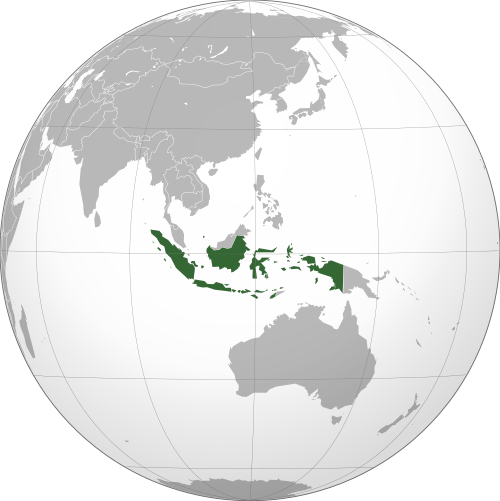
Photo by Addicted04, CC BY-SA. Source.
.svg)
The Dutch planted Java first and the island became the model colonial coffee estate. What ended that was a disease. The 1876 coffee leaf rust epidemic destroyed most of Indonesia’s Arabica, and the industry replanted with Robusta from around 1900 because Robusta shrugs the fungus off.1 That single substitution is why a country with 300 years of Arabica history is today a mostly-Robusta producer — and it is the same story that runs through Timor Hybrid, the rust-resistant Arabica–Robusta cross that emerged on the next island east and went on to reshape breeding worldwide.
After independence the Dutch plantations were nationalised in the 1950s,1 and the estate structure broke up into the smallholder pattern that still defines the country.
Where it grows
Coffee is spread across the archipelago rather than concentrated in one highland belt:
- Sumatra — the biggest producing island. Lampung, South Sumatra and Bengkulu are the volume provinces (mostly lowland Robusta); the same source puts the three at roughly half of national output and up to three-quarters of Robusta.1 The Arabica names the specialty trade knows sit further north: the Gayo Highlands of Aceh and Mandheling/Mandailing around Lake Toba — both trade names for places, not varieties, and both explained in Wet hulling.
- Java — the historic origin, and still where the country’s highest-scoring lot came from: the Ijen Plateau in East Java, above 1,400 m.1
- Sulawesi — the Toraja highlands in the south, long recognised for a cleaner, more balanced Indonesian cup.1
- Bali — the Kintamani region on the volcanic uplands.1
- Flores and East Nusa Tenggara — an emerging zone that produced Indonesia’s second-place Cup of Excellence lot in 2023.12
- Papua — the Baliem and Kamu valleys,1 the Indonesian half of the island whose eastern half is Papua New Guinea.
Robusta occupies the lower, hotter ground and Arabica the highlands, the same split described in Arabica vs Robusta.
To verify
The Robusta share is reported three different ways. Wikipedia’s sector summary gives 75% Robusta / 25% Arabica;1 a 2025 supplier analysis quotes a 2025/26 forecast of 87% Robusta alongside 11.3 million 60-kg bags, up 5% year on year;4 a retailer guide summarising Indonesian statistics says “80–90%” in recent years.5 The last two are commercial blog sources, not government or ICO releases. Treat “roughly three-quarters to nine-tenths Robusta” as the honest answer and do not quote a precise share.
To verify
National altitude figures do not exist in a single dataset. Beyond the Ijen Plateau’s 1,400 m-plus,1 altitude in Indonesia is farm- and region-specific. The 1,200–1,600 m band widely quoted for Gayo and Mandheling Arabica is trade convention rather than published producer data — the same caveat this wiki already carries on Wet hulling.
Cup of Excellence: what the record actually shows
Indonesia is a Cup of Excellence country, run by the Alliance for Coffee Excellence. This is the only place where Indonesian coffee has a public trail of scores, prices and named buyers — everything else about quality here is trade description. ACE lists Indonesian competitions for 2021, 2022 and 2023, with 2026 also listed.2
| Year | Winning lot | Region | Variety | Process | Score | Price | Lot total | Buyer | |
|---|---|---|---|---|---|---|---|---|---|
| 1 | 2021 | Pantan Musara | Aceh | Ateng, Gayo 1, P88 | Honey | 89.28 | $80.00/lb | $37,037.60 | Wataru for Yamatoya Coffee3 |
| 2 | 2022 | Koperasi Ribang Gayo Musara | Aceh | Ateng 30%, P-88 70% | Natural | 90.59 | $40.20/lb | $17,281.98 | Sulalat Coffee Trading6 |
| 3 | 2023 | Ijen Lestari | East Java | USDA 762 (75%), Kartika (25%) | Carbonic maceration natural | 91.41 | $45.50/lb | $18,055.77 | Orsir International Co., Ltd.7 |
The auction totals matter as much as the winners, because they show a market cooling while the coffee got better:
- 2021 — 26 lots, $360,342.58 total, average $29.55/lb.3
- 2022 — 22 lots, $242,409.61 total, average $16.91/lb.6
- 2023 — 22 lots plus 2 National Winners, 14,012.33 lb sold, $193,840.18 total, average $13.83/lb.7
Two other 2023 results are worth naming. Wajamala, in East Nusa Tenggara, placed second at 90.35 points on S-795 (95%) and Typica (5%), dry hulled, selling at $30.00/lb.7 And the two National Winner lots — coffees that clear the specialty bar but miss the COE cut — went for $5.10 and $5.20/lb: Sisola Specialty Coffee (South Sulawesi, 86.38) and Dete Coffee (Bali, 85.68).7 The gap between $45.50 and $5.15 in the same auction is the clearest picture anywhere of what the top of this origin is worth versus its very good middle. See Coffee scoring and Green coffee auctions.
The variety names in that table are the practical answer to “what does Indonesia grow”: Ateng, P-88, Gayo 1, USDA 762, Kartika, S-795 and Typica — a mix of Catimor-type rust-resistant lines, Indian selections and old Typica stock, not the Geisha-led variety race of Central America.
To verify
This note’s Cup of Excellence figures do not match the wiki’s existing archive. Cup of Excellence records by country records Indonesia’s top price as $45.50/lb (2023, Ijen Lestari) and calls it the lowest national record in its table. The 2021 Indonesia auction reached $80.00/lb for Pantan Musara,3 which is the higher figure and should supersede it. Flagged rather than edited here so the archive note gets its own sourced pass.
To verify
“Indonesia’s 2023 COE was a pilot programme” appears to be wrong. The research behind this note described 2023 as an ACE pilot. ACE’s own pages list Indonesia competitions running from 2021, with 2023 presented as a full Cup of Excellence auction alongside National Winners.27 No ACE document calling any Indonesian edition a pilot was found.
To verify
The variety count is unconfirmed. A claim of “20+ commercial Arabica varieties in six main groups” (Typica-derived, Bourbon-derived, Timor Hybrid and Catimor types, and others) circulates in the sector summary,1 but no breeding-authority list — from a national institute, World Coffee Research or CQI — was located to support the grouping.
Kopi luwak
No note on Indonesia is complete without the coffee it is most famous for outside the trade and least respected for inside it. Kopi luwak is made from cherries eaten and excreted by Asian palm civets, collected and then processed normally. It is produced in Sumatra, Java, Bali and Sulawesi, and also in Timor-Leste, the Philippines, Thailand, Vietnam and Ethiopia.8
The prices are the reason it exists: farmed beans reach about $100 per kilogram, wild-collected beans up to $1,300 per kilogram, and a single brewed cup sells for $35–80 in specialty shops.8
The case against it is unusually blunt for coffee. Tens of thousands of civets are kept in battery cages and force-fed, with investigators from TRAFFIC and PETA documenting pacing, cage-biting and high mortality; BBC and PETA investigations found caged-civet coffee sold as “wild sourced.”8 On quality, the Specialty Coffee Association’s position is that the industry consensus is simply that it tastes bad — one professional cupping placed a luwak sample two points below the lowest of the three ordinary coffees it was compared against.8 Treat it as a curiosity of the market, not a benchmark of the origin — the $80/lb Aceh honey lot above is the real high-water mark.
Market and trade
Indonesia’s specialty story sits on top of a very large commodity business, and most of the country’s coffee is priced as Robusta rather than sold by name. See C-market for how that pricing works and Producer cooperatives for how smallholder volume gets aggregated into an exportable lot — the Koperasi Ribang Gayo Musara win in 2022 is a cooperative taking first place outright, which is rare anywhere.6
To verify
Retail and export figures here are single-blog sourced. A retailer guide reports Indonesian specialty beans selling for US$15–30 per 12-oz bag in international consumer markets — a shelf price, not a farm-gate or FOB price.5 A 2025 supplier analysis names leading exporters (PT Gunung Luhur, Goldenside.id, CV RF Brothers, PT Arsyam Nusantara Sejahtera, PT Java Capital) and says Indonesia is fast-tracking a digital traceability dashboard for agricultural commodities including coffee in response to the EU Deforestation Regulation.4 Neither claim was confirmed against a government, ICO or customs source.
To verify
The “best Indonesian coffees” producer names are listicle-sourced. A 2026 ranking names Gayo Kopi (wild kopi luwak), Toarco Toraja (washed, Toraja highlands), Akasa Coffee (honey process, Bali), Seven Bika Coffee (Java Preanger, West Java) and Mandailing Estate Coffee as leading Indonesian coffees.9 These are real, findable brands, but the ranking is a consumer SEO page with no scores, protocol or judging panel behind it. Named here as claims worth researching individually, not as an authority on quality.
Related
- Wet hulling — the giling basah process that gives Indonesian coffee its signature cup; the note this one hands the flavour question to
- Papua New Guinea — the neighbour on the same island, washed instead of wet-hulled, and processed the opposite way on purpose
- Timor-Leste · Vietnam coffee market · India — the other Asian origins Indonesia is shelved beside
- Timor Hybrid · Catimor · Typica · Robusta — the plant material behind the archipelago’s Arabica and its Robusta pivot
- Coffee leaf rust — the 1876 epidemic that turned an Arabica colony into a Robusta country
- Cup of Excellence · Cup of Excellence records by country · Alliance for Coffee Excellence · Green coffee auctions — where Indonesia’s only public score-and-price record lives
- Orsir Coffee — the Taiwanese buyer of the 2023 winning lot
- Honey process · Natural process · Carbonic maceration — the processes behind the three COE winners
- Arabica vs Robusta · Coffee Belt — why the species sort by altitude across the archipelago
- Producer cooperatives · Coffee supply chain · C-market — how a hectare of smallholder coffee becomes a container
- Coffee scoring · Cupping — what the 89–91 point scores in the table mean
- History of coffee · Specialty coffee — the wider frame this origin sits inside
Official links
- Official — Alliance for Coffee Excellence, Indonesia programme — the country’s Cup of Excellence competitions and auction archives; confirmed via WebFetch
- Official — Indonesian Ministry of Trade (Ditjen PEN) coffee exporter directory — government-published directory of registered coffee exporters and trade promotion offices
- (No reachable official site for a national coffee association was found — both the Indonesian exporters’ association and the Ministry of Agriculture’s estate-crops directorate refused automated access when checked.)
Footnotes
-
Coffee production in Indonesia — Wikipedia — confirmed via WebFetch; source of the fourth-place 2025 rank, the late-1600s/early-1700s Dutch introduction and 1711 first Java export, the 1876 rust epidemic and ~1900 Robusta introduction, the 1950s nationalisation, 660,000 t in 2017, the 75/25 Robusta–Arabica split, ~154,800 t domestic consumption, the >90% smallholder and ~1 ha farm size, the Lampung/South Sumatra/Bengkulu, Ijen Plateau (1,400 m+), Toraja, Kintamani, Flores and Papua (Baliem, Kamu) region list, and the kopi luwak mention ↩ ↩2 ↩3 ↩4 ↩5 ↩6 ↩7 ↩8 ↩9 ↩10 ↩11 ↩12 ↩13 ↩14 ↩15 ↩16 ↩17 ↩18 ↩19 ↩20 ↩21 ↩22
-
Alliance for Coffee Excellence — Indonesia programme — confirmed via WebFetch; source of the 2021/2022/2023/2026 competition list, the National Winner 85+ definition, the five-cupping protocol and the producing regions represented ↩ ↩2 ↩3 ↩4 ↩5
-
Alliance for Coffee Excellence — Indonesia 2021 results and auction — confirmed via WebFetch; source of the Pantan Musara win (Aceh, Ateng/Gayo 1/P88, honey, 89.28, $80.00/lb, $37,037.60, Wataru for Yamatoya Coffee) and the 26-lot / $360,342.58 / $29.55 average auction totals ↩ ↩2 ↩3 ↩4
-
Top 5 Coffee Suppliers in Indonesia in Quarter 3 of 2025 — Freshdi — trade blog; the 11.3 million-bag 2025/26 forecast, the 87% Robusta share, the named exporters and the EUDR traceability dashboard, cited in the research report and flagged above ↩ ↩2
-
Indonesian Coffee: Growing, Taste, and How To Choose — Colipse Coffee — retailer guide; the “80–90% Robusta” statement and the US$15–30 per 12-oz retail range, cited in the research report and flagged above ↩ ↩2
-
Alliance for Coffee Excellence — Indonesia 2022 results and auction — confirmed via WebFetch; source of the Koperasi Ribang Gayo Musara win (Aceh, Ateng/P-88, natural, 90.59, $40.20/lb, $17,281.98, Sulalat Coffee Trading) and the 22-lot / $242,409.61 / $16.91 average totals ↩ ↩2 ↩3
-
Alliance for Coffee Excellence — Indonesia 2023 results and auction — confirmed via WebFetch; source of the Ijen Lestari win (East Java, USDA 762/Kartika, carbonic maceration natural, 91.41, $45.50/lb, $18,055.77, Orsir International), the Wajamala second place, the Sisola and Dete National Winner lots, and the 14,012.33 lb / $193,840.18 / $13.83 average totals ↩ ↩2 ↩3 ↩4 ↩5
-
Kopi luwak — Wikipedia — confirmed via WebFetch; source of the civet process, the production countries, the $100/kg farmed and $1,300/kg wild prices, the $35–80 cup price, the battery-cage and TRAFFIC/PETA welfare findings, the mislabelling investigations and the SCA quality consensus ↩ ↩2 ↩3 ↩4
-
Indonesia’s Top 9 Coffees in 2026 — Qahwa World — consumer ranking page; the Gayo Kopi, Toarco Toraja, Akasa Coffee, Seven Bika and Mandailing Estate names, cited in the research report and flagged above ↩