Colombia
Colombia is the origin that organised itself. Almost every other coffee country is a collection of farms, exporters and traders that happen to share a border. Colombia has one body — the Federación Nacional de Cafeteros (FNC), founded in 192712 — that negotiates prices, runs the research station, owns the brand, and speaks for the growers. Nothing else in coffee works like it.
The result is a country whose coffee you can recognise without being told: Arabica, almost exclusively; washed, almost exclusively; grown high, on small family plots. At the end of 2019 the FNC described Colombia as the world’s largest producer of mild washed Arabica coffees.1 That is the sentence the whole national reputation sits on.
| Global rank, all coffee | Third, after Brazil and Vietnam12 |
| Typical annual crop | ~11.5 million 60 kg bags2 |
| Species grown | Arabica, effectively 100% — see Arabica vs Robusta |
| Dominant processing | Washed process |
| Growers | Half a million-plus families, mostly smallholders2 |
| National institution | FNC, since 1927 — research arm Cenicafé, since 19382 |
How coffee got there
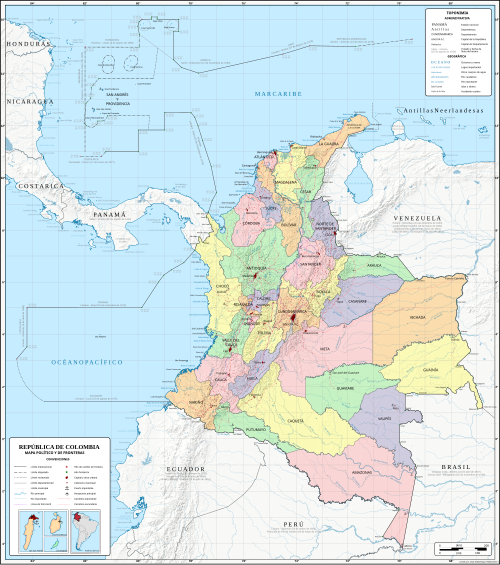
Photo by Milenioscuro, CC BY-SA. Source.

The account everyone repeats: Jesuit missionaries brought coffee into what is now Colombia during the first half of the 18th century, coming across from Venezuela.3456 The oldest surviving written mention is by the Jesuit José Gumilla, who in El Orinoco Ilustrado (1730) describes coffee growing at the mission of Santa Teresa de Tabajé, near where the Meta river meets the Orinoco on today’s Colombia–Venezuela border.234
From those eastern mission stations, cultivation moved west and north into Santander through the late 1700s, then spread across the Andes during the 1800s until coffee became the country’s main export.746
To verify — nobody agrees on the year coffee arrived
Three different framings turn up in the sources consulted here. The encyclopedia record simply says coffee had reached Colombia by 1790, treating Gumilla’s 1730 account as the earliest evidence rather than the arrival date.2 Blog and trade histories give c. 1724–1736, or “around 1730”, as the introduction itself.3456 The research behind this note could not tie any of them to a primary archival document. The 18th century and Jesuit agency are solid; the year is not. Do not quote a specific year.
To verify — two different "first exports", 27 years apart
- 1808: the first commercial production is recorded as 100 bags of 60 kg green coffee exported from the port of Cúcuta.2 This is confirmed on the encyclopedia record but is itself a reconstruction from trade history, not a customs document seen here.
- 1835: a widely repeated account gives the first documented export as 2,560 pounds shipped from Cúcuta to the United States.58
Both name Cúcuta, which suggests they describe the same port and two different milestones (first commercial shipment vs. first documented shipment) rather than a flat contradiction — but no source consulted here reconciles them. Also outstanding: a claim that recognised plantations existed at Girón and Muzo by 1787,8 which rests on a single retail blog.
One federation, one research centre
The FNC was formed in 1927 by producers in the Zona Cafetera who wanted collective bargaining power on price.12 It has since become something much larger: a marketing body, an export standard-setter, a rural extension service, and the owner of the Café de Colombia name.
Its research arm, Cenicafé, was founded in 1938.2 Cenicafé’s fingerprints are all over this wiki already — it supplies the working definition of a washed coffee quoted on the Washed process note, and it built the Becolsub and Ecomill machines that cut washing water use from 40 litres per kilo to well under one. Its other job is breeding, and that job rewrote Colombian agriculture.
To verify — how many coffee growers there actually are
Three figures are in circulation and they do not agree.
- 349,983 — growers registered and eligible to vote, published by the FNC itself on its official site.9
- “more than 500,000 farming families” — the encyclopedia record.2
- “about 600,000 coffee growers”, said to cultivate more than 12% of the world’s Arabica.105
The FNC’s own number is the lowest and the most authoritative, but it counts registered voters in federation elections, which is not the same population as families who grow coffee. Treat “roughly half a million growing families” as the honest statement and do not quote 600,000 as a fact.
What Colombia grows, and why it changed
The traditional plantings are the old Latin American set — Typica, Bourbon, Caturra, and the giant-beaned Maragogipe.10 Caturra in particular became the backbone of the national crop.
Then rust arrived. Coffee leaf rust reached Colombia in 1983, and Caturra — rated very highly susceptible — was indefensible. Cenicafé’s answer was a family of Timor Hybrid-derived varieties that carry rust resistance borrowed from Robusta:10
| Variety | Cross | What it is for |
|---|---|---|
| Variedad Colombia | Caturra × Timor Hybrid | The first national rust-resistant release |
| Castillo | Caturra × Timor Hybrid (Catimor-type) | The variety that replaced Caturra nationally |
| Tabi | Typica × Bourbon × Timor Hybrid | A taller, quality-focused resistant selection, introduced 2002 |
| Cenicafé 1 | Caturra × Timor Hybrid 1343 | The 2017 release: Castillo’s yield, more Supremo-grade beans, resistance to coffee berry disease too11 |
From 2008, a government-backed programme replaced billions of Caturra trees with Castillo — the single clearest case anywhere of a disease deciding what an entire country plants. That story is told in full on the Caturra note; the short version is that Colombia did not switch because Castillo cupped better, it switched because rust was going to take the crop either way.
The Cup of Excellence and specialty markets still see plenty of Caturra, Bourbon and Geisha out of Colombia — but the national average tree is now a Cenicafé hybrid.
The shape of the country
Colombia’s stretch of the Andes splits into three cordilleras — three parallel mountain ranges running north to south — and coffee grows on the slopes of all of them, mostly between about 1,200 and 1,800 m.12 Plenty of specialty farms sit above that band, but no source consulted here publishes a consistent upper figure, so none is given.
Three ranges means an enormous number of distinct microclimates within one country. The named departments are Antioquia, Caldas, Quindío, Risaralda, Tolima, Huila, Nariño, Cauca, Santander and others; one common classification groups them into North, Central, East and South, covering 16 recognised coffee regions.1012
The best-known cluster is the Eje Cafetero — the “coffee axis” of Caldas, Quindío and Risaralda.2 In 2011 UNESCO inscribed the Coffee Cultural Landscape of Colombia (Paisaje Cultural Cafetero) as a World Heritage site under cultural criteria (v) and (vi): 141,120 hectares with a 207,000-hectare buffer zone, made up of eighteen urban settlements across six sites, spanning Caldas, Risaralda, Quindío, northwestern Tolima, northern and eastern Valle del Cauca and southwestern Antioquia.27
What UNESCO actually recognised is worth being precise about: not the coffee, but a way of farming it — steep-slope smallholdings worked by families, and the towns built around them.
How the coffee is graded
Colombia runs its own green-coffee classification on top of the international one. The FNC sorts green coffee by screen size (how big the beans are, measured through graded sieves) and by the number of defects in a sample.10
A Colombian green coffee is described as reaching specialty grade when it scores above 80 points on an SCA-style cupping, carries zero primary defects, and has no more than five secondary defects. Primary defects are the serious ones — full black beans, full sour beans, dried cherry or pod, fungus damage, foreign matter, severe insect damage.10
To verify — the sample size does not match this wiki's other note
The source above states the defect count is taken from a 500 g sample.10 This wiki’s Specialty coffee note gives the widely repeated grading rule as 0 primary / ≤5 secondary defects in a 350 g sample. Same thresholds, different sample weight — which changes the strictness materially. Neither figure comes from a published SCA green-grading standard, because as the Specialty coffee note records, there currently isn’t one (SCA-110 is listed as in development). The 500 g figure here comes from a green-importer blog and was not confirmed against an FNC document.
To verify — is Colombia first or second in Arabica?
The encyclopedia record states Colombia ranks third overall and highest in the world for Arabica beans.2 The research behind this note instead reports Colombia as the second-largest Arabica producer, behind Brazil.10 Both can’t be right, and the difference matters: Brazil grows far more coffee in total but a large share of it is Robusta (Conilon). The reliable, uncontested claim is the narrower one the FNC itself makes — largest producer of mild washed Arabica,1 which is a different category from Arabica overall. Use that one.
The cup, and the brand
Colombian coffee is described with remarkable consistency across the trade: balanced acidity, medium body, clean cup — caramel and nut sweetness, often citrus at altitude.12 That is a consensus impression from cupping tables rather than a measured sensory study, and it is really a description of what washing does to high-grown Arabica.
The reason a supermarket shopper knows the word “Colombian” at all is marketing, and it was very good marketing. The FNC created Juan Valdez, a fictional coffee farmer with a mule named Conchita, to give an anonymous commodity a face; a “100% Colombian coffee” seal followed, and in 2002 the federation opened its own café chain under the Juan Valdez name, past 320 locations by 2020.1
There is also a legal layer under the brand. Café de Colombia is a designation of origin — a legally protected geographical name, run by the FNC through its own programme13 — and the encyclopedia record dates its European Union protected designation to 2007.23
To verify — when Juan Valdez actually appeared
The trade press says the character debuted in US advertising in 1958.1 The encyclopedia record instead attaches 1981 to the Juan Valdez branding concept and 1983 to the first television advertisement, while giving 1961 for the 100% Colombian seal.12 These are probably three separate milestones — character creation, logo registration, TV campaign — collapsed into one date by different retellings, but no source consulted here untangles them. Don’t quote a single “Juan Valdez started in ____” year. The EU designation-of-origin date of 2007 rests on a single encyclopedia line and no registration document was checked.
What this note does not have
The research behind this page turned up no primary competition or auction data for Colombia — no Cup of Excellence winning lots, scores, prices or buyers; no Alliance for Coffee Excellence auction sheets; no named farms with documented altitude, ownership and processing from a producer’s own site. Colombia runs a Cup of Excellence programme and its top lots sell at auction, so those records exist; they simply were not consulted here. Until they are, this note stays a country note, not a records note — and any specific Colombian score or price you see elsewhere should be checked against allianceforcoffeeexcellence.org before repeating it. See Premiumisation for why an auction price would say nothing about the national average anyway.
Why it matters
Colombia is the counter-example to almost every generalisation about origin countries.
It is big without being industrial — third in the world on the back of half a million smallholdings, not plantations. It is branded, which almost no origin manages; nobody asks for “Vietnamese coffee” by name at a supermarket. And it is the one country that deliberately replanted itself, trading a beloved variety for a durable one on the advice of its own research station, at national scale.
That last decision is the one specialty buyers still argue about. But it is the reason there is a Colombian crop at all to argue over.
Related
- Ethiopia — the origin Colombia’s plants ultimately descend from, by way of Yemen
- Brazil — the producer above it in the rankings, and the opposite model: scale over smallholder branding
- Caturra — the variety that was half the national crop, and what rust did to it
- Castillo · Catimor · Timor Hybrid — the rust-resistant lines that replaced it
- Typica · Bourbon · Maragogipe · Geisha — the other varieties grown here
- Chiroso · Pink Bourbon — the two Colombian specialty varieties whose DNA points at Ethiopia rather than at the parent they are named after
- Federación Nacional de Cafeteros — the growers’ federation that has run all of this since 1927, and the purchase guarantee under the whole crop
- Cenicafé — the FNC’s research centre, breeder of Castillo and builder of the Ecomill
- Coffee leaf rust — the disease that arrived in 1983 and rewrote the planting map
- Washed process — the method Colombia is defined by, and whose textbook definition comes from Cenicafé
- Arabica vs Robusta — why an Arabica-only country sits where it does on the map
- Specialty coffee · Coffee scoring · Cupping — the 80-point line Colombian grading refers to
- Cup of Excellence · Alliance for Coffee Excellence — where Colombian competition records would be found
- Premiumisation — why record lots and national averages are different worlds
- Nariño · Huila — southern departments with reputations of their own
- Café Granja La Esperanza — the Valle del Cauca producer holding Colombia’s auction price record
- El Vergel Estate — the Tolima farm that got famous through experimental fermentation rather than through a competition table
Official links
- Official site — Federación Nacional de Cafeteros de Colombia — the growers’ federation, the sector’s governing body since 1927
- Official site — Café de Colombia — the FNC’s origin brand, designation-of-origin and 100% Café de Colombia programme
Footnotes
-
Perfect Daily Grind — How did Colombia become so famous for its coffee? (December 2020) — confirmed via WebFetch; source of the 2019 mild-washed-Arabica statement, FNC 1927, Juan Valdez 1958/Conchita, the 1961 seal and the 2002 café chain ↩ ↩2 ↩3 ↩4 ↩5 ↩6 ↩7 ↩8
-
Coffee production in Colombia — Wikipedia — confirmed via WebFetch; source of the 1790 arrival, Gumilla 1730, 1808 Cúcuta export, Cenicafé 1938, 11.5 million bags, 500,000 families, EU designation 2007 and UNESCO 2011 ↩ ↩2 ↩3 ↩4 ↩5 ↩6 ↩7 ↩8 ↩9 ↩10 ↩11 ↩12 ↩13 ↩14 ↩15 ↩16
-
Colombia One — Origins of coffee production in Colombia and reasons for its success — source of the Jesuit introduction account and the Café de Colombia designation of origin ↩ ↩2 ↩3 ↩4
-
Ineffable Coffee — Colombian coffee: monograph by origin — Gumilla and the Santa Teresa de Tabajé mission ↩ ↩2 ↩3 ↩4
-
Green Plantation — The history of coffee in Colombia — the 1835 export account and the 600,000-grower figure ↩ ↩2 ↩3 ↩4
-
Norohy — History of coffee in Colombia — Jesuit introduction and 18th-century spread ↩ ↩2 ↩3
-
Coffee Cultural Landscape of Colombia — Wikipedia — confirmed via WebFetch; source of the 2011 inscription, criteria (v)/(vi), hectares and covered departments ↩ ↩2
-
Majestic Mountain Coffee — History of Colombian coffee — the 1787 Girón/Muzo plantations and the 2,560-pound 1835 shipment ↩ ↩2
-
Federación Nacional de Cafeteros de Colombia — official site — confirmed via WebFetch; source of the 349,983 registered growers figure ↩
-
Genuine Origin — Colombia coffee origin report 2023 — green-coffee importer; source of the grading rules, defect definitions, Cenicafé variety pedigrees and the 16-region classification ↩ ↩2 ↩3 ↩4 ↩5 ↩6 ↩7 ↩8
-
Perfect Daily Grind — What you need to know about Colombian coffee variety Cenicafé 1 (November 2017) — confirmed via WebFetch; source of the Cenicafé 1 parentage, dual disease resistance and screen-size figures ↩
-
Escondido Specialty Coffee — Colombian coffee: history, characteristics & cultural legacy — source of the three-cordillera geography, 1,200–1,800 m band and cup descriptors ↩ ↩2 ↩3
-
Café de Colombia — official site — confirmed via WebFetch as the FNC’s official origin-brand portal ↩