Ecuador
Ecuador is a small coffee origin with an outsized name in specialty. It is one of very few countries that grows coffee on the coast, in the Andes and in the Amazon at the same time, from roughly sea level to about 2,300 metres,1 and it is the country that produced Sidra and Typica Mejorado — two varieties that have won world barista titles and top auction lots while nobody can say for certain what they genetically are.
The tension in Ecuador is that the reputation is rising while the crop is shrinking. Exports peaked in the mid-1980s and have fallen by roughly two-thirds since.2
| Where it grows | Coast (Manabí, El Oro, Guayas, Los Ríos), Sierra/Andes (Loja, Pichincha, Imbabura, Chimborazo), Amazon (Orellana, Sucumbíos, Napo), plus the Galápagos21 |
| Altitude | 600–800 m on the coast; 1,700–2,300 m in the southern highlands1 |
| Species | Roughly 60–70% Arabica, the rest Robusta2 — see Arabica vs Robusta |
| Main specialty regions | Loja, Pichincha, Zamora Chinchipe, Chimborazo341 |
| Signature varieties | Sidra (also spelled Sydra), Typica Mejorado, plus Typica, Bourbon, Caturra, Castillo, Sarchimor, Geisha31 |
| Processing | Predominantly washed, with a strong recent move into anaerobics and naturals31 |
| Planted area | ~262,060 ha (2001) → ~200,000 ha (2012), of which ~150,000 ha in production2 |
| Exports, peak vs now | 1,810,000 60 kg sacks (1985) → ~650,000 bags (2012)2 |
| Competition | Cup of Excellence Ecuador, three editions: 2021, 2022, 20235 |
| Highest auction price seen here | $105.10/lb — Hacienda Lugmapata, 20224 |
| C-market origin differential | 400-point discount — see C-market |
The three Cup of Excellence years
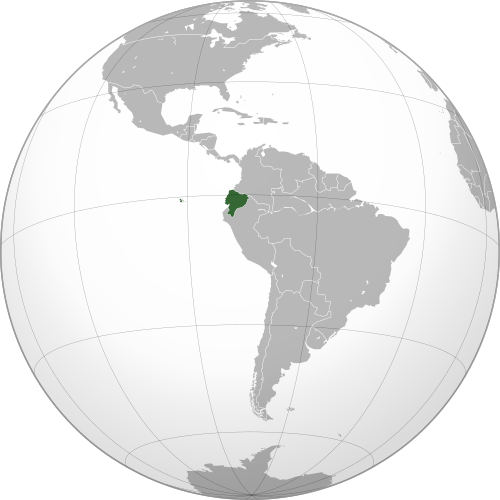
Photo by Addicted04, CC BY-SA. Source.
.svg)
Ecuador ran a Cup of Excellence — a blind national cupping competition ending in a public online auction — in 2021, 2022 and 2023, and the Alliance for Coffee Excellence keeps all three results pages up.5 Ecuador is not on ACE’s list of currently active programmes, so this is a closed three-year window rather than an annual fixture. Those three auctions are the single best-documented thing about Ecuadorian coffee quality, because every number in them is a published price against a published score.
| Year | Top lot | Producer | Region | Variety / process | Score | Top price | Buyer | |
|---|---|---|---|---|---|---|---|---|
| 1 | 2023 | La Noria | María del Pilar Burneo Samaniego | Loja | Washed Geisha | 91.22 | $103.20/lb | Sae Coffee Studio3 |
| 2 | 2022 | Hacienda Lugmapata | Familia Merino | Chimborazo | Washed Sydra | 90.28 | $105.10/lb | Izaki Coffee Co.4 |
| 3 | 2021 | Arashi | Abel Salinas Pacheco | Loja | Washed Typica Mejorado | 90.39 | $97.10/lb | GK Coffee (Taiwan) and others6 |
Three things are worth pulling out of that.
Loja dominates. In the 2023 auction, 12 of the 16 winning lots came from Loja, the southern Andean province on the Peruvian border; the rest came from Pichincha, Chimborazo and Zamora Chinchipe.3 Loja is to Ecuador what Cajamarca is to Peru — and the two are the same mountain range, a few hundred kilometres apart.
The prices are high for the volume. Ecuador’s 2022 auction moved just 6,449.06 lb for $264,640.01, a weighted average of $42.45/lb, with the cheapest winning lot at $9.90.4 In 2021 it was 7,452.89 lb for $250,068.45, average $33.55/lb.6 By 2023 the whole sale had shrunk to 4,751.21 lb for $147,468.91 across 16 lots, average $31.03/lb, floor $16.35.3 Those averages sit above Peru’s steady ~$26/lb, and the top prices clear $100 where Peru’s stall near $80 — on a fraction of the volume. See Premiumisation for why country name and scarcity, not score, set that gap.
The auction rewarded the odd varieties. It started in 2021, where five Sydra lots placed — all of them from Loja — led by a natural from El Aguacate in second place at 90.21 and $49.20/lb.6 Full table on Sidra. The 2023 table is full of names that exist almost nowhere else: Sydra, Improved Typica / National Typica, Typica Mejorada, and F1 hybrids — a washed-anaerobic Typica/Sydra blend from Cruz Loma in Pichincha took third at 89.53 and $64.80/lb, and an F1 hybrid from Lugmapata in Chimborazo took sixth at 89.25.3 Ecuador is one of the few origins where a competition table reads like a variety experiment.
To verify — the spelling is not standardised
ACE’s own published tables spell the same variety Sydra (2022, and lots 3, 13, 15 in 2023), Sidra (2023 lot 14) and Typica Mejorada / Typica Mejorado / Improved Typica / National Typica interchangeably.346 These may be one variety, several, or a naming convention rather than a plant. The Sidra note records that World Coffee Research’s Arabica variety catalogue has no Sidra entry at all, and one Ecuadorian-coffee source warns that “Typica Mejorado” may not be true Typica but a hybrid of uncertain identity.7 Treat the variety column in these tables as what the farmer called it, not as a verified genotype.
Where it grows
Ecuador’s unusual feature is that it grows coffee in three completely different landscapes at once.
The coast — Manabí, El Oro, Guayas, Los Ríos — grows Arabica low and warm, at roughly 600–800 m, and accounts for about 30% of production.1 Manabí is where coffee entered the country.
The Sierra, the Andean spine, is where the specialty sector lives: Loja, Zamora Chinchipe and El Oro’s highlands in the south at 1,700–2,300 m, and Pichincha, Imbabura and Chimborazo further north. It is about 25% of production but nearly all of the reputation.1 The Intag Valley in Imbabura is singled out for organic, shade-grown Arabica in cloud forest.8
The Amazon — Orellana, Sucumbíos, Napo — is Robusta country, another 30% of the crop.21
The Galápagos Islands grow a small volume of coffee on volcanic soil. Every source consulted treats it as a premium curiosity sold on its address rather than a flavour benchmark.197
To verify — Galápagos altitude and status
One green-coffee importer states Galápagos coffee grows at roughly 100–400 masl, which would be extraordinarily low for Arabica and is said to work because of the islands’ cool ocean climate.10 No official Ecuadorian or Galápagos-authority document confirming that band was found, and no production figure for the islands appears in any source read here — Wikipedia’s Ecuador coffee article mentions Galápagos cultivation but gives no numbers.2
A crop in decline
The export record is the clearest long-run data on Ecuador, and it goes up and then sharply down:2
| Year | Exports (60 kg sacks) | |
|---|---|---|
| 1 | 1935 | 220,000 |
| 2 | 1960 | 552,000 |
| 3 | 1975 | 1,018,000 |
| 4 | 1985 | 1,810,000 (peak) |
| 5 | 2001 | 1,062,000 (63,720 t) |
| 6 | 2012 | ~650,000 |
Planted area fell with it — from about 262,060 ha in 2001 to about 200,000 ha in 2012, with only 150,000 ha actually in production.2 A 2018 account puts harvested area lower still, at 87,000 ha of 200,000 planted, and yields at roughly 400 kg per hectare, about a third of Colombia’s.1
The reasons given are consistent across sources and unglamorous: dollarisation (Ecuador adopted the US dollar in 2000, which raised local costs against a dollar-priced world coffee price), emigration, an ageing grower population — average producer age around 60 — and labour costs of about $20 a day for pickers.1 The C-market note records Ecuador at a 400-point discount on ICE origin differentials, one of the steepest in the table, which is the market’s own verdict on the bulk crop.
To verify — how much coffee Ecuador actually makes
There is no agreed current production number, and the figures in circulation are far apart:
- ~650,000 60 kg bags (2012), per Wikipedia’s summary of trade data.2
- ~500,000 bags in 2019/20, per one specialty retailer’s country guide.11
- ~700,000 bags a year, per an expat-oriented Ecuador guide.8
- ~300,000 bags a year, per a French green-coffee importer.10
None comes from an official Ecuadorian statistical bulletin or an ICO release checked here, and they may refer to different years, to exports versus production, or to Arabica only versus both species. Quote a range, not a number.
To verify — the soluble-coffee share
A single source states that 84% of Ecuador’s coffee exports are soluble (instant) coffee.1 If true it reframes the whole origin — it would mean the specialty crop is a rounding error on a country that mainly ships processed Robusta, and it would explain the 400-point C-market discount. But it appears in one 2018 article and nowhere else in the material read here, and it was not cross-checked against Ecuadorian customs or ICO data.
To verify — how many farmers, and how big
Two secondary sources agree that Ecuadorian coffee is overwhelmingly smallholder, and disagree on every number:
- ~100,000 families, on farms of 1–10 hectares.9
- 90% of producers on small plots averaging 1.2 hectares.10
The smallholder character is not in doubt — no source describes large Ecuadorian coffee estates on the Brazilian or Panamanian model — but the counts are unconfirmed. See Producer cooperatives for how origins farmed in one-hectare pieces get their coffee milled and sold.
Varieties and processing
Ecuador plants the standard Latin American set — Typica, Bourbon, Caturra, Castillo, Colombia, and rust-resistant Sarchimor material — alongside Robusta in the lowlands.19 What makes it interesting is the two names it exported to the rest of the world.
Sidra is the big one. Grown mainly in Pichincha, Imbabura and Loja, it carried two World Barista Championship titles (2019 and 2022) despite having no entry in any official variety register, and the story that it came out of a closed Nestlé breeding facility in Pichincha remains unconfirmed. The Sidra note covers all of that in detail.
Typica Mejorado — “improved Typica” — is the other. It won Ecuador’s 2021 Cup of Excellence outright at 90.39 points and $97.10/lb,6 and appears under four different spellings across the ACE tables. As with Sidra, the name is a trade convention, not a verified genotype.7
On processing, Ecuador’s classic reputation is washed — the fruit stripped off, the beans fermented and rinsed, producing a clean cup — with some lots given a double wash in the Kenyan style.17 But the competition tables show the sector has moved fast: of the 16 lots in the 2023 auction, only six were straight washed; the rest were washed anaerobic, natural, natural anaerobic, or natural carbonic maceration.3 See Anaerobic fermentation and Natural process.
What it tastes like
Descriptions of the Ecuadorian cup cluster tightly across independent sources: sweet and juicy, with stone fruit — peach, apricot, plum — plus jam-like notes, florals, a creamy body and medium to lower acidity.111 These are tasting observations from coffee media and sellers, not lab measurements, and they describe the highland specialty crop rather than the coastal or Amazonian bulk coffee.
Where the country has a documented score, it is the auction record above: 91.22 for the 2023 winner, 90.39 in 2021, 90.28 in 2022.346 Claims that Ecuadorian coffees “regularly score 85+” appear in general guides with no named lot or scoring body attached,8 and should not be quoted as a measurement. See Coffee scoring.
Related
- Sidra — the variety Ecuador gave the world, with no registry entry and two barista titles
- Typica Mejorada — the other one, which took eight of the 23 winning lots in the 2021 Cup of Excellence
- Cup of Excellence · Cup of Excellence records by country · Alliance for Coffee Excellence — the three Ecuadorian editions and where their prices rank
- Peru · Colombia — the neighbours on the same mountain range, and the price comparison that matters
- Typica · Bourbon · Caturra · Geisha · Castillo · Sarchimor — what is planted here
- Washed process · Natural process · Anaerobic fermentation · Carbonic maceration — the processing mix in the competition tables
- Arabica vs Robusta — the two species Ecuador grows side by side
- C-market — where Ecuador’s 400-point origin discount is recorded
- Premiumisation — why a 91-point Ecuadorian lot clears $100 while a 90.7-point Peruvian one stops at $80
- Producer cooperatives — how a country of small farms reaches the market
- World Coffee Research — the body whose catalogue has no Sidra or Typica Mejorado entry
- Coffee Belt · Green coffee auctions · Coffee scoring · Climate change and coffee
Official links
- Official results — Alliance for Coffee Excellence, Ecuador 2023
- Official results — Alliance for Coffee Excellence, Ecuador 2022
- Official results — Alliance for Coffee Excellence, Ecuador 2021
- Official site — Ministerio de Agricultura, Ganadería y Pesca del Ecuador — confirmed as the government ministry site; no coffee statistics section was found on it here
- ANECAFÉ, Ecuador’s national coffee exporters association, is widely referenced but its domain did not resolve when checked here, so no official national coffee body page is linked
Footnotes
-
Perfect Daily Grind — Origin spotlight: exploring Ecuador’s specialty coffee — confirmed via WebFetch ↩ ↩2 ↩3 ↩4 ↩5 ↩6 ↩7 ↩8 ↩9 ↩10 ↩11 ↩12 ↩13 ↩14 ↩15 ↩16
-
Coffee production in Ecuador — Wikipedia — confirmed via WebFetch; source of the export series, planted area and species split ↩ ↩2 ↩3 ↩4 ↩5 ↩6 ↩7 ↩8 ↩9 ↩10
-
Alliance for Coffee Excellence — Ecuador 2023 results and auction — confirmed via WebFetch; auction held 14 March 2024 ↩ ↩2 ↩3 ↩4 ↩5 ↩6 ↩7 ↩8 ↩9 ↩10
-
Alliance for Coffee Excellence — Ecuador 2022 results and auction — confirmed via WebFetch; auction held 14 December 2022 ↩ ↩2 ↩3 ↩4 ↩5 ↩6
-
Alliance for Coffee Excellence — competition & auction results archive — confirmed via WebFetch; lists Ecuador 2021, 2022 and 2023 and no later edition ↩ ↩2
-
Alliance for Coffee Excellence — Ecuador 2021 results and auction — confirmed via WebFetch ↩ ↩2 ↩3 ↩4 ↩5 ↩6
-
Happy Gringo — Ecuadorian coffee: the complete guide for coffee lovers ↩ ↩2 ↩3
-
XLIII Coffee — Details of the elite specialty Ecuador coffee region ↩ ↩2