Huila
Huila is the part of Colombia that specialty buyers name out loud. Most Colombian coffee is sold as “Colombian” and nothing more. Huila is one of the handful of departments that broke out of that — enough so that the Colombian state gave the name legal protection, and enough that roasters print it on the bag instead of the country.
It is a department (a province, in effect) in southwestern Colombia, capital Neiva, covering 19,890 km² — about 1.74% of the country — with roughly 1.2 million people as of 2020.1 Geographically it is a funnel: the Colombian Massif in the south, where the Andes split into the country’s three mountain ranges, opening north into the Magdalena River valley. The country’s third-highest peak, the Nevado del Huila volcano, sits on its western edge.1 That combination — volcanic parent rock, steep ground, and a lot of separate valleys — is the whole terroir argument for the place.
| Country | Colombia |
| Capital | Neiva |
| Coffee-growing municipalities | 35 of 372 |
| Production, 2016 | 2.6 million 60 kg bags — 18% of Colombia’s crop2 |
| Typical altitude | 1,200–1,800 m2 |
| Typical temperature | 17–23 °C2 |
| Average farm size | ~1.5 hectares23 |
| Dominant processing | Washed process |
| Protected name | Café de Huila, denomination of origin since 20134 |
| Highest auction price on record | USD 65 per pound — a Geisha from Finca La Fortuna, Pitalito, at Huila Coffee 20255 |
The scale of it
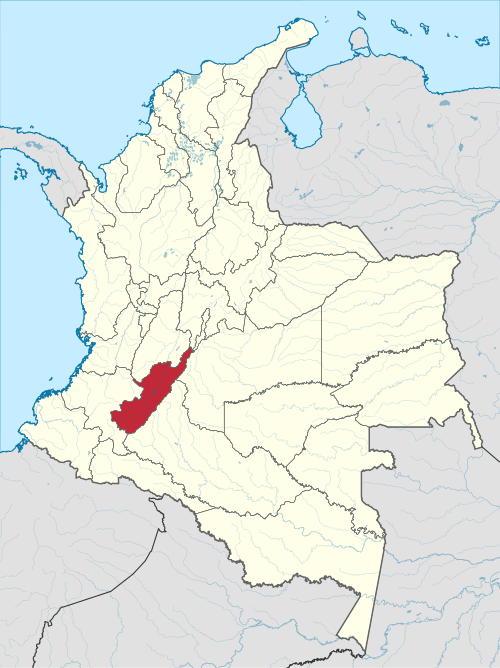
Photo by TUBS, CC BY-SA. Source.
.svg)
The load-bearing number is the 2016 one, and it comes from the FNC: Huila produced 2.6 million 60-kilo bags, or 18% of all Colombian coffee.2 Set that against the national picture — roughly 11.5 million bags a year from half a million families — and Huila alone is doing close to a fifth of it.
It does that with almost no large farms. 35 of Huila’s 37 municipalities grow coffee, and the average holding is about 1.5 hectares.23 There is no plantation model here to fall back on; the department’s output is the sum of tens of thousands of very small farms, which is also why organising them into cooperatives mattered so much (see Producer cooperatives).
To verify — nobody agrees how much land or how many families
Three different sets of figures are in circulation and the research behind this note could not reconcile them against an FNC statistical bulletin.
- Hectares planted to coffee: 154,800 from the trade press2 versus 144,895 from a green-coffee marketing page.6
- Coffee-growing families: 83,0006 versus 67,000, the latter alongside a claim of 191 growers associations.3
These are secondary sources of different quality, and they may be counting different years or different things (registered growers vs. households). Treat “well over a hundred thousand hectares and tens of thousands of families” as the honest statement and check SICA/FNC statistics before quoting any single number.
Café de Huila — the protected name
Colombia protects regional coffee names the way France protects wine appellations. The Superintendencia de Industria y Comercio (SIC) — the national industry and trade regulator — granted Café de Huila a denominación de origen through Resolución No. 17989 of 16 April 2013, and then handed the job of authorising who may use the name to the FNC through Resolución No. 69904 of 26 November 2013.4
Huila was the third regional coffee origin Colombia protected, in a set of seven:4
| Protected origin | Year | |
|---|---|---|
| 1 | Café de Cauca | 2011 |
| 2 | Café de Nariño | 2011 |
| 3 | Café de Huila | 2013 |
| 4 | Café de Santander | 2014 |
| 5 | Café de Tolima | 2017 |
| 6 | Café de la Sierra Nevada | 2017 |
You will see 2011 given as Huila’s denomination year in coffee education material.7 That is the year Cauca and Nariño were protected, not Huila; the FNC’s own designation-of-origin page and the SIC resolution number both give 2013.4
What the designation actually describes is a cup: delicate profile, bright acidity, medium body, sweet notes, and a fruity, caramel aroma.2 That is a legal description of a sensory expectation, not a guarantee any particular bag will taste like it.
What grows there, and when
The variety list is the standard Colombian one — old commercial types alongside the rust-resistant crosses Cenicafé bred to survive Coffee leaf rust: Caturra, Typica, Castillo, Bourbon, Variedad Colombia, Maragogipe, Tabi, and increasingly Geisha.2 Southern Huila is also where Pink Bourbon emerged — the department’s own variety, and not a Bourbon at all. Huila’s Tabi shows up on this wiki already, as does a washed Variedad Colombia from Finca Tamana roasted by Tim Wendelboe — who also bought his own farm, Finca El Suelo, here.
Processing is overwhelmingly washed: pulp the cherry, ferment off the sticky mucilage layer, wash it clean, dry in the sun. One roaster description puts Huila fermentation at up to 36 hours before sun drying.3
Harvest runs on Colombia’s two-crop rhythm. The main harvest is reported as August–December, with a smaller mid-year crop — the mitaca — around March–June.7 The mitaca is a second, lighter flowering’s worth of cherry; it exists because Colombia sits close enough to the equator to get two rainy seasons.
To verify — the altitude and harvest numbers move around by source
- 1,200–1,800 m for most farms, with high-altitude lots to 2,000 m, is the figure the trade press and Colombian tourism material give.2
- A coffee-education course gives a much wider 1,000–2,200 m and the August–December / March–June calendar above.7 That page returned a paywall when checked here, so the numbers come via the research report, not the source itself.
- An importer’s Pitalito profile — Pitalito being Huila’s second city and the heart of the southern coffee belt — lists farm altitudes of 1,450–1,800 masl with the town itself at 1,345 masl.8
- A different importer lists a Huila lot at 1,700–1,870 masl with harvest March–July.9
These are describing different subregions and different sourcing programmes, so they are not strictly contradictory — but there is no single “Huila altitude range”. Record them as regional examples.
Cadefihuila, the cooperative
The department’s best-known institution is the Cooperativa Departamental de Caficultores del Huila Ltda. — Cadefihuila. Its own site describes a business that buys and sells green coffee, mills and exports it, and sells fertiliser and farm supplies back to its members: about 4,005 associated coffee farmers across 27 municipalities, served by 35 purchase points and 18 agricultural supply stores, as of September 2020.10
Buying coffee and selling inputs is the point. A grower with 1.5 hectares has no leverage on either side of that trade alone; pooling both is what a cooperative is for.
To verify — Cadefihuila's founding story and membership detail
A green-coffee dealer profile says Cadefihuila was founded in 1963 by 19 members, expanded after the coffee crisis of the 1990s, and now has “almost 4,000 members from 25 municipalities”, of whom 11% are women; it gives the co-op’s coffee profile as 1,600 m average altitude and 3.1 ha average smallholding.11 Cadefihuila’s own site gives 2001 as the cooperative’s constitution date with predecessor organisations dating to 1963, and 27 municipalities.10 The 1963-founding date and the 19 founding members were not confirmed on the cooperative’s own site here, and the 3.1 ha average conflicts with the 1.5 ha departmental average cited above.2 Use the co-op’s own figures; treat the dealer profile’s history as reported, not established.
Where Huila coffee gets sold at auction
Huila does not wait to be picked out of a national contest. It runs its own, and its producers also enter the federation’s national auction. Two sets of published results sit behind the department’s reputation — and neither of them is Cup of Excellence.
Huila Coffee — the department’s own competition and auction
Huila Coffee is a departmental quality competition with an auction attached, organised by the Comité Departamental de Cafeteros del Huila, the FNC’s own committee in Neiva.5 That is a level of local organisation most Colombian departments do not have: Huila cups its own coffee, ranks it, and sells the top of it to foreign buyers under its own name.
The 2025 edition moved COP 2,236,850,759 in total, counting lot purchases, the international auction and a business roundtable together.5
| Huila Coffee 2025 | |
|---|---|
| Lots sold | 156, totalling 61,742 kg5 |
| Value of those purchases | COP 1,577,442,3105 |
| International auction | 15 lots, COP 598,552,6725 |
| Average auction price | USD 17.90 per pound5 |
| Business roundtable | COP 60,855,7775 |
| Top lot | USD 65 per pound5 |
The record lot was a Geisha grown by Víctor Andrés Ramírez López at Finca La Fortuna in Pitalito, bought by Faro Coffee Hub for USD 65 a pound — COP 146 million for twelve 24-kilo boxes, and reported as the highest price ever paid at a coffee auction in the department.5
Put that beside the auction’s own USD 17.90 average and you have the shape of every specialty auction in one picture: one lot runs away, and the other fourteen sit far below it. The department’s ceiling and the department’s normal are three and a half times apart (see Premiumisation). Prize money for the winning cups was COP 5, 3 and 2 million, and the committee’s director, Edna Yolima Calderón Ome, described the event as connecting growers straight to global buyers.5
To verify — the scores, the categories, and how old the event is
- Winning scores reported from Huila Coffee 2025 are 87.86, 87.50 and 87.05 in one variety category and 86.85 and 86.55 in another.5 The source is a Spanish-language news report and the two category names did not survive translation cleanly, so do not attach a named category to a score from this note.
- No cupping score, altitude or processing method is published anywhere for the USD 65/lb Geisha itself. Note also that a 65-dollar lot would normally be expected to outscore 87.86, which suggests the scores above belong to categories the record lot did not compete in. Unresolved.
- A competition video circulated on Instagram states that Ramírez won the category “otras variedades y varietales” (other varieties and varietals) with a farm in the vereda Bruselas. That video was not verified here, and neither the category nor the vereda appears in the news report.
- Whether 2025 was the first Huila Coffee is not stated, and no earlier edition’s results were found.
Colombia Land of Diversity — the national auction
Colombia Land of Diversity is the national quality auction run under the Café de Colombia banner on M-Cultivo’s bidding platform.12 Huila lots appear in it. The 2022 results list five from the department:12
| Producer | Process | Boxes (24 kg) | Winning bid per box | Total | Buyer | |
|---|---|---|---|---|---|---|
| 1 | Alba Lucía Camacho | Washed | 16.00 | USD 1,100.00 | USD 9,312.23 | Blanche Dael |
| 2 | Juan Evangelista Cubillos Angulo | Washed | 10.21 | USD 1,050.00 | USD 5,671.33 | Vive Café S.A. |
| 3 | Cielo Esperanza Baigue Méndez | Washed, long fermentation | 12.00 | USD 950.00 | USD 6,031.79 | FFT Colombia S.A.S. |
| 4 | Oscar Solin Vargas Losada | Washed | 14.58 | USD 750.00 | USD 5,787.07 | Coffee People |
| 5 | Alberto Ruiz Castro | Natural | 12.00 | USD 700.00 | USD 4,444.47 | FFT Colombia S.A.S. |
Two things are worth reading off that table. Four of the five lots are washed, which is the department’s default turning up in what buyers actually bid on — the one natural sold lowest, though five lots is far too few to call that a pattern. And the bids are per 24-kilogram box, not per pound — converting them would need a net-weight assumption the auction does not publish, so this note leaves them as they are.12 The results table names producers and their department but not their farms, so none of these five lots can be tied to a named finca here.12
What this note does not have
To verify — the popular claims with one source each
- The name. A roaster states that “Huila” means “luminous mountain” in the Indigenous Páez language.3 No linguistic or Indigenous-community source was checked. Repeated widely; verified nowhere here.
- 1862. The same coffee course gives 1862 as the year coffee was first planted in Huila, citing a 2008 academic work it does not reproduce.7 Plausible, unverified from any archive.
- 35% specialty. The claim that 35% of Huila’s production is specialty grade, and that Huila and Nariño routinely dominate Colombia’s Cup of Excellence competition, is a secondary synthesis.7 No Alliance for Coffee Excellence results page was consulted, so this wiki carries no verified Huila Cup of Excellence placement, lot, score, buyer or price. The auction records above come from Huila Coffee and Colombia Land of Diversity, which are different competitions entirely — they say nothing about how Huila does at COE. Check allianceforcoffeeexcellence.org before repeating the COE claim.
- Named producers. An importer lists a Huila offering built from five producers — Alexander Hernandez, Alexander Vargas, Linarco Rodriguez, Luis Carlos Guzman and Cesar Augusto Cardoso — washed Caturra at 1,700–1,870 masl.9 Another lists a Pitalito lot pooled from 4,845 farmers at an average 2.2 ha.8 Both are importer descriptions of blended sourcing programmes, not traceable single-farm lots, and neither producer was verified independently.
No cupping score is assigned to Huila as a region here, because no SCA or CQI table for the department was found — the Huila Coffee 2025 scores above belong to individual competition lots, not to the department. Regional averages and record lots are different worlds anyway — see Premiumisation.
Why it matters
Huila is the test case for whether an origin name can do real work at the level below a country. Colombia as a brand was built by the FNC over a century, on consistency. Huila is the opposite bet: that a specific corner of the country, with its own soil and its own altitude band, can be worth naming separately — and that the value of naming it flows back to farms of a hectare and a half.
The legal machinery says yes. Since 2013 the name has been property, administered by the federation, usable only by growers who qualify.4 Whether the price premium actually lands with the grower rather than the exporter is the same open question as everywhere else in specialty sourcing.
Related
- Colombia — the country note: the FNC, the three cordilleras, and the national replanting that changed what Huila grows
- Nariño — the neighbouring southern department, protected two years earlier, and Huila’s usual companion in “best of Colombia” arguments
- Federación Nacional de Cafeteros — the federation that administers the Café de Huila name
- Cenicafé — the research centre that bred Castillo, Tabi and Variedad Colombia
- Cadefihuila — the departmental growers’ cooperative, ~4,000 members across 27 municipalities
- Pitalito — the southern municipality at the heart of Huila’s specialty reputation
- Producer cooperatives — what Cadefihuila is an example of
- Caturra · Typica · Bourbon · Castillo · Variedad Colombia · Tabi · Maragogipe · Geisha — the varieties grown here
- Washed process · Coffee fermentation — how Huila coffee is almost always made
- Coffee leaf rust — the disease behind the department’s variety mix
- Cup of Excellence · Alliance for Coffee Excellence — the national competition Huila’s COE record would be found in, if one could be confirmed
- M-Cultivo — the bidding platform the Colombia Land of Diversity auction runs on
- Tim Wendelboe · Finca El Suelo — the Norwegian roaster who bought a farm here
- Specialty coffee · Green coffee grading · Premiumisation — the grading and pricing context
Official links
- Official site — Comité Departamental de Cafeteros del Huila (FNC) — the federation’s departmental committee, based in Neiva
- Official site — Cadefihuila — Cooperativa Departamental de Caficultores del Huila
- Official page — Café de Colombia, regional denominations of origin — the FNC’s own record of the Café de Huila designation
Footnotes
-
Huila Department — Wikipedia — confirmed via WebFetch; source of Neiva as capital, 19,890 km², ~1.2 million people, the Colombian Massif, Magdalena valley and Nevado del Huila ↩ ↩2
-
Perfect Daily Grind — A coffee buyer’s guide to Huila, Colombia (March 2018) — confirmed via WebFetch; source of the FNC’s 2.6 million bags / 18% for 2016, 154,800 hectares, 35 of 37 municipalities, 1,200–1,800 m, 17–23 °C, 1.5 ha average farm, the variety list and the denomination’s cup description ↩ ↩2 ↩3 ↩4 ↩5 ↩6 ↩7 ↩8 ↩9 ↩10 ↩11 ↩12
-
Coava Coffee Roasters — Explorer Series: Huila, Colombia — roaster origin page; source of the “luminous mountain” Páez etymology, the 1.5 ha family-estate description, up to 36 hours fermentation, 67,000 families and 191 growers associations ↩ ↩2 ↩3 ↩4 ↩5
-
Café de Colombia — Denominación de Origen Regional (FNC) — confirmed via WebFetch; source of SIC Resolución 17989 of 16 April 2013, Resolución 69904 of 26 November 2013, and the seven regional designations and their years ↩ ↩2 ↩3 ↩4 ↩5
-
La Voz de la Región — Huila Coffee 2025 consolidó el liderazgo de los cafés de calidad (4 October 2025) — confirmed via WebFetch; source of the Comité Departamental de Cafeteros del Huila as organiser, COP 2,236,850,759 total, 156 lots / 61,742 kg / COP 1,577,442,310, the 15-lot international auction at COP 598,552,672 and USD 17.9/lb average, the COP 60,855,777 roundtable, the USD 65/lb Geisha from Víctor Andrés Ramírez López at Finca La Fortuna (Pitalito) bought by Faro Coffee Hub for COP 146 million / twelve 24 kg boxes, the 87.86 / 87.50 / 87.05 and 86.85 / 86.55 scores, the COP 5/3/2 million prizes and the Edna Yolima Calderón Ome quote ↩ ↩2 ↩3 ↩4 ↩5 ↩6 ↩7 ↩8 ↩9 ↩10 ↩11 ↩12
-
Clearpath Coffee — Huila — green-coffee marketing page; source of the 144,895 hectares and 83,000 families figures ↩ ↩2
-
Barista Hustle — CBGC 1.11 Huila — coffee-education course; source of the 1862 planting date, the 2011 denomination claim, the 1,000–2,200 m range, the August–December / March–June harvest calendar, the 35% specialty figure and the Cup of Excellence claim. Returned a paywall when checked here; cited via the research report, not read at source ↩ ↩2 ↩3 ↩4 ↩5
-
InterAmerican Coffee — Colombia · Huila · Pitalito — importer offering sheet; source of the 4,845-farmer pooled lot, 2.2 ha average, 1,450–1,800 masl farm altitudes and Pitalito at 1,345 masl ↩ ↩2
-
Marvell Street — Huila, Colombia — importer offering sheet; source of the five named producers, washed Caturra, 1,700–1,870 MASL and the March–July harvest window ↩ ↩2
-
Cadefihuila — official site — confirmed via WebFetch; source of the full cooperative name, ~4,005 associates as of September 2020, 27 municipalities, 35 purchase points, 18 supply stores, and the 2001 constitution with predecessors to 1963 ↩ ↩2
-
Kengabbay Coffee — Cadefihuila producer profile — green-coffee dealer profile; source of the 1963 founding by 19 members, the 1990s expansion, “almost 4,000 members from 25 municipalities”, 11% women, 1,600 m and 3.1 ha ↩
-
Colombia Land of Diversity — 2022 auction results — official auction results table, confirmed via WebFetch; source of the five Huila lots, their processes, box counts, per-box winning bids, totals and buyers, and of the auction being run under Café de Colombia on the M-Cultivo platform ↩ ↩2 ↩3 ↩4