Pitalito
Pitalito is the town most Colombian specialty coffee comes home to. If a bag says “Huila” and names a producer, there is a good chance the farm sits within an hour of this one municipality in the far south of the department. It is a real town of about 128,630 people — not a farm, not an estate, not a brand — and its coffee reputation is the sum of thousands of very small holdings rather than any single famous property.1
It sits in the Valle de Laboyos (the Laboyos valley), near the head of the Magdalena River valley, 188 km from Neiva, Huila’s capital.1 Its own municipal government leans on the coffee identity openly, branding the place Tierra de Café — coffee country.2
| Country | Colombia |
| Department | Huila |
| Town elevation | 1,318 m1 (an importer gives 1,345 masl3) |
| Population | 128,630, 2020 estimate1 |
| Distance to Neiva | 188 km1 |
| Farms in one importer’s programme | 4,845 growers, averaging 2.2 ha3 |
| Typical farm altitude | roughly 1,250–2,000 m depending on source345 |
| Dominant varieties | Caturra, Castillo, Variedad Colombia346 |
| Dominant processing | [[Washed process |
Why one municipality ended up with a name
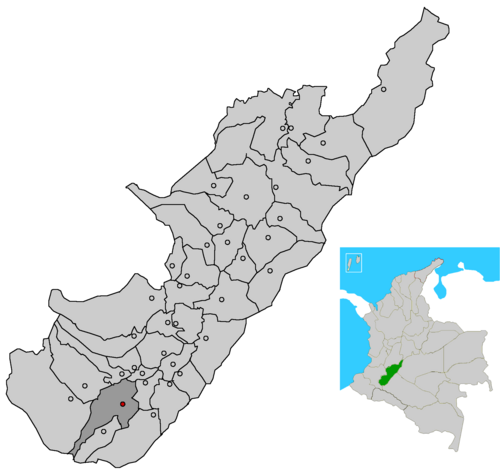
Photo by —F3rn4nd0 07:18, 29 April 2007 (UTC), CC BY. Source.

Pitalito was founded on 18 December 1538 by the Spanish captain Pedro de Añasco, as a village in the Laboyos valley originally called Guacacallo; the settlement moved to its present site in 1818.1 None of that has anything to do with coffee, which arrived much later — and that lateness is part of the argument for the place.
The version told by roasters is that coffee reached Pitalito in the early 20th century, long after Colombia’s traditional growing heartland in Antioquia, and that arriving late let the valley skip straight to a smallholder, quality-first model instead of a volume one.5 It is a tidy story and it fits what the region sells, but it is a roaster’s telling, not a documented history — see the flag below.
What is not in dispute is the shape of the farming. This is smallholder country: an importer running a pooled Pitalito programme counts 4,845 farmers at an average of 2.2 hectares each.3 For scale, the Huila departmental average is about 1.5 hectares, so Pitalito’s farms are, if anything, slightly larger than the departmental norm — but still family plots, not estates. There is no plantation model here to fall back on, which is why cooperatives and buying stations do so much of the work (see Producer cooperatives).
Ground, altitude and what it grows
The valley’s selling points are volcanic soils and the convergence of the Magdalena and Guachicos rivers.5 Farm-level soil descriptions vary by lot: one importer’s Pitalito offering describes sandy loam with clay minerals,7 another roaster describes loamy soils on a farm at 1,750 m.8
Altitude is the number buyers care about, and there is no single figure — different sourcing programmes cover different slices of the municipality:
| Source | Farm altitude given |
|---|---|
| InterAmerican Coffee (importer) | 1,450–1,800 masl3 |
| List & Beisler (importer info sheet) | 1,250–2,000 masl4 |
| Ona Coffee (roaster) | 1,300–2,000 m5 |
| Vanguelpen (buying station lot) | 1,700–2,015 masl6 |
These are consistent enough to say honestly: most Pitalito coffee is grown between roughly 1,300 and 2,000 metres, with the competition-grade lots clustering at the top of that band.
The variety mix is standard Colombian, with one regional quirk. Two importers independently report Caturra and Castillo as the mainstays, and one adds that Pitalito growers have preferred Caturra over Castillo — trading away some rust resistance for a more consistent cup.34 A buying-station lot adds Variedad Colombia to the pair.6 Processing is overwhelmingly washed: ferment, wash off the mucilage, dry to about 12.5% moisture.4
That is the everyday Pitalito coffee — washed Caturra, graded Excelso, described by its importer as balanced in body with lively acidity and red-fruit flavour.3 A second importer’s regional profile runs juicy, smooth, caramel, sugar cane, berry jam.4 A roaster adds bright citric acidity, floral aromatics and structured sweetness.5 Those descriptions agree more than they disagree, which is about as close to a regional cup signature as this wiki is willing to state.
The competition end
Pitalito’s fame is not built on Excelso. It is built on a small number of farms doing heavily engineered fermentations and selling them to barista competitors — the same route described in detail on the Nestor Lasso note. Lasso’s Finca El Diviso and the partner farm Las Flores both sit in this municipality, and between them they supplied the coffee behind Anthony Douglas’s 2022 World Barista Championship win and Jack Simpson’s 2023 third place.
Beyond that, what exists publicly is a shelf of roaster and importer listings. They are worth recording as examples of what the municipality sends out, but every one of them is a seller describing a bag it had for sale:
| Lot / programme | Producer or seller | Altitude | Variety | Process | Reported score | |
|---|---|---|---|---|---|---|
| 1 | ASOPROCAPI cooperative lot | via Fratello Coffee (Canada) | 1,350–1,500 masl | 91% Caturra, 7% Typica | fully washed | 88.59 |
| 2 | El Mirador | Elkin Guzmán | 1,750 m | Catiope | ”Yellow Fruits Nectar” anaerobic | 89.58 |
| 3 | Las Flores / El Diviso | Nestor Lasso, Adrián Lasso, Johan Vergara | 1,700–1,900 masl | Caturra, [[Variedad Colombia | Colombia]] | not stated |
| 4 | Finca La Esperanza | Carlos Cerquera | 1,780 masl | Geisha | washed | not stated10 |
| 5 | La Esperanza | Alexander Hernández | 1,800 masl | not stated | anaerobic washed | not stated5 |
| 6 | 12-producer pooled lot | 12 named smallholders | 1,480–1,800 masl | Castillo | not stated | not stated7 |
| 7 | Pitalito buying station | pooled smallholders | 1,700–2,015 masl | Caturra, Colombia, Castillo | washed, sun-dried | not stated6 |
| 8 | Finca La Fortuna — Huila Coffee 2025 top lot | Víctor Andrés Ramírez López | not stated | Geisha | not stated | not published11 |
The two scores in that table — 88.5 and 89.5 — are roaster and importer cupping evaluations, not Cup of Excellence or SCA results. They are what a buyer’s own table gave a coffee it had already decided to sell. Read them accordingly.
One real auction price does exist. At the Huila Coffee 2025 competition run by the departmental committee of the FNC, a Geisha from Víctor Andrés Ramírez López’s Finca La Fortuna, here in Pitalito, sold to Faro Coffee Hub for USD 65 per pound — COP 146 million for twelve 24-kilo boxes, and the highest price recorded at a Huila auction.11 No score, altitude or process was published for it. The full figures are on the Huila note.
Every other price is a seller’s own. A retail green-coffee listing offers a washed Geisha microlot from Carlos Cerquera’s 3-hectare Finca La Esperanza at USD 8.91 per pound, USD 392 per bag.10 That is an asking price, not an auction result and not what the farmer was paid.
To verify — "the largest producer of coffee in Colombia"
Wikipedia states flatly that “Pitalito is considered the largest producer of coffee in Colombia,” with no citation attached.1 The superlative is repeated widely in trade copy. The only concrete production figure found anywhere is narrower and comes from an importer: that Pitalito is the biggest coffee-producing municipality of Huila, with about 15% of the department’s production — and that same page calls Pitalito Huila’s second city, not its first.3 No FNC or DANE municipal production table was reached in the research behind this note, so neither the national superlative nor the 15% figure is independently confirmed here. Check SICA/FNC Huila statistics before quoting either.
To verify — the Cup of Excellence claim has no lot, year or score behind it
Wikipedia says Pitalito has “on several occasions … been awarded with the ‘Cup of Excellence’, for producing the best coffee in the country,”1 and an importer info sheet refers to “many successful entries in Colombia’s Cup of Excellence over the years.”4 Neither names a farm, a year, a rank or a score. Two Alliance for Coffee Excellence results pages were checked here. The Colombia 2017 table lists Huila entries from Neiva, Algeciras and Palestina — not Pitalito.12 The Colombia 2021 table records department only, with no municipality column at all, so it can neither confirm nor rule Pitalito in.13 This wiki therefore carries no verified Pitalito Cup of Excellence placement, lot, score, buyer or price. Check allianceforcoffeeexcellence.org before repeating the claim. The same caution already stands on the Huila note.
To verify — two different Finca La Esperanzas
A roaster lists La Esperanza, Pitalito, producer Alexander Hernández, 1,800 masl, anaerobic washed.5 A green-coffee seller lists Finca La Esperanza, Pitalito, producer Carlos Cerquera, 3 ha, 1,780 masl, washed Geisha.10 These are almost certainly two separate farms sharing a very common Colombian farm name — “La Esperanza” means “hope” and is one of the most-used farm names in the country. Note also that this wiki already has a Café Granja La Esperanza note for an entirely unrelated Colombian operation, and that a “La Esperanza 2017” appears in the Cup of Excellence Colombia 2017 results under a producer in Palestina, Huila.12 Do not merge any of these. No Colombian land registry was consulted to disambiguate them.
To verify — the origin story and the farm histories
- Coffee arriving in the early 20th century, and the claim that Pitalito’s late start let it leapfrog older regions like Antioquia into microlot production, comes from a single roaster origin page with no year, document or archive behind it.5 Plausible; unverified.
- The same page credits the FNC and exporters with building the cupping labs and training programmes that made this possible.5 Also single-source.
- El Mirador is described as having “about 80 years” of history.8 That is marketing copy, not a founding date; no year is documented.
- Finca Las Flores is said to have begun in 1990.14 The Nestor Lasso note records Las Flores as the Vergara family’s farm merged with the Lassos’ El Diviso, and gives no founding year — these are compatible, but the 1990 date rests on one roaster listing.
Why it matters
Pitalito is the clearest test in Colombia of whether specialty value can attach to a place smaller than a department. Huila already has a legally protected name; Pitalito has no such protection and no governing body of its own — just an accumulated reputation carried by roaster copy, competition stages and a handful of farms.
That reputation is real enough that buyers now name the municipality on the bag. But the record behind it is thin in exactly the way the Nestor Lasso note describes: there is no auction archive for Pitalito, no published municipal production table this note could reach, and no score sheet that is not a seller’s own. What the valley demonstrably has is thousands of two-hectare farms, a very high altitude ceiling, and a cluster of producers who learned to run fermentations precisely — and that combination has proven to be enough. Whether the premium reaches the 4,845 growers or stops at the exporter is the same unanswered question as everywhere else in specialty sourcing; see Premiumisation.
Related
- Huila — the department Pitalito sits in, and the protected “Café de Huila” name
- Colombia — the country note: the FNC, the cordilleras, and the national variety replanting
- Nestor Lasso — the Pitalito producer behind Finca El Diviso and the Las Flores partnership
- Anthony Douglas · Jack Simpson · World Barista Championship — the championship routines built on Pitalito coffee
- Federación Nacional de Cafeteros · Cadefihuila · Producer cooperatives — the institutions that organise farms this small
- Caturra · Castillo · Variedad Colombia · Typica · Geisha — the varieties grown here
- Washed process · Coffee fermentation · Anaerobic fermentation — how Pitalito coffee is made, at both ends of the market
- Coffee leaf rust — the disease behind the Caturra-versus-Castillo choice
- Cup of Excellence · Alliance for Coffee Excellence — where a Pitalito competition record would be, if one could be found
- Coffee scoring · Green coffee grading — what “Excelso” and an 88.5 do and do not mean
- Café Granja La Esperanza — an unrelated Colombian operation with a confusingly similar name
- Direct trade · Green coffee buying · Premiumisation — how a two-hectare farm reaches a competition buyer, and what it earns
Official links
- Official site — Alcaldía Municipal de Pitalito, Huila — the municipal government’s own site, confirmed here
- Official site — Comité Departamental de Cafeteros del Huila (FNC) — the federation’s departmental committee, where municipal production statistics would be published
Footnotes
-
Pitalito — Wikipedia — confirmed via WebFetch; source of the 128,630 (2020 est.) population, 1,318 m elevation, 188 km to Neiva, the Valle de Laboyos location, the 1538 founding by Pedro de Añasco as Guacacallo, the 1818 move, and the uncited “largest producer of coffee in Colombia” and Cup of Excellence claims ↩ ↩2 ↩3 ↩4 ↩5 ↩6 ↩7 ↩8
-
Alcaldía Municipal de Pitalito, Huila — official site — confirmed via WebFetch as the official municipal government site; source of the municipality’s Tierra de Café self-description ↩
-
InterAmerican Coffee — Colombia · Huila · Pitalito — confirmed via WebFetch; source of the 4,845 farmers, 2.2 ha average, 1,345 masl town altitude, 1,450–1,800 masl farm range, the Caturra-over-Castillo preference, washed Excelso grade, the balanced/lively/red-fruit profile, and the “biggest coffee producer of the Huila, 15% of the department” claim ↩ ↩2 ↩3 ↩4 ↩5 ↩6 ↩7 ↩8 ↩9
-
List & Beisler — Colombia Huila, Pitalito info sheet (PDF) — importer info sheet; source of the 1,250–2,000 masl range, Caturra and Castillo as main varieties, washed processing to 12.5% moisture, the juicy/caramel/sugar-cane/berry-jam profile and the Cup of Excellence entries claim ↩ ↩2 ↩3 ↩4 ↩5 ↩6 ↩7
-
Ona Coffee — La Esperanza, Colombia, Anaerobic Washed — roaster origin page; source of the 1,300–2,000 m range, the volcanic soils and Magdalena/Guachicos confluence, the early-20th-century arrival and Antioquia comparison, the FNC infrastructure credit, and the Alexander Hernández La Esperanza lot at 1,800 masl ↩ ↩2 ↩3 ↩4 ↩5 ↩6 ↩7 ↩8 ↩9
-
Vanguelpen — Colombia Pitalito Station — importer listing; source of the buying-station lot at 1,700–2,015 masl, Caturra/Colombia/Castillo, washed and sun-dried ↩ ↩2 ↩3 ↩4
-
Royal Coffee — Colombia Huila Pitalito, A Castillo — importer listing; source of the 12-producer pooled Castillo lot, 1,480–1,800 masl and the sandy-loam soil description ↩ ↩2
-
Sango Amsterdam — Colombia Pitalito, El Mirador — roaster listing; source of El Mirador, Elkin Guzmán, the “about 80 years” description, 1,750 m, the Catiope variety, the “Yellow Fruits Nectar” anaerobic process, the loamy soils and the 89.5 in-house score ↩ ↩2 ↩3
-
Fratello Coffee — Colombian Huila Pitalito — roaster listing; source of the ASOPROCAPI cooperative lot, 1,350–1,500 masl, 91% Caturra / 7% Typica, fully washed, and the 88.5 in-house cupping score. Returned HTTP 429 when fetched here; cited via the research report ↩
-
Bodega Coffee — Colombia microlot, Carlos Cerquera, Finca La Esperanza, Pitalito, Gesha — green-coffee listing; source of the 3 ha farm size, 1,780 masl, washed Gesha, and the USD 8.91/lb and USD 392/bag asking prices ↩ ↩2 ↩3
-
La Voz de la Región — Huila Coffee 2025 consolidó el liderazgo de los cafés de calidad (4 October 2025) — confirmed via WebFetch; source of the USD 65/lb Geisha from Víctor Andrés Ramírez López at Finca La Fortuna, Pitalito, bought by Faro Coffee Hub for COP 146 million / twelve 24 kg boxes at Huila Coffee 2025 ↩ ↩2
-
Alliance for Coffee Excellence — Cup of Excellence Colombia 2017 results — confirmed via WebFetch; source of the Huila entries from Neiva, Algeciras and Palestina, the “La Esperanza 2017” lot, and the absence of any Pitalito entry ↩ ↩2
-
Alliance for Coffee Excellence — Cup of Excellence Colombia 2021 results — confirmed via WebFetch; source of the department-only result table with no municipality column ↩
-
Harmony Coffee Roasters — Pitalito, Colombia (via every.coffee) — roaster listing; source of the Néstor Lasso / Adrián Lasso / Johan Vergara Las Flores–El Diviso lot, 1,700–1,900 masl, Caturra and Colombia varieties, and the 1990 Finca Las Flores start date ↩