Coffee fermentation
Fermentation in coffee is the stage, right after picking, where naturally occurring microbes eat the sugary fruit layer around the seed — turning its sugars into acids, alcohols and gases, and in the process loosening the fruit off the bean and pushing flavour into it. It happens to every coffee, whether anyone plans it or not; the craft is in controlling it.12
The sugar-rich layer the microbes feed on is the mucilage — the thin, slippery coat glued to the seed once the skin is off (the same layer washed processing removes, honey leaves partly on, and natural never removes at all). In a whole cherry, the fruit itself is the substrate. Either way, fermentation is a controlled version of the rot that would eventually consume the fruit anyway.
Who does the work: three families of microbe
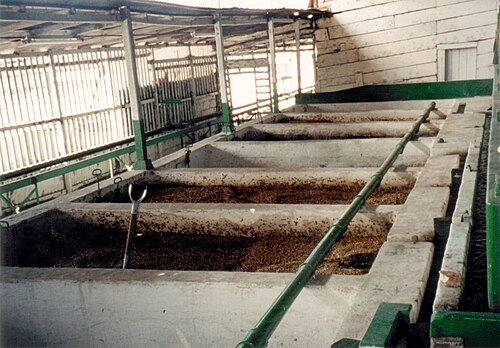
Photo: public domain. Source.

The microbes are not added (except in some experimental lots) — they arrive on the fruit from the farm. Three groups dominate coffee fermentation:1
- Yeasts — produce alcohols and fruity esters, and thrive early when sugar is plentiful.
- Lactic acid bacteria (LAB) — the same family that sours yoghurt and sourdough; they produce lactic acid and become dominant when air is shut out. A peer-reviewed study of sealed-tank coffee ferments found Weissella, Leuconostoc and Lactiplantibacillus leading the LAB population.3
- Acetic acid bacteria (AAB) — produce acetic acid (the smell of vinegar); useful in small amounts, a defect in large ones.
Which family wins is decided mostly by oxygen. Open, airy conditions favour yeasts and acetic bacteria; a sealed, oxygen-starved tank shifts the balance toward lactic acid bacteria and the softer, wine-like acidity they bring.31 That single lever — how much air the microbes get — is what separates the three big styles below.
The one dial: aerobic → anaerobic → carbonic
Aerobic, anaerobic and carbonic maceration are not three separate inventions. They are three settings on the same control — how much oxygen the microbes have — running from wide open to sealed shut.
| Style | Oxygen | What’s in the vessel | Character it pushes |
|---|---|---|---|
| Aerobic (traditional) | Open to the air | Depulped seed in an open tank | Clean, bright, restrained |
| Anaerobic | Sealed, air shut out | Depulped seed (or whole cherry) in a closed tank | Fruity, wine-like, heavy body |
| Carbonic maceration | Sealed + CO₂-flushed | Whole intact cherries under carbon dioxide | Most intense, candy-like fruit |
Crucially, none of these is a way of drying the coffee. A coffee still finishes as a washed, honey or natural — fermentation is what happens before or during that. “Anaerobic natural” and “carbonic washed” describe the ferment and the finish separately. See Anaerobic fermentation for why sealing the tank is a modulation, not a fourth processing method.
Aerobic (traditional) fermentation
The oldest and most common form is the open-air ferment at the heart of washed processing: depulped seeds sit in a tank, open to the air, while the microbes break the mucilage down, before the coffee is rinsed clean and dried.1 It is sometimes done underwater, and a post-fermentation soak in clean water often follows.
Because air is plentiful, yeasts and acetic bacteria stay in play and the ferment runs relatively fast and warm — the appeal is a clean, bright cup where the seed and the place, not the fermentation, do most of the talking. Traditional washed ferments are typically measured in hours, not days; a fermentation-focused roastery describes short aerobic runs of roughly 12–18 hours giving a clean, citric cup and medium runs of 24–36 hours building more body and stone-fruit notes.1 (These overlap with, but do not exactly match, the several other timing ranges collected on Washed process — see the To-verify note there.)
To verify
The specific aerobic time bands are single-sourced. The 12–18 h and 24–36 h aerobic ranges, and the pH/temperature/Brix control targets below, come from one fermentation-education roastery (Particular Coffee) and are presented there as general rules of thumb, “not tied to a specific farm” and not competition-validated.1 Washed process collects four different overlapping fermentation ranges from four sources — the honest state of the practice is that there is no single standard time.
What producers actually measure
Serious fermentation management means watching four things — the same four the expensive sealed tanks put gauges on:1
- Time — how long the microbes work.
- Temperature — a recommended working range of roughly 18–25 °C; above about 35 °C, undesirable bacteria take over and defects follow. A peer-reviewed sealed-tank study measured near-ambient 20 °C under self-induced anaerobic conditions versus 30–37 °C in semi-anaerobic ones — cooler and slower being the whole appeal.31
- pH (acidity) — mucilage starts around 5.5–6.0 and drops as acids build, toward roughly 4.0–4.5 for a clean washed ferment and lower still, 3.5–4.0, for an extended anaerobic one.1
- Brix (sugar content) — falling Brix shows the microbes eating through the sugars, a live readout of how far the ferment has gone.1
To verify
The pH, temperature and Brix figures are single-sourced. The specific numbers above (pH 5.5–6.0 → 3.5–4.5, 18–25 °C working range, the 35 °C ceiling, Brix tracking) come from one education-focused roastery.1 The 20 °C vs 30–37 °C contrast is independently corroborated by a peer-reviewed study,3 but the rest should be read as one operation’s practice guidance, not an industry specification. No standards body publishes a fermentation temperature or pH specification.4
The risk that never leaves: over-fermentation
Fermentation is powerful precisely because it can go too far. Push time or temperature too hard and the microbes run past pleasant fruit into vinegar, alcohol and rotten-fruit notes — an over-fermented coffee is generally considered unsalvageable.1 This is why fermentation is often called the most controllable and the most misunderstood stage of coffee processing: the same lever that produces prized intensity produces spoilage one step further on.1 Sealing the tank (see Anaerobic fermentation) buys a longer, safer window — but “safer” is not “safe,” and the four measurements above still have to be watched.
Why it matters
Fermentation is where the specialty industry’s centre of gravity moved over the last decade — from the field to the wet mill.
- It is the producer’s biggest lever after picking. Two lots from the same trees, fermented differently, can cup as different coffees. That is why competitions like Best of Panama run separate washed and natural categories, and why farms deliberately prepare split lots.
- It drives the loud experimental coffee of the 2010s–2020s. Extended anaerobic and carbonic lots — intense, fruity, wine-like — are fermentation-forward coffees, and they dominate the competition circuit and the top of the auction market.
- It reopened the terroir argument. Because a managed ferment can put so much flavour into a cup, critics ask whether process-driven intensity reveals a coffee’s origin or covers it up. That debate — the sharpest version of it around co-fermentation, where flavours are added to the tank — runs through Anaerobic fermentation and Carbonic maceration.
For a reader, the shortcut: every coffee is fermented; the label just tells you how the producer chose to run it. “Washed” means a clean aerobic ferment; “anaerobic” and “carbonic maceration” mean a sealed one turned up for intensity — and the word next to them still tells you how the coffee was dried.
Related
- Anaerobic fermentation · Carbonic maceration — the two sealed-tank settings of the dial
- Washed process · Honey process · Natural process · Pulped natural — the drying methods every ferment finishes as
- Coffee cherry — the fruit whose sugars the microbes eat
- Dry milling — what happens to the seed once fermentation and drying are done
- Pu’er tea — the drink that built a legally defined product category on deliberate post-harvest fermentation and aging
- Cupping · Coffee scoring · Q Grader · Coffee Value Assessment — how the resulting cup is judged
- Daterra · Carmen Estate · Alo Coffee · Echoes of the Peak · Best of Panama · Cup of Excellence · Sidama
Official links
Footnotes
-
Particular Coffee — Fermentation Science in Coffee — fermentation-focused roastery and education project; sole source for the aerobic time bands, the pH/temperature/Brix control targets, the microbe families and the over-fermentation framing; cited in the research report, not independently fetched ↩ ↩2 ↩3 ↩4 ↩5 ↩6 ↩7 ↩8 ↩9 ↩10 ↩11 ↩12 ↩13
-
Royal Coffee — A Guide To Carbonic Maceration And Anaerobic Fermentation In Coffee — green-coffee importer’s technical guide; the fermentation-as-microbial-activity framing and the aerobic/anaerobic/carbonic distinctions confirmed via WebFetch ↩
-
Foods (2025) — Development of Fermentation Strategies for Quality Mild Coffee Production (Coffea arabica L.) Based on Oxygen Availability and Processing Time — peer-reviewed; source of the LAB genera (Weissella, Leuconostoc, Lactiplantibacillus) and the 20 °C vs 30–37 °C temperature contrast; cited via Anaerobic fermentation, not independently fetched for this note ↩ ↩2 ↩3 ↩4