Tanzania
Tanzania is the East African origin that most people have tasted without noticing. It sits between Kenya and the Great Lakes, grows coffee on the flanks of Kilimanjaro and along the Malawi border, and supplies a steady stream of clean, bright, moderately priced coffee to blenders and supermarket shelves. Where Kenya sells a grade letter and Ethiopia sells a region, Tanzania mostly sells a shape: peaberry, the round single bean that Tanzanian exporters have marketed harder than almost anyone.1
Two things make it structurally different from its northern neighbour:
- It is a two-species country. Roughly 70% Arabica and 30% Robusta, with the Robusta concentrated in Kagera on the Ugandan border — a genuinely split national crop rather than an Arabica monoculture.123 See Arabica vs Robusta.
- The farms are tiny and the paperwork is dense. Around 90% of the crop comes from smallholders,12 and the sector runs through a statutory regulator that licenses every curing factory, roaster and exporter by name and number.456
| Species split | ~70% Arabica / ~30% Robusta123 |
| Global production rank | roughly 15th2 |
| Annual production | 877,750 bags of 60 kg per Sucafina2 — but see the To-verify note below |
| Who grows it | ~450,000 smallholders, plots of 0.5–3 ha, >90% of output2 |
| Arabica regions | Kilimanjaro, Arusha, Karatu/Ngorongoro, Tarime, Kigoma, Ruvuma/Mbinga, Mbeya/Mbozi, Iringa, Morogoro, Ngara, Usambara Mountains12 |
| Robusta regions | Kagera, especially Kyerwa and Karagwe districts1 |
| Common Arabica varieties | Arusha, Bourbon, Blue Mountain, Kent2 |
| How it is sold | Weekly auction at the Moshi coffee exchange, Thursdays, over a nine-month season1 |
| Regulator | Tanzania Coffee Board (TCB)4563 |
| Signature grade | **[[Peaberry |
How coffee got there
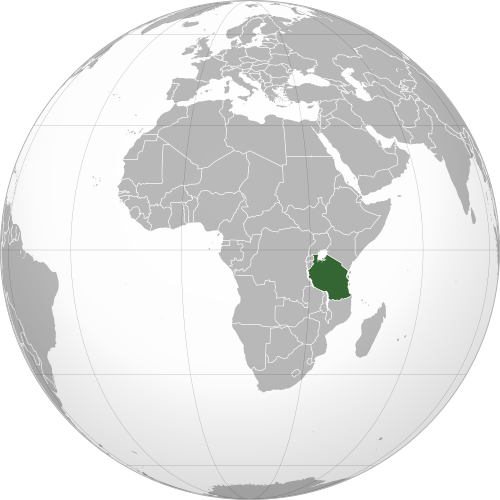
Photo: public domain. Source.
.svg)
Tanzania’s coffee history does not start with a colonial plantation. It starts with people chewing it.
Coffee reached the region from Ethiopia in the 16th century, and the Haya people of Kagera used Robusta beans as a stimulant — boiled and steamed with herbs rather than brewed as a drink.1 That is an unusually old and unusually non-European entry point for an African coffee country, and it explains why Kagera is still the Robusta heartland today.
The commercial industry is a colonial creation. Under German administration in the late 1800s, coffee became an export crop, and in 1911 Arabica cultivation was mandated — a compulsory-planting order of the kind that also shaped Rwanda and Burundi.1 The country was then called Tanganyika, a name that survives in specialty coffee for an odd reason: SL28, the variety Kenya’s reputation rests on, was selected from a population called Tanganyika Drought Resistant — Tanzanian material, chosen for surviving dry seasons. Geisha passed through Tanzanian research stations too, on its way from Ethiopia to CATIE and eventually to Panama.
How Tanzanian coffee is sold
Like Kenya, Tanzania funnels its crop through a national auction — and like Kenya’s, it is old, weekly and government-backed.
The Moshi coffee exchange, in the Kilimanjaro Region, holds an auction every Thursday across a nine-month season, and licensed exporters are required to buy through it unless they use a direct-sale window.1 Sucafina describes the system in the same terms specialty traders use for the Nairobi Coffee Exchange: a public price-discovery mechanism meant to raise farmer prices and give buyers confidence in what they are bidding on.2
The consequence is the same as in Kenya. A lot arrives at market catalogued by grade and mill, not by farm and variety — which is why a bag of Tanzanian coffee is far more likely to say “Tanzania Peaberry” than to name a producer. See Green coffee auctions for the general mechanism and Green coffee grading for what the letters mean.
The Tanzania Coffee Board
The Tanzania Coffee Board is the statutory body that regulates the sector, and its most useful public output is a set of licence registers — published lists naming, with licence numbers and contact details, every:
- coffee curing factory (washed) — the dry mills that hull and grade coffee, including Dan and Associates Enterprises (DAE) in Mbinga, Arusha Coffee Mill, Rungwe Coffee Corporation and Tanganyika Coffee Curing in Moshi;4
- licensed local roaster — including Burka Coffee Estates in Arusha, Utengule Estate (T) and Kaffee Koffee in Dar es Salaam, Mweru and J Coffee in Bukoba and Puzzle Coffee Shop in Zanzibar;5
- licensed exporter — including Amir Hamza (T) and Tanganyika Instant Coffee in Bukoba and the Kagera Cooperative Union (1990) in Moshi.6
That is a lot more supply-chain transparency than most origins publish. What the registers do not contain is anything about quality: no cup scores, no prices, no roast profiles.456 They tell you who is allowed to touch the coffee, not how good it is.
The register of local roasters is worth a second look for a different reason. A licensed domestic roasting layer — an estate roasting its own coffee in Arusha, a café roasting in Zanzibar — is something most producing countries barely have. Africa grows a great deal of coffee and drinks very little of it, and this is one of the few places you can see the domestic side documented at all.
To verify
The Tanzania Coffee Board’s own website could not be reached. The registers cited above are PDFs hosted at
www.coffee.go.tz, the board’s official domain, but three attempts to fetch the site during this research timed out at DNS. The board’s headquarters is described as being in Kilimanjaro, with regional offices in Dar es Salaam, Tanga, Kagera, Mbeya and Ruvuma, in the Tanzania Coffee Business Directory3 — a document read here through a third-party PDF-hosting mirror rather than from the board itself. Treat the office list as a claim from an unverified copy.
To verify
National production figures disagree by nearly 50%. Three sources give three answers: the Tanzania Coffee Business Directory says about 50,000 tonnes a year;3 Sucafina gives 877,750 bags of 60 kg and a global rank of 15th,2 which works out at roughly 52,700 tonnes; and the encyclopedia entry says 30,000–40,000 tonnes.1 No ICO, USDA or TCB statistical release was reachable to settle it. The 70/30 Arabica–Robusta split is agreed across all three and is stated as fact above; the tonnage is not.
To verify
The harvest window is disputed. Sucafina gives a main harvest of May–November with the export season running July–December;2 the encyclopedia entry says the harvest is traditionally October–February.1 These are not reconcilable as stated. Tanzania spans a wide range of latitudes and altitudes, from Kilimanjaro in the north to Mbinga near the Malawi border, so a genuinely long and regionally staggered picking window is plausible — but no Tanzanian government or research document confirming it was located. Do not quote a harvest month for Tanzania from this note.
Producers, altitudes and processing
The most detailed producer-level document surfaced by this research is a sample list prepared by the Embassy of Tanzania in Japan for SCAJ 2025 — the Specialty Coffee Association of Japan’s trade show — giving named estates, cooperatives and exporters with their species, processing, grade and altitude for the 2025/2026 crop.7
To verify — all figures in this section come from a single unconfirmed spreadsheet
The SCAJ 2025 sample list is a plausible-looking primary document from a Tanzanian diplomatic mission, but it could not be independently confirmed, and it contains internal signs of transcription error — one entry’s website is written with a comma in place of a dot, and another company’s name and web address are spelled two different ways (“Megnacio” versus “magnacio”).7 The Robusta altitudes are the bigger problem: two Robusta entries are listed at 1,500–2,200 m, which is far above the normal global range for the species and higher than the Arabica entries on the same list. The most likely reading is that those figures describe a cooperative’s whole farmer catchment area, not the plots the Robusta actually grows on. Treat everything in the table below as claims from that spreadsheet.
| Entity | Type | Where | Species | Processing | Altitude | |
|---|---|---|---|---|---|---|
| 1 | Burka Coffee Estate | Estate | Arusha, Northern Zone | Arabica (Bourbon / Kent) | Wet, fully washed | 1,350–1,400 m |
| 2 | GDM Co | Export company | Mbozi, Songwe Region | Arabica (Bourbon / Kent) | Wet, fully washed | 1,500–2,000 m |
| 3 | Megnacio Company | Export company | Mbinga, Ruvuma Region | Robusta | Dry, natural sun-dried | 1,500–2,200 m |
| 4 | Karagwe District Cooperative Union (KDCU) | Cooperative | Karagwe District, Kagera | Robusta | Dry, natural sun-dried | 1,500–2,200 m |
Two patterns in that table are the real story, and they hold regardless of the exact numbers.
Arabica is washed, Robusta is dried. The Arabica entries all run through a central processing unit — a shared wet mill where several farmers’ cherry is pulped, fermented and washed together — producing the clean, bright profile the origin is known for. See Washed process and Producer cooperatives. The Kagera Robusta is sun-dried whole, the cheaper and less water-hungry route, which matters in regions where water is short.
Burka appears twice. It is both an estate on the export list and a licensed local roaster in Arusha,57 which makes it one of the clearer examples of a Tanzanian producer capturing value past the farm gate rather than selling green and stopping there.
What it tastes like, and what that claim rests on
Specialty descriptions of Tanzanian Arabica converge on bright acidity, medium body, and fruit — berry and citrus.8 That is close enough to the Kenyan profile that the two get compared constantly, usually with Tanzania cast as the gentler, rounder, less electric one.
To verify
This is trade consensus, not a sensory study. The flavour description above comes from specialty-importer origin guides,8 not from an SCA sensory report, a CQI dataset or any published Tanzanian cupping work. No verified average cup score for Tanzanian coffee — national, regional or by grade — was located. See Cupping and Coffee scoring for what a real quality assessment would involve.
The one shape claim that is well established elsewhere on this wiki is peaberry: Tanzania is one of the two or three origins most associated with sorting and selling the round single-bean mutation as its own grade, alongside Kona coffee. Whether peaberry actually tastes better is a much weaker claim than the marketing suggests — the Peaberry note lays out why.
What Tanzania does not have
The same gap that shapes Kenya’s note shapes this one, for the same reason.
Tanzania has no Cup of Excellence programme. It does not appear among the countries in this wiki’s Cup of Excellence records by country archive, and no Tanzanian entry in an Alliance for Coffee Excellence auction was found. There is therefore no public series of named lots with scores, prices and winning buyers — the currency this wiki otherwise trades in.
What it does have is the African Fine Coffees Association. Tanzania is one of AFCA’s eleven member countries, holds a chapter chair, and ran one of the nine national Taste of Harvest competitions in the 2025–26 season.9 That is the closest thing to a Tanzanian quality competition with published protocols behind it — and it is the route by which Tanzanian lots are most likely to acquire citable scores in future.
To verify
No lot-level prices, cup scores or named buyers for Tanzanian specialty coffee were verified anywhere in this research. Neither the TCB licence registers456 nor the embassy sample list7 contains them, and no Moshi auction bulletin was reachable. This wiki does carry one Tanzanian data point from elsewhere: a Tanzania Shiwanda Estate Peaberry roasted by Pebble Coffee scored 91 points at Coffee Review in May 2014 — recorded on that note, not established here.
Related
- Kenya — the northern neighbour with the same auction logic and far more fame
- Rwanda · Burundi · Ethiopia — the other East African origin notes
- Peaberry — the grade Tanzania is best known for
- Arabica vs Robusta · Robusta · Fine Robusta — the species split that defines Kagera
- Bourbon — one of the four common Arabica varieties grown here
- SL28 — selected from Tanzanian “Tanganyika Drought Resistant” material
- Washed process · Natural process — the two routes Tanzanian Arabica and Robusta take
- Producer cooperatives — the central-mill structure behind almost every Tanzanian lot
- Nairobi Coffee Exchange · Green coffee auctions — the auction model Moshi belongs to
- Green coffee grading · Cupping · Coffee scoring — how the grade letters and scores work
- African Fine Coffees Association — the pan-African body running Tanzania’s national quality competition
- Cup of Excellence · Cup of Excellence records by country — the competition circuit Tanzania sits outside of
- C-market — where Tanzania is priced when it is not a specialty lot
- Pebble Coffee — the roaster behind this wiki’s one scored Tanzanian coffee
- Specialty coffee — the category all of this sits underneath
Official links
- Official — Tanzania Coffee Board licensed coffee exporters register — hosted on the board’s official
coffee.go.tzgovernment domain; the site homepage did not respond when checked - Official — Tanzania Coffee Board licensed curing factories (washed)
- Official — Embassy of Tanzania in Japan, SCAJ 2025 sample list
- Official site — African Fine Coffees Association — Tanzania’s chapter and Taste of Harvest competition
Footnotes
-
Coffee production in Tanzania — Wikipedia — confirmed via WebFetch; source of the 16th-century Ethiopian introduction and Haya use of Robusta, the 1911 German Arabica mandate, the 70/30 species split, the nine Arabica zones and Kagera Robusta districts, the 90% smallholder share, the Moshi Thursday auction and nine-month season, and the 30,000–40,000 tonne figure ↩ ↩2 ↩3 ↩4 ↩5 ↩6 ↩7 ↩8 ↩9 ↩10 ↩11 ↩12
-
Sucafina — Tanzania origin profile — confirmed via WebFetch; source of the 877,750-bag figure and 15th global rank, the ~450,000 smallholders and 0.5–3 ha plots, the Arusha/Bourbon/Blue Mountain/Kent variety list, the regional list, the May–November harvest window, and the auction description ↩ ↩2 ↩3 ↩4 ↩5 ↩6 ↩7 ↩8 ↩9 ↩10 ↩11
-
Tanzania Coffee Business Directory — third-party mirror of a TCB directory; not confirmed against the board itself ↩ ↩2 ↩3 ↩4 ↩5
-
Tanzania Coffee Board — licensed coffee curing factories (washed) ↩ ↩2 ↩3 ↩4 ↩5
-
Tanzania Coffee Board — licensed local coffee roasters ↩ ↩2 ↩3 ↩4 ↩5 ↩6
-
Tanzania Coffee Board — licensed coffee exporters ↩ ↩2 ↩3 ↩4 ↩5
-
Embassy of Tanzania in Japan — SCAJ 2025 sample list (XLS) ↩ ↩2 ↩3 ↩4
-
Opal Coffee — Tanzania, East Africa origin guide — importer origin guide; source of the flavour description and the regional and harvest listings ↩ ↩2
-
African Fine Coffees Association — Taste of Harvest — as already recorded on African Fine Coffees Association ↩