Yungas
The Yungas is a strip of forest clinging to the eastern face of the Andes, where the cold high plateau falls away toward the Amazon basin. It is a transition zone rather than a country or a province: a narrow, wet, extremely steep band that runs through Peru, Bolivia and the northwest corner of Argentina.1
In coffee terms, though, “Yungas” almost always means the Bolivian part of it — the eastern shoulder of the La Paz department, which grows around 95% of Bolivia’s coffee.23 Nearly everything the specialty trade has ever bought from Bolivia, including all five winners of the country’s short-lived Cup of Excellence, came out of this one landscape.2
| What it is | A bioregion — a band of montane and cloud forest on the eastern Andean slope1 |
| Countries | Peru, Bolivia, northwest Argentina1 |
| Elevation (bioregion) | roughly 500–3,500 m1 |
| Average temperature | ~22 °C1 |
| Crops | Coffee, citrus, coca; historically rubber and quinine1 |
| Bolivian coffee share | ~95% of the national crop23 |
| Bolivian provinces | Nor Yungas (capital Coroico) and Sud Yungas (capital Chulumani), plus neighbouring Caranavi45 |
| Nor Yungas | 1,720 km², population 51,441 (2024 census)4 |
| Sud Yungas | 5,770 km², population 121,518 (2024 census)5 |
| Varieties | Typica and locally-named “Criolla”, with Caturra and Catuai26 |
| Processing | Predominantly washed, dried on raised beds2 |
| Farm structure | Overwhelmingly smallholder — 85–95% of Bolivian coffee, plots of 1–8 ha2 |
The geography, in plain terms
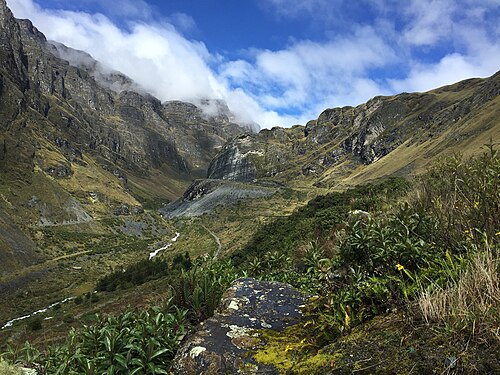
Photo by Jan Beck, CC BY. Source.

Everything about the Yungas follows from one fact: it is a wall. The Cordillera Real rises above it to nearly 6,500 m, and within a few dozen kilometres the land drops from Andean rock into humid lowland jungle. Squeezed into that drop is a stack of climates — from moist lowland forest through evergreen montane forest to cloud forest — which is why the region is one of the most biodiverse places on the continent, and why a farm’s altitude can change by hundreds of metres over a single property.1
The average temperature across the bioregion is about 22 °C, with heavy seasonal rain.1 For coffee that combination is close to ideal: warm enough to ripen, cool and high enough to ripen slowly, wet enough that irrigation is not part of the conversation. The cost is that the ground is nearly vertical, roads are bad, and landslides are routine.
Coffee is not the only thing that likes those conditions. Coca grows in the same valleys and, in the parts of the Yungas where both crops are possible, coca simply pays better — which is the single biggest reason Bolivia’s coffee area has shrunk.2 See Climate change and coffee for the slower, wider version of the same squeeze.
How the Bolivian Yungas is divided
Administratively, the Bolivian Yungas is not one unit. The original Yungas Province of La Paz was split in two under president José Manuel Pando at the turn of the twentieth century — Wikipedia’s own two articles date the split to 12 January 1899 and 12 January 1900 respectively, so the exact year is not settled here.45
- Nor Yungas (“North Yungas”) — capital Coroico, 1,720 km², population 51,441 at the 2024 census. Two municipalities, Coroico and Coripata. The population is mainly Aymara and Afro-Bolivian, a legacy of the colonial haciendas.4
- Sud Yungas (“South Yungas”) — capital Chulumani, 5,770 km², population 121,518 at the 2024 census. Five municipalities: Chulumani, Irupana, Yanacachi, Palos Blancos and La Asunta. Yanacachi is where Agrotakesi, the estate that won Bolivia’s 2009 Cup of Excellence, sits.5
- Caranavi — the province that actually supplies most of the coffee. It was carved out as a separate province in 1992 and is not part of Nor Yungas, though it is culturally and geographically part of the Yungas landscape and is often lumped in with it.
To verify — is Caranavi "in" Nor Yungas?
The research report behind this note states that Nor Yungas Province is “centred on Caranavi”.7 That does not match the administrative record: Coroico is Nor Yungas’ capital, and Caranavi has been its own province since 1992.4 The existing Caranavi note on this wiki treats it as a separate province, and that is the reading followed here. Sources that place Caranavi inside Nor Yungas are describing the coffee region loosely, not the provincial map — worth knowing when you see a bag labelled “Nor Yungas”.
Coffee here, historically
Coffee reached Bolivia in the late 18th to early 19th century and took root first in the Yungas, which was the obvious candidate: fertile, high, tropical and already settled. Large-scale cultivation only began in the 1920s, with further agrarian reform in the middle of the century.2
Older accounts are unusually flattering about the place. A period survey of Bolivian coffee names Yungas — alongside Caupolicán, Espíritu Santo and Valle Grande — as one of the country’s principal districts, calls its coffee the best in Bolivia, and records that “there was a time in which the Yungas coffee had a great demand, especially so in Europe.”8 The same account puts Bolivian production at 2,400,000 lb in 1885, falling to 1,500,000 lb by 1908, of which only about 150,000 lb was exported — most of it to Chile.8 It also gives the growing band as 800–2,300 m.8
Two things are worth taking from that. First, the Yungas has been Bolivia’s coffee region for well over a century — this is not a recent specialty discovery. Second, the shrinking crop is not new either: production was already falling before the First World War.
What grows, and how it is handled
Everything here is Arabica, and the planting is old-fashioned. Typica and the locally-named “Criolla” (generally a Typica selection) dominate, with Caturra and Catuai filling out the rest.26 There is no signature Yungas cultivar and no Geisha story; what makes good lots good is altitude, picking discipline and careful sorting.
Processing is overwhelmingly washed — strip the fruit, ferment the beans in tanks to loosen the sticky layer, rinse, dry — and because the growing zones are high and cool, drying happens on raised beds rather than patios.2 Most of that work happens at cooperative mills rather than on farms, which is the inevitable consequence of a region farmed in one- and two-hectare pieces. Organic and Fair Trade certification are common, partly because chemical inputs were never affordable at this scale in the first place.9
The trade body most associated with the region is FECAFEB, the Bolivian federation of coffee-exporting growers, founded in 1991, whose activity is concentrated in Caranavi, Nor Yungas and Sud Yungas.26
To verify — the Nor Yungas numbers that circulate online
A detailed set of figures for Nor Yungas is widely quoted: coffee at 1,200–2,300 m, Typica at 60–70% of plantings and Caturra at 20–30%, cooperative lots scoring SCA 84–88 with micro-lots above 88, and a harvest and drying window of April–October.7 All of it traces to one self-published reference site (“Coffeepedia”, page dated 2026) which lists FECAFEB, Hoffmann’s World Atlas of Coffee and “SCA Bolivia Origin Reports” as sources but does not show the underlying documents.7 None of it was independently confirmed, and three of the four claims conflict with what this wiki already records:
- The Bolivia note puts the specialty band at 1,200–2,000 m, not 2,300 m. (A period source does give 800–2,300 m for Bolivia as a whole, so the upper figure is not impossible.8)
- The Bolivia and Caranavi notes give harvest as roughly June–October or July–November, not April–October.
- The Caranavi note states that no verified cupping score exists for any Bolivian coffee outside the five Cup of Excellence auctions. A blanket “84–88” for a whole region has no scorecard behind it. See Coffee scoring.
Treat the whole block as one seller-grade claim, not four facts.
To verify — the FECAFEB variety split
A separate figure says Typica and Criolla together make up about 80% of planted varieties in the FECAFEB zone.6 This comes from a university repository PDF and a document-sharing upload whose provenance could not be established, and it does not agree with the 60–70% Typica figure above.679 FECAFEB has no working website — the obvious domains do not resolve — so there is currently no way to check either number at the source. Quote neither as fact.
What is not documented
There are no public FOB or auction prices, and no lists of international buyers, tied to Yungas coffee as a region.26 Outside the five Bolivian Cup of Excellence editions of 2004–2009 — whose results are published in full by the Alliance for Coffee Excellence and are covered on the Bolivia and Caranavi notes — no competition or auction record naming Yungas lots, scores, prices and buyers was found. Bolivia’s own national competition, Taza Presidencial, has not published results that surfaced here.
If you see a Yungas farm advertised as a competition winner or with a specific auction price, that claim needs a source before it goes anywhere near this wiki. See Green coffee auctions for how the records that do exist are published, and Premiumisation for why Yungas coffee has consistently cupped better than it has sold.
To verify — how many bags the Yungas actually produces
Bolivia exports roughly 30,000 sixty-kilo bags a year in recent harvests.2 Multiplying that by the 95% share gives ~28,500–29,000 bags from the Yungas — but no source states that figure; it is arithmetic, not a statistic.2 No Bolivian government, ICO or FAO number for Yungas-specific output was found.
A name collision worth knowing about
There is a nonprofit called simply “Yungas” (yungas.org) that works on regenerative agriculture, farmer cooperatives and cloud-forest protection, and which reports protecting over 35,000 hectares of forest and doubling farmer income within three years through a farmer-owned cooperative, Café Orígenes, founded in 2021.10
It is not a Bolivian organisation. It works in the Peruvian Andes and Andean-Amazon communities, having grown out of a long partnership with the Andean Alliance for Sustainable Development.10 The name refers to the same bioregion — which does extend into Peru — but nothing on that site is evidence about Bolivian Yungas coffee, and the two should not be conflated.
Related
- Bolivia · Caranavi — the country this region defines, and the province inside it that grows most of the coffee
- Agrotakesi — the Yanacachi estate in Sud Yungas that won Bolivia’s last Cup of Excellence
- Peru — the other side of the same bioregion
- Cup of Excellence · Alliance for Coffee Excellence · Cup of Excellence records by country — the only published competition record the region has
- FECAFEB · Taza Presidencial — the exporters’ federation and the national competition
- Typica · Caturra · Catuai — what is planted here
- Washed process · Natural process — how it is processed
- Producer cooperatives · Green coffee auctions · Premiumisation · Coffee scoring — how smallholder coffee reaches a buyer, and at what price
- Coffee leaf rust · Climate change and coffee · Coffee Belt — the pressure on the crop
Official links
- Official site — Gobierno Autónomo Municipal de Caranavi — the municipality inside the Yungas landscape that calls itself Bolivia’s coffee capital; the Yungas as a whole is a geographic region with no single governing body
- Yungas (nonprofit) — about page — the similarly-named Peru-based organisation, listed here so readers do not mistake it for a Bolivian body
- (no working website found for FECAFEB, the Bolivian coffee exporters’ federation)
Footnotes
-
Yungas — Wikipedia — confirmed via WebFetch ↩ ↩2 ↩3 ↩4 ↩5 ↩6 ↩7 ↩8
-
Perfect Daily Grind — Exploring the Bolivian coffee sector (February 2022) ↩ ↩2 ↩3 ↩4 ↩5 ↩6 ↩7 ↩8 ↩9 ↩10 ↩11 ↩12 ↩13 ↩14
-
Nor Yungas Province — Wikipedia — confirmed via WebFetch ↩ ↩2 ↩3 ↩4 ↩5
-
Sud Yungas Province — Wikipedia — confirmed via WebFetch ↩ ↩2 ↩3 ↩4
-
Universidad Mayor de San Andrés repository — thesis PDF on Bolivian coffee production ↩ ↩2 ↩3 ↩4 ↩5 ↩6
-
Coffeepedia — Nor Yungas Coffee Region — confirmed via WebFetch; a self-published reference site, not a primary source ↩ ↩2 ↩3 ↩4
-
Coffee production in Bolivia — Wikipedia — confirmed via WebFetch; the production and altitude figures there derive from an early-20th-century survey ↩ ↩2 ↩3 ↩4
-
Yungas — About — confirmed via WebFetch ↩ ↩2