Nariño
Nariño is the department in the far southwest corner of Colombia, pressed between Ecuador to the south and the Pacific Ocean to the west. Its capital is Pasto. It covers 33,268 km² and is divided into 64 municipalities, with a 2018 population of 1,630,592.1 The Galeras volcano — still active — sits beside the capital and gives the department its motto, “from the sea to the Galeras.”1
For coffee, three things matter about that corner of the map.
It sits almost on the equator. Nariño is roughly one to two degrees north. That removes the usual altitude ceiling: the higher you go anywhere else, the closer you get to frost, but this close to the line there is no real winter, so farms can climb to elevations that would kill a coffee tree in, say, southern Brazil.
It is volcanic. Galeras and its neighbours have laid down deep, fertile, mineral-rich soils.
It is smallholder country. There are no big estates here in the Brazilian or Panamanian sense — the coffee comes from thousands of family plots, delivered through cooperatives and the FNC’s buying network.
Put together, those give the thing Nariño is actually famous for: very high-grown washed Arabica with sharp, bright acidity and heavy sweetness — and a habit of winning Colombia’s national competition.
The first protected Colombian coffee region
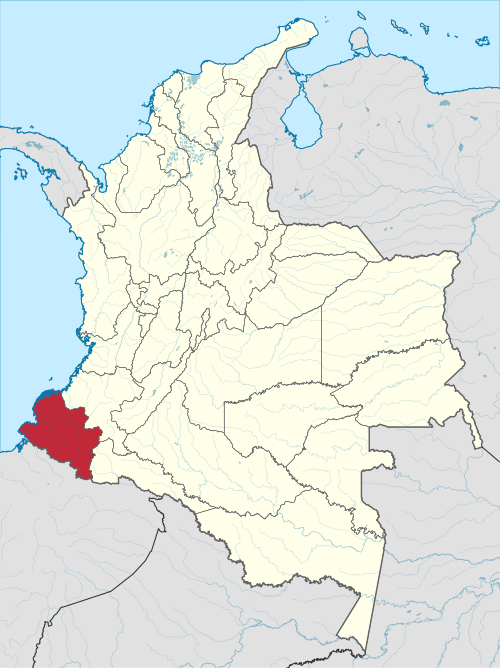
Photo by TUBS, CC BY-SA. Source.
.svg)
In 2011, Nariño became one of the first Colombian coffee regions to receive its own regional denomination of origin — a legally protected place name, granted by Colombia’s Superintendencia de Industria y Comercio (SIC), the national industrial-property authority.23
A denomination of origin is the Champagne idea applied to coffee: the name Café de Nariño belongs to coffee actually grown there, meeting the rules, and nobody else may sell under it. Nariño and Cauca were granted theirs in 2011, followed by Santander (2014), Huila (2013), and Tolima and Sierra Nevada (2017).2 These sit underneath the country-wide Café de Colombia designation described on the Colombia note.
The FNC’s own account of why Nariño coffee tastes the way it does is unusually blunt: high organic matter in the soil, great altitude, and low temperatures that force the plant to hold onto its sugars. The official cup description is high acidity, medium body, sweet notes, a clean cup, and a soft but very pronounced aroma.2
What it actually wins
This is where Nariño stops being a marketing story. Colombia runs a Cup of Excellence programme, and its results are published by the Alliance for Coffee Excellence — a primary record of scores, lots and hammer prices, not a blog claim.
Colombia Cup of Excellence 2017 — Nariño took first place and three of the top five:4
| Rank | Farm | Producer | Department | Score | |
|---|---|---|---|---|---|
| 1 | 1 | Mirador – El Naranjo | Rodrigo Arley Díaz, Buesaco | Nariño | 91.28 |
| 2 | 2 | La Maria | Orlando Ospina Salazar, La Mesa | Cundinamarca | 90.78 |
| 3 | 3 | Costa Rica | Abdias Lasso Muñoz, San Pedro de Cartago | Nariño | 90.63 |
| 4 | 4 | Llano Redondo | — | Nariño | 90.25 |
| 5 | 5 | La Loma | — | Nariño | 90.19 |
That auction sold 560 bags for $399,975.73, averaging $10.80/lb; the top price was $40.30/lb for the second-place La Maria lot, with the winning Nariño lot at $37.30/lb.4
Colombia Cup of Excellence 2021 — Nariño won again, and the price gap had exploded:5
| Rank | Farm | Producer | Department | Score | |
|---|---|---|---|---|---|
| 1 | 1 | Obraje | Pablo Andrés Guerrero Pérez | Nariño | 90.61 |
| 2 | 2 | La Siria | Anibal Celestino Sanchez Burbano | Huila | 90.07 |
| 3 | 3 | El Zafiro | Nancy Liliana Maca Pinilla | Cauca | 89.46 |
The winning Obraje lot sold at $135.10 per pound to K.V.N. Import Export (1991) Co., Ltd — $49,153.43 for the lot.5 Six of that year’s top ten came from Huila, which is the other half of the story: the two southern departments trade the podium between them, and the old Eje Cafetero in the centre of the country is largely absent from it.
See Premiumisation for why a $135/lb auction lot tells you almost nothing about what a Nariño smallholder gets for an ordinary bag.
To verify — how consistently Nariño "dominates"
Trade and education sources say Nariño regularly tops the Colombian Cup of Excellence, usually sharing the podium with Huila. The research behind this note confirmed that directly for 2017 and 2021 only, from the official Alliance for Coffee Excellence result pages.45 Other years were not checked and the ACE year-index pages returned errors. Two wins is not “dominates” — treat the broader claim as unverified until the full year-by-year archive at allianceforcoffeeexcellence.org is read.
Growing conditions
To verify — nobody agrees on the altitude band
Every source consulted gives a different range for Nariño coffee, and none is a primary agronomic document:
- 1,300–2,300 m, harvest May–September, rainfall 1,300–2,400 mm/year, temperature 17–23 °C — a coffee-education course.6
- 1,500–2,300 m, “among the highest in Colombia” — secondary geography write-ups.7
- 1,600–2,000 m across the municipalities of Buesaco, Sandoná, Samaniego, Consacá and Linares, with the “best growing region” at 1,600–1,900 m and daytime temperatures of 18–24 °C — an exporter’s microlot programme.8
- 1,800–2,000 m for many farms — an importer’s offer sheet.9
The 1,800 m-plus, high-for-Colombia framing is safe. Do not quote a specific band as fact; the FNC’s own denomination-of-origin page cites altitude as a quality driver but publishes no range.2
Nariño’s mountains and its closeness to the Pacific produce a patchwork of microclimates over short distances, which is the standard explanation given for why acidity and sweetness run so high here.610
Varieties and processing
The plantings are the Colombian national set described on the Colombia note — Caturra, Castillo, Variedad Colombia and surviving old Typica. Individual exporter programmes report different mixes: roughly 70% Caturra / 20% Castillo / 10% Typica in one microlot programme,8 Castillo and Colombia in an importer’s Excelso offering,9 and 100% Castillo for one single-producer lot.11
Processing is washed, essentially without exception — depulped, fermented, washed clean, then dried, often in parabolic driers (plastic-tunnel greenhouses that let farms dry coffee slowly through the region’s rain).8911
Scale, and who grows it
To verify — the production and smallholder numbers
None of these came from an official FNC or AGRONET document that could be read directly; the FNC’s Nariño departmental pages returned errors.
- ~600,000 bags of 60 kg per year, about one-fifth of Huila’s output — attributed to AGRONET data but reported second-hand.6
- Coffee grown in 37 municipalities by roughly 33,000 coffee-growing families — a single uploaded document.12 Note that the department has 64 municipalities in total,1 so “37 with coffee” is plausible but unconfirmed.
- Coffee accounts for around 40% of Nariño’s agricultural production — a single retailer blog.10
The uncontested part is the shape, not the number: Nariño is smallholder territory, thousands of families on small plots, not estates.9
History
To verify — who planted the first coffee here
The sources directly contradict each other. One account says coffee has been grown in Nariño since the 18th century, brought by clergymen carrying seed down from northern Colombia.12 Another says indigenous communities were the region’s first coffee growers.10 Neither is backed by a primary historical record in the research behind this note, and the two cannot both be the origin story. Do not state either as fact.
What is better attested is how recent Nariño’s reputation is. A coffee-education source describes the department going, over roughly the past thirty years, from virtually unknown to “perhaps the best-reputed Colombian region for quality coffee” — part of a broader shift in specialty attention away from the traditional Eje Cafetero in central Colombia and toward the southwest.6 The Cup of Excellence tables above are the visible edge of that shift.
Prices and premiums
To verify — the "Million Pesos" programme
A single roaster’s producer page describes a Colombian quality-premium scheme called “Million Pesos”, said to pay producers double the standard price for coffees cupping above 90 points, and names Nariño producer Alejandro Ahumado (a 15-hectare farm) as a member.11 The research behind this note found no FNC or programme documentation for it, no price levels, and no second source. The same page’s “cups above 90 points” line refers to the programme’s threshold, not a published score for that lot. Treat the whole programme as a claim.
To verify — the 85–92 point score band
An educational geography site states Nariño washed Arabica typically scores 85–88 for accessible specialty lots and 88–92+ for top microlots on the SCA scale.7 This is a secondary source with no methodology and no lot list behind it. The verified numbers on this page are the individual Cup of Excellence scores above — use those, and see Cupping and Specialty coffee for what a score actually measures.
Why it matters
Nariño is the clearest case in Colombia of geography beating history. The Eje Cafetero has the UNESCO listing, the museums and the Juan Valdez imagery. Nariño has the equator, the volcanoes and the altitude — and over three decades that has been enough to move the top of the Colombian quality table several hundred kilometres southwest, into a department most coffee drinkers still cannot place on a map.
It is also a smallholder success, which is rarer than it sounds. The record lots above did not come from estates with brand names and their own websites. They came from family farms in Buesaco and San Pedro de Cartago, found by a national competition that scores the coffee before it knows whose it is.
Related
- Colombia — the country note: the FNC, the Castillo replanting, and where Nariño sits in the national map
- Federación Nacional de Cafeteros — the federation that buys, markets and certifies the department’s coffee
- Cenicafé — the FNC research centre that bred most of what Nariño plants
- Cup of Excellence · Alliance for Coffee Excellence — where the verified scores and prices on this page come from
- Castillo · Caturra · Typica · Variedad Colombia — the varieties grown here
- Washed process — the processing method the department is defined by
- Coffee scoring · Cupping · Specialty coffee — what an 89 or a 91 means
- Premiumisation — why a $135/lb auction lot and a smallholder’s income are different worlds
- Cerrado Mineiro — the Brazilian parallel: a coffee region with a legally protected name
Official links
- Official site — Café de Colombia, regional denominations of origin — the FNC page recording Nariño’s 2011 designation of origin
- Official site — Federación Nacional de Cafeteros de Colombia — the growers’ federation that runs the department’s committee and buying network
- Official results — Alliance for Coffee Excellence, Colombia Cup of Excellence — the competition archive containing Nariño’s winning lots
Footnotes
-
Nariño Department — Wikipedia — confirmed via WebFetch; source of the capital, borders, area, 64 municipalities, 2018 population and the Galeras motto ↩ ↩2 ↩3
-
Café de Colombia — Denominación de Origen Regional — confirmed via WebFetch; source of the 2011 Nariño designation, the granting authority (SIC), the other regional designations and their years, and the official Café de Nariño cup description ↩ ↩2 ↩3 ↩4
-
Barista Hustle — CBGC 1.13 Nariño — cites Colombia’s Superintendency of Industry and Commerce for the 2011 denomination of origin; page itself was not retrievable during this research ↩
-
Alliance for Coffee Excellence — Colombia Cup of Excellence 2017 results — confirmed via WebFetch; source of the 2017 ranking, scores, producers, auction total and per-pound prices ↩ ↩2 ↩3
-
Alliance for Coffee Excellence — Colombia Cup of Excellence 2021 results — confirmed via WebFetch; source of the 2021 ranking, the Obraje lot’s $135.10/lb price and its buyer ↩ ↩2 ↩3
-
Barista Hustle — CBGC 1.13 Nariño — source of the climate ranges, the ~600,000-bag production figure, the Huila comparison and the thirty-year reputation shift ↩ ↩2 ↩3 ↩4
-
Vauldt — Nariño Coffee Region — secondary educational source for the 1,500–2,300 m band and the 85–92+ score claim ↩ ↩2
-
Condor — Nariño Microlots — exporter programme; source of the municipality list, 1,600–2,000 m band, temperature range and variety percentages ↩ ↩2 ↩3
-
InterAmerican Coffee — Colombia Nariño — importer offer sheet; source of the 1,800–2,000 m figure, Castillo/Colombia varieties, washed Excelso grade and smallholder structure ↩ ↩2 ↩3 ↩4
-
Orange Brown Imports — Coffee producing region highlight: Nariño, Colombia — retailer blog; source of the indigenous-first-growers claim and the 40%-of-agriculture figure ↩ ↩2 ↩3
-
Cubico Coffee — Colombia Nariño — roaster page; source of the Alejandro Ahumado lot, 100% Castillo, parabolic drying and the “Million Pesos” programme claim ↩ ↩2 ↩3
-
Nariño Coffee (uploaded document, Scribd) — unverified user upload; source of the 37 municipalities, 33,000 families and 18th-century clergymen account ↩ ↩2