Pour-over brewing
Pour-over is filter coffee made by hand. You put ground coffee in a paper filter, sit that in a cone or funnel over a cup or jug, and pour hot water over it in stages. Gravity does the rest — the water passes through the coffee and drips out the bottom.12
The word that matters is through. In a French press the coffee sits in the water for four minutes and you push a plunger down at the end — that is immersion. In a pour-over the water is never still; it arrives, dissolves what it can on the way past, and leaves. That single mechanical difference is why pour-over is described as producing a “cleaner” cup: less sediment, more separation between flavours, less body.31
It is also the method the specialty world competes on. The World Brewers Cup — the world championship for filter coffee — is hand-brewing, not espresso, and the routines that win it are pour-over routines.
Where it came from
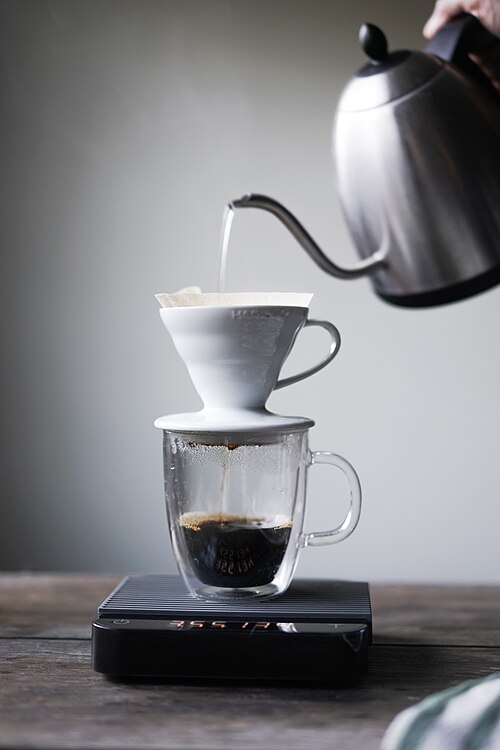
Photo by HungryHuy, CC BY. Source.

Pour-over in the sense used here — water through coffee held in a disposable paper filter — starts in 1908 with one person: Melitta Bentz, a housewife in Dresden, Germany.456
Her complaint was the coffee of the day. The choices were a percolator, which cycles boiling water through the grounds again and again until the cup turns bitter, or a cloth bag, which had to be washed, went stale, and let grit through. Her fix was improvised out of what was in the house: she punched holes in the bottom of a brass pot, tore a sheet of blotting paper out of her son’s school notebook to line it, put ground coffee in and poured hot water over the top.5 Every cone on every café counter since is a refinement of that afternoon.
The dates are on record with the company itself:
| Date | Event |
|---|---|
| 20 June 1908 | The Imperial Patent Office in Berlin grants protection for the filter45 |
| 15 December 1908 | Melitta and her husband Hugo Bentz register the business — the start of the Melitta company45 |
| 1936 | Melitta develops and patents its filter bags4 |
| 1963 | The “1x” filter-size numbering system arrives4 |
Two things follow, and they run through the rest of this note. First, the paper filter and the method were invented together, by the same person, in the same year — the filter is not an accessory bolted onto pour-over, it is what makes pour-over a distinct thing. Second, the reason a modern V60 or Chemex cup is described as “clean” traces straight back to what Bentz was escaping: paper holds back the coffee oils and the finest particles that cloth and metal let through.
Before the paper
Pouring water through a bed of coffee was not new in 1908 — doing it through disposable paper was. Cloth-and-metal drip pots existed in Europe from the late eighteenth century, and Japan built a whole café culture on a cloth filter: see Nel drip, the flannel-bag method that has been in kissaten since the 1920s, and Chorreador, Costa Rica’s cloth-on-a-stand brewer. Those are pour-overs by mechanism. What none of them had was a filter you throw away, which is the part that turned a technique into a product.
The line of descent
From the Dresden brass pot the shape of the thing changes but the principle does not: Chemex in 1941, a chemist’s glass flask with a very thick paper (below); flat-bottomed filters in the American diner-and-office world; and Japan’s cone drippers, ending in the Hario V60 that specialty coffee now runs on. See History of coffee for the wider story the method sits inside.
The three brewers
Almost all of specialty pour-over runs on three devices, and the difference between them is the shape of the hole the water leaves through.
| Brewer | Shape | Drainage | What it is known for |
|---|---|---|---|
| Hario V60 | 60° cone, spiral ribs | one large hole | fastest, most controllable, most competition wins |
| Chemex | hourglass glass flask, conical neck | filter seals against the glass | thick filters, very clean cup, design-object status |
| Kalita Wave | flat bottom | three small holes | flatter coffee bed, more forgiving of a sloppy pour |
Hario V60
The V60 is a Japanese cone dripper made by Hario, a glassware manufacturer. The name is the specification: V for the cone, 60 for its 60-degree angle.1738 Three design choices define it — the steep cone, spiral ribs running up the inside wall, and a single large opening at the tip.371
The ribs are the clever part. They hold the paper slightly off the plastic or ceramic so that air can escape and water can move down the sides rather than being sealed flat against the wall. Combined with the big exit hole, this means the V60 barely restricts flow at all — the brewer is not controlling the brew time. You are, through grind size and how fast you pour. That is exactly why competitors like it and why beginners find it unforgiving: there is nothing to hide behind.
It is the dripper Tetsu Kasuya used to win the 2016 World Brewers Cup, in ceramic rather than plastic because ceramic holds heat through the brew.
Chemex
The Chemex is the odd one out: it is not a cone that sits on a vessel, it is the vessel. One piece of glass in an hourglass shape, with a conical funnel neck, a split wooden collar around the waist and a leather tie holding the collar shut.9
It was invented in 1941 by Peter Schlumbohm, a chemist rather than a coffee person — which shows in every decision.109 The company’s own account is that he set out in 1930s Manhattan to design a coffeemaker that would brew the perfect cup, and it says the glass is “the same high quality glass used for lab ware,” chosen because it “imparts no flavors or chemicals into your brewed coffee.”10 It is a laboratory funnel and flask, fused into one object and pointed at breakfast.
The filters are the other half. Chemex Bonded filters are noticeably thicker than ordinary paper filters, and that thickness is deliberate — Chemex says they are “based on laboratory paper” and designed to strip out “bad fats, bitterness, acidity, and sediments.”10 The trade-off is real: a thicker filter holds back more coffee oils, so a Chemex cup is exceptionally clear and tea-like, but has less body than the same coffee through a V60.9
It is also, unusually for a kitchen object, in the Museum of Modern Art collection in New York, and in 1958 designers at the Illinois Institute of Technology named it one of the best-designed products of modern times.9
Kalita Wave
The Kalita Wave is the flat-bottomed alternative — see the callout below, because this wiki cannot yet source its details first-hand.
How a pour-over is actually run
Four numbers do most of the work, and three of them have their own notes here.
Ratio. Filter coffee clusters around 1:16 — one gram of coffee per sixteen grams of water — or the same thing written as 60 g per litre. A common single-cup recipe is 15 g of coffee to 250 g of water.112 See Brew ratio for why the two notations are the same recipe and where the number comes from.
Water temperature. Common guidance sits at roughly 90–96 °C (194–205 °F).12 Hotter water dissolves more, faster; too hot and you pull out the harsh end of the coffee before you can stop it.
The bloom. The first pour is small and its job is not extraction — it is to wet the grounds and let trapped carbon dioxide escape, which otherwise pushes water away from the coffee. Typical guidance is 30–45 seconds of blooming before the main pours begin.12 Fresher coffee needs it more, because it holds more gas.
Total time. Around 2–4 minutes end to end for a single cup, depending on grind and recipe.12
Underneath those numbers, the thing you are steering is extraction — what fraction of the dry coffee actually dissolved — while strength is what you taste. Grind finer or pour slower and the water spends longer with the coffee, dissolving more; grind coarser or pour faster and it dissolves less.
The 4:6 method
The most widely copied pour-over recipe in specialty coffee is Tetsu Kasuya’s 4:6 method, published after his 2016 World Brewers Cup win. Split the total brew water 40 / 60: the first 40% sets the balance between sweetness and acidity, and the remaining 60% does nothing but set the strength.
Its appeal is that it hands a home brewer two independent dials instead of one recipe to obey. This wiki documents the full published competition recipe on the Tetsu Kasuya note.
Why it matters
Pour-over is where specialty coffee makes its argument. An espresso machine is an industrial object costing thousands; a V60 costs about the same as two bags of coffee. The whole “the coffee is the point, not the equipment” claim of Third wave coffee depends on there being a cheap, transparent brewing method that shows what a good lot actually tastes like — and that is this one.
It is also why the Japan coffee market sits so centrally in modern brewing culture. Two of the three standard brewers are Japanese, the reigning technique came from a Japanese champion, and the Japanese kissaten tradition of slow hand-brewed coffee predates the Western specialty scene by decades.
And it shapes what gets bought. Delicate, floral, expensive lots — Geisha from Best of Panama, or a Laurina — are bought specifically to be brewed this way, because immersion and espresso flatten exactly the aromatics that make them worth the price.
To verify
The Melitta patent number, and whether it was a patent at all. The research behind this note gives the 1908 filing as German Patent No. 300,378, filed on 20 June 1908.1213 Neither half survives contact with better sources. Melitta’s own history page says that on 20 June the Imperial Patent Office granted utility model protection (Gebrauchsmuster) — a granting date, not a filing date, and a weaker, cheaper registration than a full patent.4 Wikipedia says only that Bentz “was granted a patent” in June 1908 and gives no number at all.5 No source read here carries the number 300,378, and the original document was not consulted. Use “protection granted 20 June 1908”; do not repeat the patent number.
To verify
The pre-1908 drip pots. The research report dates a French ceramic drip pot, the cafetière du Belloy attributed to Jean-Baptiste de Belloy, Archbishop of Paris, to 1795, and a British cloth-sock pot, the “Mr. Biggin,” to about 1780.1412 Both come from an enthusiast forum thread and a blog, not from patent or museum records, and Wikipedia’s coffeemaker article carries neither date — it links both devices but says nothing about them.6 The general point (cloth and metal drip pots predate paper) is safe; the two dates are not.
To verify
The 1957 Bunn flat-bottom filter. The report credits George R. Bunn Jr., founder of Bunn-O-Matic, with inventing the flat-bottomed fluted paper filter in 1957, sourced to a forum thread.14 Bunn’s own site does not support it. Its history page says only that George R. Bunn “founded a beverage equipment division in the late 1950’s,” with no mention of a filter invention, no year, and no “Jr.”15 This matters here because the flat-bottom filter is the ancestor of the Kalita Wave in the table above — so the wiki has no sourced origin for either.
To verify
Three different years for the Chemex design award. This note says designers at the Illinois Institute of Technology named the Chemex one of the best-designed products of modern times in 1958, from Wikipedia.9 The research report gives 1959 and attributes it to design museums and MoMA.16 This wiki’s own Chemex Corporation note gives 1956, from Lemelson-MIT. Three sources, three years, no primary award document read by any of them. That the recognition happened is well supported; the year is not settled — and the report’s added claim that it was a MoMA award conflates two separate things, since MoMA collecting the object is not MoMA awarding it.
To verify
The Melitta cone by 1910, and the Kona Meimon. Two dates from the report have no support beyond a single blog each. The first is that by 1910 Melitta was mass-producing porcelain cones with filter papers calibrated to a 15–20 second drip-through time.12 Melitta’s own history jumps from 1908 straight to 1936 for the filter bag,4 the 15–20 second figure reads as a modern writer’s interpretation rather than a 1910 specification, and the cone shape is not dated anywhere first-hand here. The second is the Kona Meimon, a ribbed cone brewer with a single large hole, dated to 1973;14 the date and the design description come from enthusiast documentation with no manufacturer source. Neither should be repeated as fact.
To verify
When the V60 actually appeared. The research behind this note contains a direct conflict. One source dates the V60’s development to the 1950s in Japan;17 another states Hario introduced it in 2004, with the specialty world picking it up between 2005 and 2009.7 Those cannot both describe the same event. The plausible reconciliation — that the 1950s figure refers to Hario’s earlier dripper lineage and 2004 to the V60’s commercial launch — is inference, not something any source states. Hario’s own European site has since been read directly and gives a third date: the V60 was released in October 2005.18 A first-party statement outranks the blogs, but it is a marketing page rather than a dated product record, and Hario’s Japanese and global history pages (
hario.com,global.hario.com) still return HTTP 403 to this machine.19 Prefer October 2005 as Hario’s own account, attributed as such; no launch year is independently established. See Hario.
To verify
Everything about the Kalita Wave. The research report behind this note contains no sourced material on Kalita at all — no founding date, no company history, no design documentation. The widely repeated description (a flat-bottomed stainless or ceramic dripper with three small extraction holes and a fluted “wave” paper filter whose ridges hold the paper off the wall) is common knowledge in brewing circles but is not verified here, and Kalita’s official site returned HTTP 403 when fetched.20 Treat the hole count, the filter geometry and any dates as unconfirmed until a first-hand source is read. The Kalita Wave earns a place in the table above because it is genuinely one of the three standard brewers, not because this wiki can yet document it.
To verify
The 90–96 °C temperature band is practice, not a published standard. Two independent sources give it,12 but neither is a standards document. This wiki’s Brew ratio note records that the Specialty Coffee Association’s public standards page publishes no numeric brewing values at all — so do not attribute this range, or the 2–4 minute brew time, to the SCA. It is a summary of common café practice.
To verify
The Chemex health claim. Wikipedia notes that the thicker Chemex filters “may also remove more cafestol,” a compound associated with raised cholesterol.9 The hedge is in the original wording, no study is cited on the page read, and Chemex’s own site makes only the vaguer claim about removing “bad fats.”10 This is a plausible mechanism — paper traps oils, and cafestol travels in the oils — but it is not a documented finding here.
Related
- Brew ratio — the coffee-to-water number every pour-over recipe starts from
- Extraction yield · Total dissolved solids — what you are actually steering, and what you taste
- Coffee grinding — grind size and pour speed are the two brew-time controls a V60 leaves you
- Water for brewing coffee — the ingredient in a pour-over that nobody thinks to change
- World Brewers Cup — the world championship fought on these brewers
- Tetsu Kasuya — 2016 champion and author of the 4:6 method
- Hario · Kalita · Chemex Corporation — the three companies behind the standard brewers
- Melitta — the German company the paper filter and the whole method started with, in 1908
- History of coffee — the longer story this method is one late chapter of
- AeroPress — the immersion-style hand brewer that competes for the same counter space
- Siphon brewing · Nel drip · Kissaten — the Japanese hand-brewing tradition this method grew out of
- Chorreador — Costa Rica’s cloth-filter hand brewer, the same mechanics with no paper and no brand
- Cupping — the other standardised way coffee gets brewed for evaluation
- Japan coffee market — where two of the three standard brewers and the reigning technique came from
- Third wave coffee — the movement that made hand-brewing the default
- Coffee roasting — roast level changes how a coffee behaves in a cone
- Specialty Coffee Association — the body whose standards these numbers get wrongly attributed to
Official links
- Official site — Chemex
- Official site — Melitta Group
- Official site — Hario
- Official site — Kalita
- Official site — Specialty Coffee Association, Coffee Standards
Footnotes
-
Perfect Daily Grind — Hario V60: The History & Brewing Guide ↩ ↩2 ↩3 ↩4 ↩5 ↩6 ↩7 ↩8
-
Gambero Rosso International — Drip coffee: what it is and how to make it ↩ ↩2 ↩3 ↩4 ↩5 ↩6
-
European Coffee Trip — The Story and Development of Hario V60 ↩ ↩2 ↩3
-
Our history — Melitta Group — confirmed via fetch: the 1908 invention of the coffee filter, utility model protection granted by the Imperial Patent Office on 20 June 1908, the business registered by Melitta and Hugo on 15 December 1908, the 1936 filter bags patent and the 1963 “1x” system ↩ ↩2 ↩3 ↩4 ↩5 ↩6 ↩7
-
Melitta Bentz — Wikipedia — confirmed via fetch: Amalie Auguste Melitta Bentz, 1873–1950, born in Dresden, blotting paper torn from her son’s notebook in a perforated brass pot, a patent granted by the Imperial Patent Office in Berlin in June 1908 with no number given, and the company established with her husband Hugo in 1908 ↩ ↩2 ↩3 ↩4 ↩5
-
Coffeemaker — Wikipedia — confirmed via fetch: “the first non-electric drip coffee maker, using notebook paper as the precursor to the paper coffee filter, was developed by German entrepreneur Melitta Bentz in 1908”; the article links the biggin and the cafetière du Belloy but gives no dates for either ↩ ↩2
-
Eighteen Grams — The History and Evolution of the V60 Pour Over Technique ↩
-
Bean Brew Digest — The Origin of Pour Over Coffee: A Brewing History — blog source for the “German Patent No. 300,378” number, the 1795 de Belloy date and the 1910 porcelain-cone claim; not read first-hand here ↩ ↩2 ↩3
-
CoffeeGeek — Pour Over History and Development — second secondary source repeating the patent number and 20 June 1908 filing date ↩
-
Home-Barista forum — History of pour over — enthusiast discussion thread; sole source for the Mr. Biggin, Bunn flat-bottom filter and Kona Meimon dates ↩ ↩2 ↩3
-
History behind the brand — BUNN — confirmed via fetch: George R. Bunn “founded a beverage equipment division in the late 1950’s”; no mention of the flat-bottom fluted filter or of any invention date ↩
-
A43 Coffee — History of Pour Over, Filter Coffee, Drip Coffee — blog source behind the report’s 1959 Chemex design-award claim; not read first-hand here ↩
-
Hamlet Wokingham — The History of V60 Coffee: From Japan to Your Cup ↩
-
About HARIO — HARIO Europe — confirmed via fetch: the V60’s cone/spiral-rib/single-hole design and an October 2005 release date ↩
-
Hario — global site — returned HTTP 403, not readable from here ↩
-
Kalita — official site — returned HTTP 403, not readable from here ↩