Chorreador
A chorreador is the traditional Costa Rican way of making coffee: a cotton bag hung from a wooden stand, with the cup or pot waiting underneath. You spoon ground coffee into the bag, pour hot water slowly over it, and the coffee drips through into the container below.12
That is the whole device. There is no paper, no pump, no filter basket and nothing to break. The stand holds the cup at its base and suspends the bag from the top; the bag itself is an elongated cotton pocket held open by a circular wire or wooden rim with a handle.1 Costa Ricans call the bag a bolsita — “little bag” — and English speakers usually call it a coffee sock, because that is what it looks like.12
The name comes from the Spanish verb chorrear, meaning to drip or trickle: the brewer is named after the sound and the sight of coffee running into the cup.123 The drink itself is café chorreado.
Why it is the cheapest serious brewer in coffee
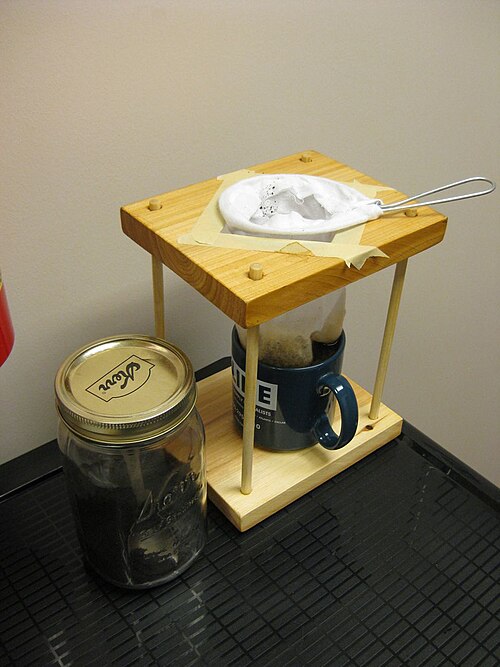
Photo: public domain. Source.

The chorreador’s real distinction is that it costs almost nothing and can be made by hand. Wikipedia puts it plainly: it “can be made at home simply and cheaply with very basic carpentry and sewing skills, or it can be crafted from beautiful and decorative softwoods or hardwoods by an artisan.”1
That range — scrap wood and a scrap of cotton at one end, a carved hardwood souvenir at the other — is why the object works simultaneously as household equipment and as Costa Rica’s most-sold coffee keepsake. Every other device in pour-over is a manufactured product with a brand on it. This one is furniture you can build.
Cloth instead of paper
Mechanically the chorreador is a pour-over: water passes through a bed of grounds rather than sitting in them, so it belongs with the V60 and Chemex rather than with a French press. The difference is the filter material.
Paper traps coffee’s oils and the finest particles. Cloth does not — a woven cotton filter is reusable and lets more oil through than paper, while still holding back the grit that makes immersion coffee muddy. That is the same trade-off the Japanese nel drip is built on, and the two devices are close cousins: a cloth bag on a frame, hot water poured by hand, coffee with more body and less clinical clarity than a paper cone gives.
Café Britt, a Costa Rican roaster, makes the more optimistic claim that “the cloth filter allows for a cleaner flavor, and the pouring method guarantees that the grounds are evenly wet.”2 Note that this cuts against the usual specialty reading, where cloth means more body and paper means a cleaner cup — see the callout below.
Brewing one
There is no governing protocol for the chorreador — no standards body publishes numbers for it. The most specific published guideline found is Café Britt’s:2
| Variable | Café Britt’s guideline |
|---|---|
| Grind | medium |
| Coffee | 10 g per cup |
| Water | 6 oz per cup |
| Bloom | pour a small amount of hot water over the grounds, wait 30 seconds |
| Main pour | pour the rest slowly through the filter, wait until dripping stops |
Ten grams to six ounces is roughly 1:18 — a touch weaker than the 1:16 most specialty filter recipes settle on. Café Britt states no water temperature.2 Everything else you would steer in any hand brew applies here too: grind size and pour speed set the contact time, and what you are actually chasing is extraction.
Looking after the bolsita
The filter is the consumable, and it is the only part of a chorreador that demands care. Wikipedia’s account: the bolsita should be “always washed and dried between each use, as a dry bolsita produces the best results,” never with soap — soap leaves an aftertaste — with a monthly scrub with salt to strip out accumulated coffee oils. “A properly cared-for bolsita lasts many months.”1
This is where the chorreador and the nel tradition split. Japanese nel guides insist the cloth is kept permanently wet, stored in the fridge and never dried, because drying is thought to turn the trapped oils rancid and change how the filter drains. Costa Rican practice as recorded here says the opposite. Both traditions are hand-brewing through cotton; they have arrived at contradictory maintenance rules, and no source consulted reconciles them.
To verify — dry, primed, or wet?
The sources conflict on the single most practical question about the filter.
- Wikipedia says the bolsita is “always washed and dried between each use, as a dry bolsita produces the best results.”1
- Café Britt says to use “a bolsita that has already been primed” for best results — i.e. pre-wetted, not dry.2
- This wiki’s Nel drip note records the Japanese rule as store it wet, never dry it.
These are three different instructions. None of the three is a standards document, and no controlled comparison was found. Treat filter care as a matter of local habit rather than settled fact.
To verify — does cloth make a cleaner cup or a heavier one?
Café Britt states that “the cloth filter allows for a cleaner flavor.”2 The Nel drip note in this wiki, sourced to Wikipedia’s coffee-filter article, describes cloth as doing the reverse of what paper does: passing more of the coffee’s oils through, which produces a thicker, heavier cup. A roaster’s marketing page is the weaker of the two sources, and “cleaner” may simply be a comparison against a plunger pot rather than against paper. No measurement — TDS or otherwise — is offered anywhere for a chorreador brew.
Where it came from
The honest answer is that nobody consulted here has a dated record, and the sources do not agree on the century’s half.
To verify — the origin dates
- A brewing guide read directly here states: “Born in the 19th century as Costa Rica’s coffee industry grew, the Chorreador adapted pre-Columbian filtration for quick brewing.”3 Both halves of that sentence are unsourced on the page, and the pre-Columbian claim is a substantial historical assertion with nothing behind it.
- The research report behind this note reproduces two further and incompatible framings from pages not read first-hand: an origin in the early 1800s,4 and evolution into the familiar wooden-framed form only in the late 1800s / early 20th century.5 One of those pages returned HTTP 429 and could not be read from this machine.4
- The Wikipedia article read here gives construction, care and etymology but no origin date at all.1
Nineteenth-century Costa Rica is the right general period — the country’s coffee economy was built in exactly those decades — but no year, inventor or primary document is established. Do not repeat a specific date.
Nothing on this was found from ICAFE, Costa Rica’s national coffee institute, either: ICAFE’s origin-brand site was read directly and covers traceability, sustainability and the structure of the industry, but does not mention the chorreador or any brewing tradition.6 The country’s official coffee body documents the supply chain, not the kitchen.
What a chorreador is not
Because much of this wiki is about auctions and competitions, the negatives are worth stating:
- It is not a coffee, a lot or a farm. No producer, estate or auction lot named “Chorreador” was found. Cupping scores, altitudes, auction prices and buyer names attach to green coffee, not to a brewing device, and nothing from Cup of Excellence or Best of Panama attaches here.
- It is not a competition category. No World Brewers Cup or other World Coffee Championships rule set naming the chorreador was found.
- It is not owned by anyone. “Chorreador” is a generic Costa Rican term with no trademark holder found; individual makers sell stands, but the object is public property in the way a wooden spoon is.
To verify — these are negative results
The three points above record that no documentation was found in the sources consulted, which is weaker than proof that none exists. In particular, a competitor brewing on a chorreador on some stage somewhere would not necessarily appear in any source read here.
Related
- Nel drip — the Japanese cloth-filter brewer, the same idea in another tradition
- Pour-over brewing — the paper-filter family the chorreador belongs to mechanically
- Brew ratio · Extraction yield · Coffee grinding — the variables any chorreador recipe is steering
- Total dissolved solids — what nobody has measured on a chorreador brew
- ICAFE — Costa Rica’s national coffee institute
- Costa Rica — the origin this brewer is the household face of
- Cupping — the other standardised way coffee gets brewed, and its opposite in spirit
- History of coffee · Third wave coffee — where a hand-built cloth brewer sits against the modern equipment market
Official links
The chorreador is a generic traditional object with no owning body, so Costa Rica’s national coffee institute stands in as the nearest authority:
- Official site — ICAFE (Instituto del Café de Costa Rica) (TLS certificate error; not readable at time of writing)
- Official site — Café de Costa Rica, ICAFE’s origin brand
Footnotes
-
Wikipedia — Chorreador — confirmed via fetch: the wooden stand and cotton bolsita with wire rim and handle, the chorrear etymology, the homemade-or-artisan range, and the wash-and-dry / no-soap / monthly-salt filter care ↩ ↩2 ↩3 ↩4 ↩5 ↩6 ↩7 ↩8
-
Café Britt — Chorreador: Café Britt’s Brewing Series — confirmed via fetch: the 10 g / 6 oz medium-grind guideline, the 30-second first pour, the “coffee sock” name, the “cleaner flavor” claim and the primed-bolsita advice ↩ ↩2 ↩3 ↩4 ↩5 ↩6 ↩7 ↩8
-
Craft Coffee Guru — Chorreador: Costa Rica’s Simple Coffee Maker — confirmed via fetch: the unsourced “born in the 19th century… adapted pre-Columbian filtration” sentence, and the colador / bolsa filter names ↩ ↩2
-
Cafetico — History of the Chorreador Pour Over Coffee Brewer of Costa Rica — cited in the research report for an early-1800s origin; returned HTTP 429 and was not readable from here ↩ ↩2
-
GEVI — Costa Rican: Chorreador De Cafe — cited in the research report for the late-1800s / early-20th-century framing; not read first-hand here ↩
-
Café de Costa Rica — ICAFE’s official origin brand — confirmed via fetch: covers origin, traceability, sustainability and industry structure, with no mention of the chorreador ↩