AeroPress
The AeroPress is a small manual coffee maker that looks like a fat plastic syringe. You put ground coffee and hot water in a cylindrical chamber, stir, then push a plunger with an airtight rubber seal down the tube — the water is forced through a paper or mesh filter held in a screw-on cap at the bottom, and out into your cup.12 The whole brew takes under a minute.
Mechanically it is a hybrid. Like a French press it is an immersion brewer — the coffee sits in the water and steeps — but instead of only gravity pulling the cup through a metal mesh, you add gentle air pressure by pressing the plunger, and the water leaves through paper. Paper traps the oils and fine grit, so an AeroPress cup is cleaner than a French press but has more body than a pour-over. It makes a small, concentrated cup — closer to a strong filter coffee than to true espresso, though it is often diluted or drunk short.1
It is the immersion-style hand brewer that competes for the same café counter space as the V60 and Kalita, and it grinds a touch finer — a medium grind, around the middle of the grind chart.
Who invented it
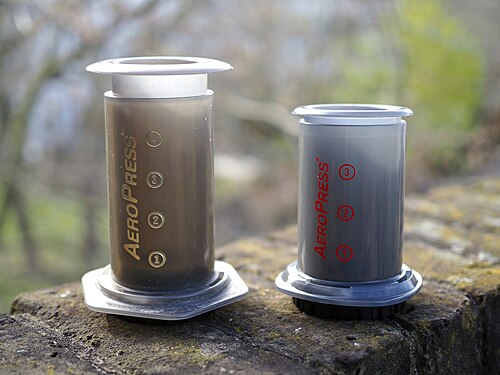
Photo by Bex Walton, CC BY. Source.

The AeroPress was invented by Alan Adler, a retired Stanford engineering lecturer. He started prototyping in his garage in 2004 and unveiled the device in November 2005 at the CoffeeFest trade show in Seattle.1 Adler was already a working inventor: in the 1980s he had created the Aerobie flying ring, the long-distance throwing toy, and his company was originally called Aerobie, Inc.12
The name is the giveaway — Aero from the flying-ring business, Press from the plunging action.
Who owns it now
The company changed hands twice in a way worth keeping straight, because it separates the toy from the coffee maker:
- In 2017, Spin Master (the Canadian toy giant) bought the Aerobie brand rights, and Adler’s company renamed itself AeroPress, Inc. to focus purely on the coffee press.1
- In August 2021, the Canadian holding company Tiny Capital bought a controlling stake in AeroPress, Inc.13
The device is now sold in about 70 countries.4 It has been made in a succession of plastics over the years — polycarbonate at launch, then BPA-free copolyester from 2009, polypropylene from 2014, and Tritan copolyester from 2023 — with newer variants like the glass-clear AeroPress Clear and the larger AeroPress XL.1
How it is brewed
The maker’s own method, demonstrated by Adler himself, is simple: a grind between drip and espresso, fill the chamber to about the 1.5 mark, stir for roughly 10 seconds, then plunge slowly and gently so you do not compact the coffee bed.5 Official guidance keeps the water relatively cool for a brewer — around 80 °C for dark roasts, 85 °C for light — cooler than the 90–96 °C typical of pour-over, because the short immersion and pressure do some of the work heat would otherwise do.2
The inverted method
The best-known thing coffee people do to an AeroPress is turn it upside down. In the inverted method you flip the whole device so the plunger is at the bottom acting as a stand, build the brew in the open top, stir and let it steep, then screw the filter cap on and flip the whole thing over onto the cup before pressing.16
The point is control. In the normal orientation, water begins dripping through the filter the moment you add it — the AeroPress was actually designed as a “partial flow-through” device, so some coffee is already brewing out during the steep.6 Inverting it stops that: nothing escapes until you flip and press, so you fully control the steep time, more like a French press.1 Crucially, this is not an official AeroPress method — it grew out of the enthusiast community, and its exact inventor and date are debated.6
Why it matters
The AeroPress punches far above a niche plastic gadget because of one thing: a global competition built entirely around it. The World AeroPress Championship takes this one cheap device and turns it into a head-to-head brewing sport, which has made “which AeroPress recipe won” a genuine driver of specialty brewing culture.
It also sits underneath one of the sport’s most-copied techniques. Tetsu Kasuya — the 2016 World Brewers Cup champion behind the 4:6 method — won the 2015 Japan AeroPress Championship and took his national Brewers Cup title brewing on an AeroPress before switching to a Hario V60 for the world final. That an immersion plunger could win a national pour-over qualifier was itself a statement about the device.
To verify
Total units sold. Media interviews sometimes quote AeroPress sales “in the millions,” but no primary company document with a verifiable figure was found. The only official scale claim confirmed here is that the device is sold in about 70 countries;4 treat any specific unit count as unconfirmed.
To verify
The Aerobie flying ring’s exact launch year. This wiki’s research report gives 1985 from brand pages; Wikipedia says only “the 1980s.”1 The decade is solid; the precise year rests on the company’s own retellings, which are not independent of each other.
Related
- World AeroPress Championship — the fan-led global competition built around this device
- Pour-over brewing — the filter method it sits beside on the café counter, and its mechanical opposite (flow-through vs immersion)
- Coffee grinding — where the AeroPress medium grind sits on the size chart
- Tetsu Kasuya — 2016 Brewers Cup champion who won Japan’s AeroPress title first
- World Brewers Cup — the pour-over world championship an AeroPress once qualified for
- Hario — the V60 maker whose brewer Kasuya switched to for the world stage
- Tiny — the holding company that took control of AeroPress in 2021
- Third wave coffee — the movement that made a cheap transparent brewer aspirational