Latte art
Latte art is the craft of pouring steamed milk into a shot of espresso so that a pattern appears on the surface of the drink — a heart, a leaf, a rosette, a swan.1 The picture is not painted on afterward. It emerges from the physics of the pour: white foam rising up through a dark brown surface, with the two colours holding their edge against each other.
Two ingredients make that contrast possible. The espresso brings crema — the thin reddish-brown layer of emulsified coffee oils that sits on top of a fresh shot — and the milk brings microfoam, milk steamed until it holds a mass of very small, uniform air bubbles with the sheen of wet paint.1 Pour the microfoam correctly and the white foam floats up to meet the crema; where the two colours touch, the design appears.1 Get either one wrong — flat espresso with no crema, or milk full of big soapy bubbles — and there is no clean line to draw with.
Two ways to make the picture
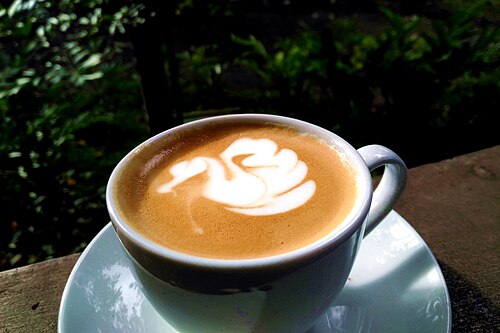
Photo by Abdulrohmatt, CC BY-SA. Source.

There are two techniques, and top competitions like the World Latte Art Championship test both:
- Free pouring — the whole design is made during the pour, by tilting and moving the pitcher so the rising foam falls into shape. No tools touch the drink. A free-poured rosette or swan is made in one continuous motion, which is what makes it hard.1
- Etching (also called designer or decorated patterns) — the milk is poured to make a plain surface first, then a thin tool, or a topping like chocolate or coloured powder, is used to draw into the foam.1 Etching allows finer detail than a free pour, but it is not the same skill.
Milk steaming: the part that decides everything
The pattern lives or dies on the milk, and the milk is made at the steam wand — the metal nozzle on an espresso machine that shoots pressurised steam into a jug of cold milk. Good steaming is usually described in two phases:2
- Stretching (aeration). The tip of the wand is held just below the milk’s surface so it pulls air in, growing the volume of foam. Done right this makes a soft, steady hiss — trainers call it the milk’s “song.” Too much air, or air added too late, gives coarse bubbles that ruin the pour.2
- Texturing (the vortex). Once enough air is in, the wand is angled to spin the whole jug into a whirlpool, which folds the big bubbles back into the body of the milk and leaves it smooth and glossy — microfoam.2
After steaming, the barista swirls and taps the jug to knock out any large bubbles left on top, aiming for milk that looks “like wet paint” — the standard quality cue before pouring.2
Temperature matters because milk changes character as it heats. The natural sugars taste sweetest in a fairly narrow window, and pushed too hot the milk proteins scorch and the foam collapses.
To verify — the exact steaming temperatures
One barista training guide gives specific targets: switch from adding air to just heating at about 37 °C (99 °F, roughly body temperature), take the milk to where the jug is too hot to hold, about 55–60 °C (130–140 °F), and never let it pass 65–70 °C (150–160 °F) or it scorches.3 These ranges are broadly consistent with what is taught across the trade, but the precise figures here come from a single, self-published training document, not an SCA or other authoritative standard. Treat them as typical guidance, not a fixed rule.
The standard patterns
A handful of shapes are the vocabulary of a free pour, each poured from a plain milk “canvas”:2
- Heart — pour into the centre until a white circle forms near the surface, then draw the pitcher forward through the middle of the circle while lifting it away, which pulls the round shape into a point.2
- Rosetta (a leaf or fern) — once close to the surface, wiggle the pitcher side to side while slowly pulling back, laying down a row of overlapping ridges, then cut a single line through the middle to make the stem.2
- Tulip — a stack of pushed-together dots that builds up into a layered flower.
Everything sits on getting the canvas right first: the early milk is poured from higher up (roughly 5–10 cm) so it sinks under the crema and fills the cup with an even brown surface; only when the cup is part-full does the barista drop the pitcher close and let the white foam surface to draw.2
Where it came from
Latte art was initially developed in Italy, where steaming milk for cappuccino had been ordinary café practice for most of the twentieth century.1 The modern, deliberately-designed style is usually credited to two places at once: Italy, and Seattle in the 1980s and 1990s.1
The best-documented name is David Schomer, of Espresso Vivace in Seattle, who studied how microfoam behaves and turned latte art into a repeatable, teachable technique.1 By his hand:
- the heart pattern was established as a signature at Espresso Vivace by 1989;1 and
- the rosetta was developed by Schomer in 1992.1
Recognition of the craft spread through the emerging competition scene — Italian barista Luigi Lupi brought attention to latte art around the 2002 World Barista Championship — and it became one of the defining visual signatures of third-wave coffee, the movement that treated coffee-making as a precise craft to be shown off.1
To verify — the pre-Schomer machine history and a book date
The research behind this note repeated several older claims from secondary videos and blogs that could not be confirmed against primary records: that Luigi Bezzera fitted a steam wand to an espresso prototype in 1911, that Desiderio Pavoni commercialised it about five years later as the “Ideal Pavoni,” and that the first latte art competition was held in the US in 1992.4 None of these is sourced to a patent, archive or official event record here. Separately, a LinkedIn post dates Schomer’s book Espresso Coffee: Professional Techniques to 1995,5 while Wikipedia’s citation for the same work gives 1994;1 the year is unsettled. And a training text’s claim that Schomer achieved “velvety” microfoam specifically in 1988 comes from one secondary source.3
How this differs from the championship
This note is about the craft. The World Latte Art Championship is the competition built on top of it — where baristas are judged on symmetry, contrast, creativity and, above all, on pouring matching pairs of identical drinks under an eleven-minute clock. Crucially, that contest scores only the picture, never how the coffee tastes; the espresso underneath is treated as a canvas. If you want the winners, the rules and the scores, that is the note to read.
Related
- World Latte Art Championship — the world title built on this craft, judged on the pattern alone
- World Barista Championship — the sibling contest where milk drinks are scored on taste, not the foam
- Espresso — the shot, and the crema, that the milk is poured into
- Third wave coffee — the movement that made this visual craft a café signature
- Specialty Coffee Association — the body whose barista curriculum teaches steaming and pouring
- David Schomer · Espresso Vivace — the Seattle lineage that codified the technique
- Cupping — how the coffee itself is scored, which latte art pointedly does not do
- Barista Hustle — the online coffee school that designed a milk pitcher specifically for this pour
Official links
- Official site — World Latte Art Championship (World Coffee Championships)
- Official site — Specialty Coffee Association
Footnotes
-
Latte art — Wikipedia — confirmed via WebFetch; source of the definition, microfoam and crema, free-pour vs etching, the Italy/Seattle 1980s–90s origin, David Schomer and Espresso Vivace, the heart pattern by 1989, the rosetta in 1992, and Luigi Lupi at the 2002 championship. ↩ ↩2 ↩3 ↩4 ↩5 ↩6 ↩7 ↩8 ↩9 ↩10 ↩11 ↩12
-
Latte Art for Beginners: History, Techniques and a Complete Guide to the Basic Patterns — Espresso Academy ↩ ↩2 ↩3 ↩4 ↩5 ↩6 ↩7 ↩8
-
What Is The History Of Latte Art? — Story Of Italy (video) ↩
-
The Origins of Latte Art: From Italy to Seattle — LinkedIn ↩